Guide
How to Build a Sovereign AI Cloud on Bare Metal GPUs
A guide for EU AI Clouds operators delivering a hyperscaler-grade Kubernetes experience on their own bare metal GPU infrastructure, with full data sovereignty and no US cloud dependencies.
The European AI cloud market is going through a structural shift. Regulation is tightening, procurement requirements are changing, and enterprise and public sector buyers are actively looking for alternatives to US hyperscalers. This is creating a real market opening for EU AI Cloud operators, but only for those who can credibly deliver compliance, control, and a cloud experience that competes with what AWS and Azure offer.
Three converging forces are driving this.
DORA (the Digital Operational Resilience Act, in force since January 2025) requires financial institutions across the EU to demonstrate that their cloud providers meet strict standards for operational resilience, concentration risk management, exit strategy viability, and auditability. The EBA cloud outsourcing guidelines impose similar obligations on banks and investment firms. NIS2 extends comparable requirements to critical infrastructure operators.
For regulated buyers, which includes the majority of large EU enterprises, choosing a cloud provider is now a compliance decision, not just a commercial one. Providers that can demonstrate data residency guarantees, tenant isolation, and audit rights have a decisive advantage over those that cannot.
The US CLOUD Act means that data held by US-owned companies, regardless of where it physically resides, can be compelled to be disclosed to US authorities. For EU financial services firms, healthcare organizations, and public sector bodies, this is not a theoretical risk. It is a legal exposure that compliance teams actively seek to eliminate.
AWS, Azure, and GCP have responded with sovereign cloud initiatives, but these offerings are typically built on proprietary services, run through US legal entities, and come with residual dependencies that regulators are scrutinizing closely.
"The European market is demanding a different approach. The shift in Europe is more on-prem, more focused on privacy and technology sovereignty." - Senior cloud architect, major European systems integrator
The EU AI Act introduces requirements for traceability, transparency, and accountability in AI systems, all of which depend on having clear control over the infrastructure running those systems. Gaia-X and the European Cybersecurity Certification Scheme for Cloud (EUCS) are beginning to define what trustworthy cloud infrastructure looks like in procurement terms. Operators aligned to these frameworks will have a structural advantage in public sector and financial services deals.
EU enterprises and public sector organizations evaluating sovereign cloud providers are looking for a specific set of guarantees that go well beyond a standard cloud SLA. They need a platform that meets compliance requirements AND delivers the quality of experience their developers expect from a major hyperscaler. Both matter. Understanding these requirements is essential for any AI Cloud operator targeting this segment.
"Multi-tenancy for a cloud provider is a foundation. It is a basic requirement." - Platform architect, European AI cloud provider
The gap between what sovereign cloud customers need and what hyperscalers can genuinely deliver is your market opportunity. As an EU AI Cloud operator, you own the hardware, you control the legal entity, and you can make guarantees that no US hyperscaler can. The challenge is delivering those guarantees alongside the operational experience your customers already expect from AWS and Google Cloud. That is what the right stack makes possible.
Major cloud providers have launched sovereign cloud programs in Europe. AWS European Sovereign Cloud, Azure sovereign regions, and Google Cloud sovereign partnerships are real commitments, but they carry limitations that compliance-sensitive buyers are increasingly aware of.
Even with data physically located in the EU, if the service is operated by a US-incorporated entity, US authorities can compel disclosure under the CLOUD Act. AWS, Microsoft, and Google are US companies. Their EU sovereign cloud subsidiaries and local operator arrangements do not fully resolve this for the most sensitive workloads.
Sovereign cloud offerings built on managed Kubernetes services, proprietary databases, and platform-specific APIs create exit cost and dependency risk. The EBA cloud outsourcing guidelines explicitly require financial institutions to demonstrate credible exit strategies, something that becomes very difficult when workloads depend on proprietary cloud services.
EU regulators are paying close attention to concentration risk from major cloud providers. The ECB draft cloud outsourcing supervisory expectations explicitly address this. A regulated financial institution that concentrates its cloud footprint on a single US hyperscaler, even with sovereign guarantees, faces growing regulatory scrutiny.
The opportunity for EU AI Clouds
You can offer something hyperscalers genuinely cannot: a full cloud experience on EU-owned, EU-operated infrastructure with no US-owned entity in the data processing or operational control path. The EU AI Clouds operator is the entity solely responsible for how tenancy is created, how data flows through the platform, and how any requests for that data are handled. vCluster Labs provides software, not operational cloud services. With vMetal + vCluster, you deliver an experience that is on par with what customers get from AWS EKS or Google GKE, running entirely on your own hardware.
EU AI Clouds operating on bare metal GPU infrastructure face a version of the same challenge every major cloud provider solved: how do you turn physical hardware into a platform that gives enterprise customers a self-service, hyperscaler-grade experience? vMetal and vCluster address the two layers that make this possible.
The goal is not to build a compromise. It is to deliver a managed Kubernetes platform that is on par with what customers would get from AWS, Azure, or Google Cloud, with the added advantages of EU data residency, full infrastructure transparency, and no vendor lock-in.
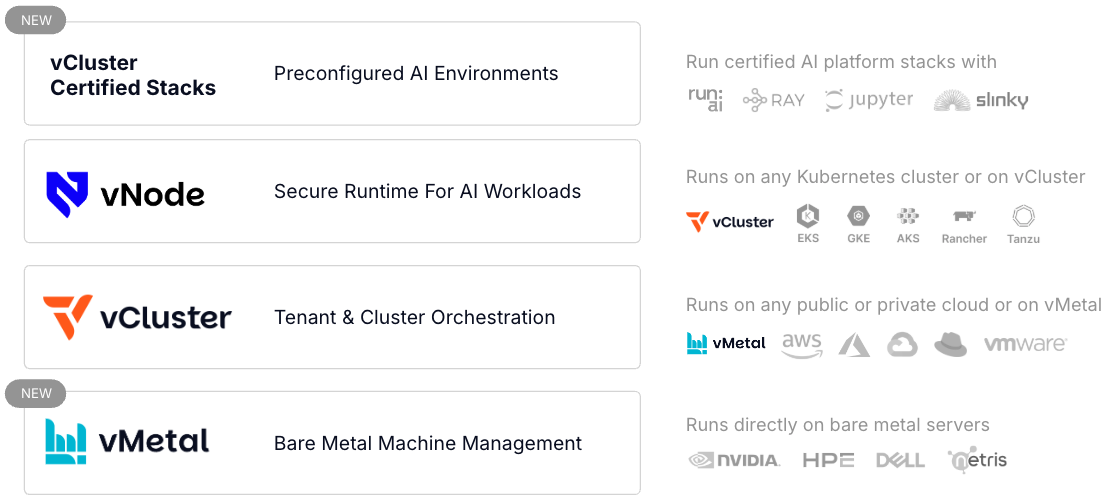
vMetal is the infrastructure layer that turns physical GPU servers into programmable cloud capacity. It provides automated bare metal provisioning and lifecycle management for your GPU nodes, eliminating the manual overhead of configuring and maintaining physical infrastructure at scale.
For sovereign cloud operators, bare metal is the right foundation for three reasons. First, physical control: you own the hardware, and your customers' workloads never share physical infrastructure with other operators. Second, performance: no hypervisor overhead means full hardware performance for training, inference, and HPC workloads. Third, compliance: you can make provable, contractual guarantees about where your hardware physically sits and who controls it.
vMetal uses Metal3 and Ironic under the hood, battle-tested open-source bare metal provisioning standards integrated directly into the vCluster Platform. New nodes can be enrolled, provisioned, and made available to tenants automatically, without manual intervention.
Once your bare metal nodes are running Kubernetes, vCluster handles the multi-tenancy layer: giving each customer a fully isolated, self-service Kubernetes environment that looks and behaves exactly like a dedicated cluster from a major cloud provider, while sharing the underlying node infrastructure efficiently.
Each tenant gets their own virtual Kubernetes control plane with their own API server, etcd, controller manager, and scheduler. From the tenant's perspective, they have a real, dedicated Kubernetes cluster with the same experience they would get from EKS or GKE. From your perspective, you are running tens or hundreds of these efficiently on shared infrastructure.
This is the architecture that lets you make two promises simultaneously: each customer has a dedicated, hyperscaler-grade cluster experience, and you are running efficiently enough to offer competitive pricing on bare metal hardware.
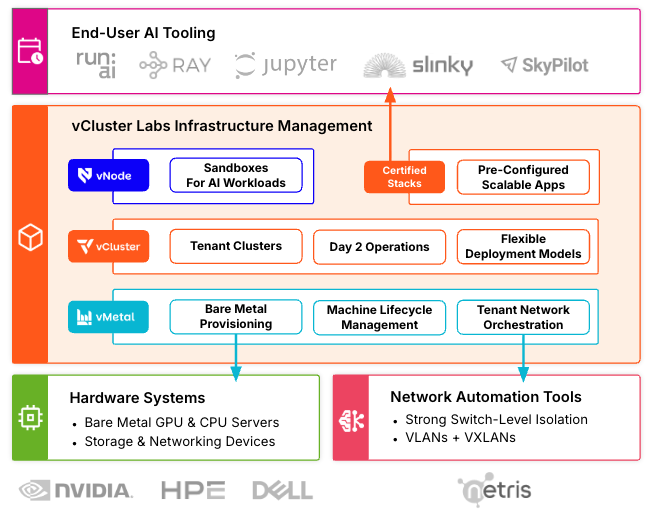
The full sovereign cloud stack
Your EU data center hardware → vMetal bare metal provisioning → Kubernetes host cluster → vCluster virtual control planes per tenant → Hyperscaler-grade self-service Kubernetes for each customer. No proprietary hyperscaler services. No US-owned entities in the data processing or operational control path. The EU AI cloud operator remains solely responsible for tenancy, data flows, and any requests for that data. Runs entirely on your infrastructure, in your jurisdiction.
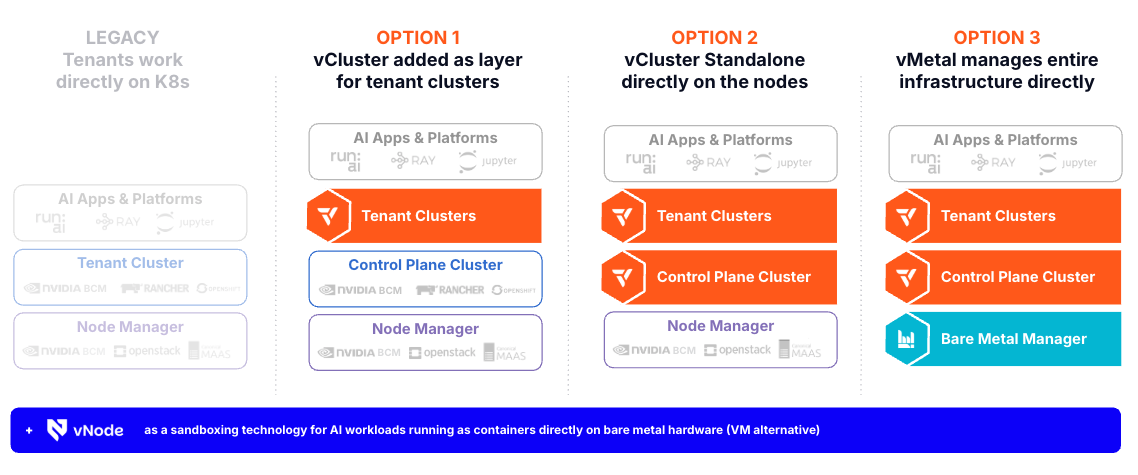
Not every EU cloud operator is starting from the same place. vCluster and vMetal are designed to meet you where you are. Option 1 layers vCluster on top of an existing Kubernetes and node management setup, a fit for operators who already have infrastructure running. Option 2 deploys vCluster standalone directly on bare metal nodes, removing the dependency of a Kubernetes control plane cluster. Option 3 is the full sovereign cloud stack: vMetal handles bare metal lifecycle management end to end, with vCluster providing multi-tenant isolation on top. For EU sovereign cloud operators building from the ground up, Option 3 delivers the most complete control over the infrastructure layer. vNode extends across all three options as a sandboxing layer for AI workloads running directly as containers on bare metal hardware.
Tenant isolation is not just a product feature for sovereign cloud operators. It is a compliance requirement. The EBA cloud outsourcing guidelines, DORA, and various national regulatory frameworks require demonstrable separation between tenants, particularly when those tenants are regulated financial institutions or public sector bodies.
vCluster provides two complementary isolation models that can be combined based on each tenant's risk profile.
Every tenant runs inside a dedicated virtual cluster with its own isolated Kubernetes control plane. Tenant A cannot see, access, or interfere with tenant B's resources, even when running on the same underlying nodes. The control plane separation is cryptographically enforced: tenant credentials are scoped to their virtual cluster and cannot be used to access the host cluster or other tenants.
This provides strong logical isolation that satisfies most regulatory requirements while allowing efficient sharing of underlying compute infrastructure.

For tenants with the highest compliance requirements, regulated financial institutions, government agencies, healthcare organizations handling sensitive data, vCluster's Private Nodes feature provides dedicated physical node isolation.
With Private Nodes, specific bare metal GPU nodes are allocated exclusively to a single tenant. No other tenant's workloads can run on those nodes. The tenant gets their own dedicated GPU capacity with complete physical separation, while you manage the entire infrastructure through a single control plane.
This lets you tier your offering: standard virtual cluster isolation for most tenants, Private Nodes for regulated tenants who need to demonstrate physical compute separation to their own auditors.
"OIDC-based isolation is a real benefit in our multi-tenancy environment. It is a compelling argument for regulated workloads." - Platform engineer, large European enterprise
When a regulated financial institution asks whether you can demonstrate that their workloads are isolated from other tenants, you have a concrete, auditable answer. Virtual control planes provide cryptographic separation. Private Nodes provide physical separation. The host cluster architecture is open source and can be reviewed by the customer's security team. This is fundamentally different from asking customers to trust a shared infrastructure provider's internal controls.
The EU regulatory landscape for cloud services is complex and evolving, but the core requirements are consistent across frameworks: data residency, operational resilience, audit rights, exit strategy, and concentration risk management. Here is how the vMetal + vCluster stack addresses each.
GDPR requires that personal data be processed lawfully, with appropriate technical controls. For cloud providers, this translates into: data stays where you say it stays, and you can prove it. Because vMetal + vCluster runs entirely on your own hardware in your EU data centers, data residency is an architecture guarantee, not a contractual promise that depends on a third-party provider's compliance program.
DORA requires financial entities to ensure that third-party cloud providers meet standards for operational resilience and that they have credible exit strategies.
For AI Clouds serving financial sector customers, this means two things: demonstrating that your platform is reliable and auditable, and ensuring your customers can migrate away without prohibitive cost or disruption.
vCluster addresses the exit strategy requirement directly. Because each tenant gets a standard Kubernetes environment with no proprietary APIs, their workloads are portable. They can run the same containerized applications on any Kubernetes-compatible infrastructure. This is a genuine answer to the DORA exit strategy requirement that hyperscaler-proprietary services cannot match.
The EBA guidelines require financial institutions to ensure they have audit rights over their cloud providers and that they are managing concentration risk. As an EU AI cloud, you can offer both: open-source infrastructure that customers can audit, and a genuine alternative to hyperscaler concentration that regulators are actively encouraging.
NIS2 applies to operators of essential services and their supply chains, including cloud providers. The requirements for incident response, security controls, and supply chain security align directly with what vMetal + vCluster provides: a well-defined, auditable software stack with clear security boundaries between tenants and between the platform operator and its customers.
One of the most common misconceptions about building a sovereign cloud is that it requires years of infrastructure development and a large platform engineering team. With vMetal + vCluster, EU AI cloud operators can go from bare metal hardware to a production-ready, isolated AI cloud offering in approximately two weeks, with a self-service experience your customers will compare favorably to AWS EKS on day one.
Install vCluster Platform on your existing Kubernetes environment or set up a host cluster on your bare metal nodes. Configure vMetal to manage your GPU node inventory, enrolling servers, configuring networking, and establishing the provisioning pipeline. This is largely automated through the vMetal node provider configuration.
Define your tenant isolation model: which tier of customers gets standard virtual cluster isolation, and which gets Private Nodes with dedicated compute. Configure resource quotas, GPU allocation policies, and namespace defaults. Set up your self-service provisioning workflow so customers can spin up their own vClusters on demand, no operator intervention required.
Configure audit logging, RBAC policies, and OIDC integration for your customers' identity providers. Set up monitoring and alerting. Document your data processing agreement and tenant isolation architecture for customer compliance teams. This documentation layer turns technical capabilities into compliance evidence your customers can use with their own regulators.
Onboard your first customers, validate the self-service workflow, test tenant isolation, and confirm GPU workloads run as expected. Run a representative AI training job across the cluster to validate performance at full GPU utilization.
"vCluster has helped us go to market quickly for clients who need a specific type of service, giving them an experience they recognize from the major cloud providers."- AI Cloud Founder
Why speed matters
EU sovereign cloud demand is active right now. Regulated buyers are looking for alternatives to hyperscalers, many of them urgently. Being in market with a credible, hyperscaler-grade sovereign cloud offering in weeks rather than months is a genuine competitive advantage.
EU and regional sovereign cloud operators are already using vCluster and vMetal to power their platforms. A few examples illustrate the pattern.
European sovereign AI cloud · NVIDIA Cloud Partner · AI Factories in Munich, Oslo, and Frankfurt
Polarise builds and operates sovereign AI Factories across Europe, providing GPU compute, networking, storage, and an API-first cloud platform that is GDPR-compliant and ISO-certified. Their customers are European enterprises in Germany and beyond who need secure, sovereign AI compute without vendor lock-in or data sovereignty risk. Polarise integrates vCluster's virtual cluster technology to provision fully isolated Kubernetes environments for each customer on shared GPU infrastructure, delivering a managed Kubernetes experience that is on par with what customers would get from a major hyperscaler, running entirely within European jurisdiction.
"vCluster Labs lets us turn GPU infrastructure into customer-ready AI environments at a pace that was previously impossible. This partnership is how we deliver on our promise of sovereign AI: fast, open, and fully European." - Nicolas Kremer, CTO, Polarise
100K GPUs planned · ~2 minutes to provision a customer-ready AI cluster · 1 Kubernetes substrate for multi-tenant workloads
Nscale is building a next-generation AI cloud spanning the full stack, from data centers and bare metal infrastructure to managed Kubernetes, Slurm, and AI services. The challenge: give every customer an isolated, cloud-native Kubernetes environment without the provisioning delays and performance overhead of separate physical clusters or heavy virtualization. With vCluster, Nscale runs a single bare metal underlay cluster and provisions each customer their own virtual control plane on top. Customer pods run directly on bare metal, preserving full GPU and RDMA networking performance. Nscale can provision 10 bare metal nodes with 80 GPUs in under two minutes. Centralized platform services, GPU drivers, storage, and monitoring are managed once on the underlay and shared across all customer environments, dramatically reducing operational overhead as the platform scales to 100,000 GPUs.
"Using vCluster lets us provision bare metal Kubernetes clusters in minutes while still giving customers the isolation and flexibility they expect from the cloud. It's a key part of how we deliver AI infrastructure with HPC-class performance." - Matt Prior, Director of Cloud Native Platform Engineering, Nscale
170+ vClusters · 60+ GPUs · AI cloud launched in 90 days
Lintasarta, a national cloud provider in Indonesia, built a production AI cloud on bare metal using vCluster with 170+ virtual clusters serving GPU workloads, launched in under 90 days. As a regional sovereign cloud operator serving government and enterprise customers with strict data residency requirements, their architecture mirrors exactly what EU sovereign cloud operators need: bare metal control, fast time to market, and proven multi-tenant isolation at scale.
Use this checklist to evaluate whether your sovereign cloud platform meets the core requirements of EU regulated buyers and the frameworks they operate under.
Building a sovereign AI cloud on bare metal GPUs with vMetal and vCluster is a faster path to market than most AI Cloud operators expect. The regulatory tailwinds in Europe mean the timing for launching a credible sovereign offering, one that genuinely competes with hyperscalers on experience while beating them on compliance, has never been stronger.
Ready to talk?
If you are building a sovereign AI cloud in the EU and want to understand how vMetal + vCluster fits your infrastructure, reach out to our AI Cloud team. We have helped operators go from bare metal to production in under 2 weeks, with a platform that gives their customers a hyperscaler-grade experience on fully sovereign infrastructure.
Deploy your first virtual cluster today.
