Agentic Security
Secure Isolation for Agentic AI Workloads
AI agents need to install packages, execute arbitrary code, and operate as root, all inside your Kubernetes cluster. Give them the freedom to act without giving them the keys to the kingdom.

AI agents need to install packages, execute arbitrary code, and operate as root, all inside your Kubernetes cluster. Give them the freedom to act without giving them the keys to the kingdom.
Kubernetes security assumes workloads are predictable. AI agents aren’t. An agentic workflow may need to:

Give agents the access they need and accept the blast radius, or lock them down and break the workflow.
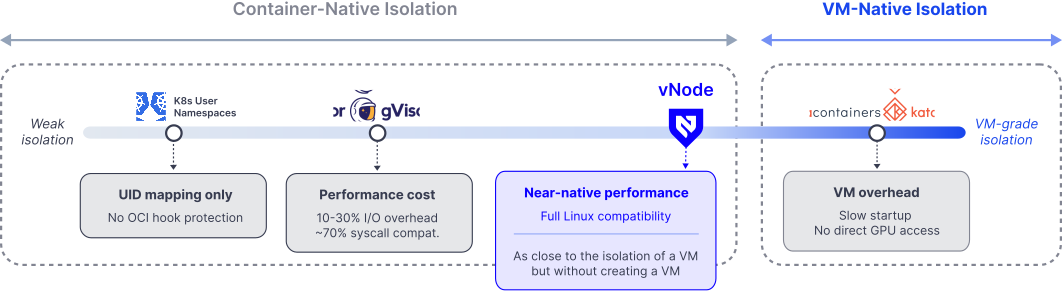
Linux kernel-native primitives create a complete identity boundary between the agent and the host. No VMs. No syscall interception. No performance tax.
Root inside the container (UID 0) maps to an unprivileged user on the host (UID 100000+). The agent believes it’s root. The kernel knows it isn’t.
Each workload gets its own PID namespace, network stack, and mount table. Structural isolation: no RBAC rules to misconfigure, no network policies to forget.
Agents can hold CAP_NET_ADMIN, CAP_SYS_PTRACE, and other privileged capabilities within their namespace, without those capabilities ever applying to the host.
Device access passes through directly, delivering bare-metal GPU performance with full isolation. No hypervisor, no driver headaches, no emulation overhead.
VM-based and syscall-interception approaches force a tradeoff between isolation and performance. Kernel-native namespace isolation doesn’t.
Container escapes, UID bypass attempts, cross-namespace access, privilege escalation. Third-party tested. We’re publishing the results because isolation should require proof, not trust.

“Cure53 was unable to identify any container escapes during the assessment, therefore the security posture of vNode can be described as impressive.”

Each session generates and executes arbitrary code, installs packages, writes to disk, spawns processes, and needs to be fully isolated from every other session. Kernel-native isolation gives each sandbox a complete private Linux environment with no performance penalty.
Run thousands of concurrent agent sessions for different customers on shared infrastructure. UID remapping ensures an escaped container lands in an unprivileged context with no access to other tenants’ processes, files, or network.
Agents invoking browsers, CLI tools, and database clients need broad system access. Capability scoping lets them hold privileged Linux capabilities within their namespace, without leaking outside it.
Direct GPU passthrough at native performance: no VM layer, no device emulation, no driver compatibility issues. Isolation that doesn’t slow down inference.
“Together, these findings confirm that vNode delivers strong, lightweight isolation on bare metal and GPU infrastructure, preventing container breakouts without the need for VMs or hypervisors.”
Isolated, high-performance agentic workloads on Kubernetes. No VMs. No syscall interception. No compromise.
