How AI Clouds Solve the Noisy Neighbor Problem in GPU Kubernetes
No items found.
Sep 14, 2026
|
min Read

Building a tenant-isolated GPU cloud, sometimes still called a multi-tenant GPU cloud, forces a decision with no comfortable answer. Dedicated physical clusters per tenant deliver the isolation every operator wants, but the economics rarely work. A single H100 node runs over $30,000, and provisioning a separate cluster for each tenant multiplies infrastructure, licensing, and operational overhead across every customer. The alternative, throwing tenants into a shared Kubernetes cluster partitioned by namespaces, trades that cost for a different problem.
Noisy neighbor GPU Kubernetes failures are not edge cases. One tenant saturates GPU memory. Another's misconfigured operator floods the API server. A third's training job monopolizes the network fabric during a critical inference window. The blast radius is shared, and everyone feels it.
The architecture question, then, is how to give every tenant dedicated GPU nodes from a centrally managed fleet without sharing failure modes. Production AI cloud providers have converged on an answer: layered tenant isolation that addresses the problem at every level of the stack, from bare metal provisioning to kernel-level workload boundaries.
Kubernetes namespaces were designed for logical separation between workloads operated by the same team under the same administrative trust model. They were not designed for hard tenant isolation between independent tenants with conflicting resource demands and security requirements.
Namespace isolation with RBAC and resource quotas works until a tenant's spike overwhelms the shared control plane. At that point, one tenant affects every other workload on the cluster because the scheduler, API server, and etcd are shared. There is no boundary.
For GPU infrastructure, the risks compound across four distinct layers:
Addressing one layer while leaving others exposed produces a security model held together by its weakest point. The providers that have scaled past this have done so by isolating at all four layers simultaneously.
The foundation of strong tenant isolation is node-level separation. Private Nodes are dedicated worker nodes assigned exclusively to a single tenant, with per-tenant CNI and storage. No other tenant's workloads are scheduled onto those nodes; no cross-tenant scheduling. GPU memory, CPU cycles, and local storage are not shared.
This eliminates the most common form of noisy neighbor GPU Kubernetes interference: resource contention at the hardware level. A tenant's training job consuming 100% of GPU memory on its assigned nodes has no effect on the compute available to any other tenant.
Private Nodes are the production default in vCluster Platform. Shared Nodes serve trusted dev/test and CI/CD workloads. Production Private Nodes are dedicated worker nodes joined directly and privately into each tenant cluster, with per-tenant CNI and storage. vNode adds kernel-native workload isolation on top for the strongest workload boundary. When a new tenant cluster is provisioned, its worker nodes are allocated exclusively to that tenant, delivering hardware-level isolation that approaches a dedicated physical cluster without the cost of one. This is where vMetal, the machine layer beneath vCluster Platform, does its work: it provisions and manages the bare metal fleet through one stable, EC2-like API, producing Bare Metal Machines and Virtual Machines that become the Private Nodes underneath each tenant cluster. The nodes are not visible from the control plane cluster; they exist only within that tenant cluster. QumulusAI provisions isolated Kubernetes environments in under one minute, with each environment backed by its own dedicated node pool.
Node-level separation also simplifies compliance. Regulated workloads that require demonstrable compute separation (under GDPR, DORA, NIS2, or FedRAMP) can be assigned dedicated node pools with a clear audit trail showing no co-tenancy of hardware.
Dedicated nodes solve compute contention but leave the network shared. On a GPU cluster running NCCL-based collective communications for distributed training, a single tenant's job can saturate the RoCE or InfiniBand fabric during an AllReduce pass, introducing latency for every other active workload.
The solution is per-tenant network virtualization. Using a CNI layer such as Netris, each tenant receives its own isolated network configuration: dedicated VLANs, VRFs, and ACLs enforced at the hardware level. Traffic from one tenant's cluster cannot traverse into another tenant's network segment. Lateral movement from a compromised workload is blocked at the switch, not at a software policy that could be misconfigured.
vMetal, the machine layer in the vCluster stack, automates this network segmentation as part of the provisioning workflow. Through one EC2-like API, vMetal turns raw GPU racks into bookable Bare Metal Machines and Virtual Machines and configures VLANs, VXLANs, and DPU policies through its Netris integration: zero-touch, with no manual switch configuration required. This approach enables distributed GPU suppliers to be wired into inference gateways with each supplier segment isolated at the network layer.
Even with dedicated nodes and isolated networks, a shared Kubernetes control plane remains a single point of failure for every tenant on the cluster. One tenant installing a conflicting CRD version blocks others from using that resource type cluster-wide. A high-frequency reconciliation loop from a misbehaving operator degrades API server response times for everyone. A tenant with cluster-admin access in a namespace-based model can inadvertently or deliberately affect resources outside their scope.
The architectural answer is a separate control plane per tenant. vCluster Platform provisions a virtualized control plane for each tenant cluster: a dedicated API server, etcd instance, and scheduler, running as pods on the control plane cluster. From the tenant's perspective, they have full cluster-admin access to a complete Kubernetes cluster. They can install CRDs, configure RBAC, deploy operators, and manage resources without constraint. None of those actions touch the control plane cluster or any other tenant's environment.
This model also enables something namespace-based isolation cannot: a different cluster type per tenant. vCluster Platform virtualizes the control plane for Kubernetes (GA), Slurm (Beta via Slinky/SchedMD), Ray (GA), and Run:AI (partner integration) clusters. All run on the same GPU fleet, with each tenant cluster pinned to dedicated Private Nodes. An AI cloud provider can offer Slurm clusters to HPC teams, Kubernetes clusters to ML engineers, Ray clusters to data science teams, and Run:AI clusters to AI platform teams, each as a fully isolated managed product running on the same fleet of dedicated Private Nodes.
The final exposure point is the container runtime itself. A well-configured cluster with Private Nodes, per-tenant networking, and a virtualized control plane still relies on the container runtime to enforce the boundary between a tenant's workload and the host kernel. Container breakout vulnerabilities, while not routine, are real; in a GPU cloud running untrusted code from multiple tenants, the consequence of one is data exposure across the entire node.
The conventional response is to run workloads in virtual machines, adding a hypervisor layer that absorbs breakout attempts. The cost is real: virtualization overhead on GPU workloads reduces effective throughput and introduces latency that matters for training and inference performance.
vNode removes this tradeoff. It provides kernel-native workload isolation using seccomp, cgroups, and Linux namespaces: no hypervisor overhead. Each workload runs in its own hardened runtime with container breakout protection, without paying the performance penalty of a VM. Bare metal GPU throughput is preserved.
This makes vNode specifically relevant for inference endpoints and agentic workloads where tenants execute dynamic code, install packages, or require root access within their environment. Those capabilities are safe to offer when the workload boundary is enforced at the kernel level. vNode is hardened and pentested to the kernel against breakout scenarios.
Together, vNode and vCluster Platform form a complete isolation stack: control plane isolation at the scheduler level, network isolation at the fabric level, and workload isolation at the kernel level.
The diagram below describes the full path from physical infrastructure to isolated tenant environment.
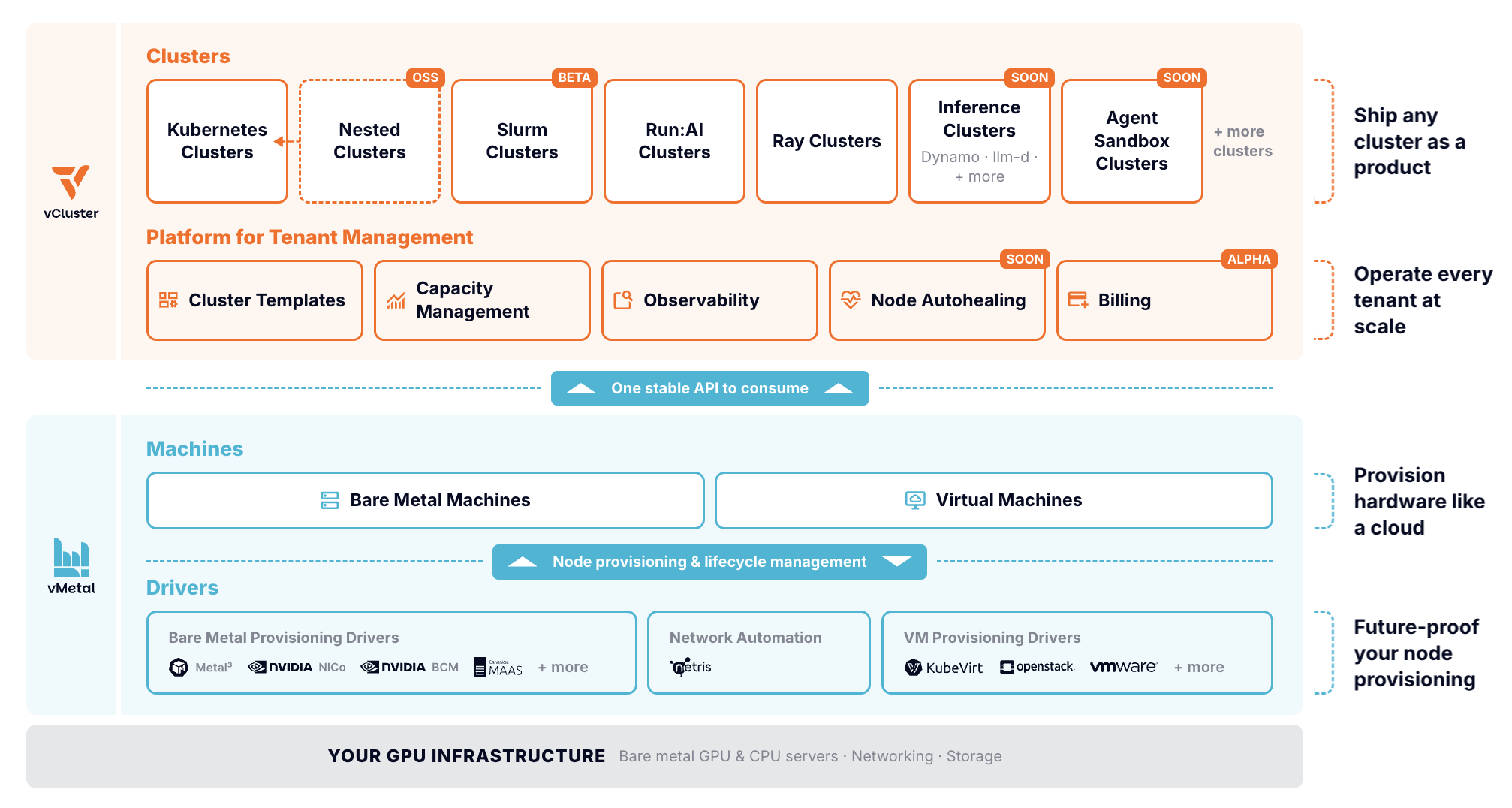
Each tenant accesses only their own API endpoint. Their control plane, node pool, network segment, and workload runtime are isolated from every other tenant on the platform. The physical GPU infrastructure is managed as a single fleet, but the nodes assigned to each tenant are dedicated Private Nodes. The failure domains are not shared.
The noisy neighbor GPU Kubernetes problem requires an integrated stack of controls. Raw namespace sharing fails because it leaves exposure at four layers simultaneously. Fixing one layer by adding node selectors, tightening RBAC, or deploying a network policy engine reduces risk without eliminating it. The providers that have scaled past this problem address all four layers as an integrated architecture, paired with the GPU-silicon partitioning methods (MIG, vGPU, time-slicing) covered in our GPU tenant isolation methods guide.
vCluster Platform delivers that architecture as a managed platform: Private Nodes for hardware isolation, per-tenant CNI via Netris for network segmentation, virtualized control planes for administrative separation, and vNode for kernel-level workload boundaries. The full path from bare metal GPU racks to isolated tenant clusters is covered by a single platform. vCluster Platform is validated in NVIDIA's DGX reference architecture and powers 100K+ GPUs across 50+ GPU Clouds & Fortune 500s.
Boost Run launched a production GPU cloud in under 45 days with zero new platform engineering hires. Lintasarta launched Indonesia's leading GPU cloud in 90 days with over 170 tenant clusters in production. QumulusAI provisions isolated Kubernetes environments in under one minute.
This is the hyperscaler model applied to GPU infrastructure: one platform, every cluster type, and full tenant isolation without dedicated physical clusters per customer.
Explore vCluster Platform to see how providers such as Boost Run and Lintasarta are turning raw GPUs into isolated, self-service tenant infrastructure at scale.
Tenant isolation in an AI cloud or GPU cloud is the practice of giving each tenant dedicated resources and control planes so workloads cannot interfere with one another.
It is achieved through a layered architecture: Private Nodes for hardware separation, per-tenant CNI for network segmentation, virtualized control planes for administrative isolation, and kernel-level workload boundaries with vNode. This model prevents noisy neighbor problems without requiring a dedicated physical cluster per tenant.
Namespace-based isolation fails for GPU Kubernetes workloads because it shares the scheduler, API server, and networking stack across tenants, leaving no hard boundary when resource spikes or misconfigurations occur.
The failure spans four layers: GPU compute contention at the hardware level, network fabric saturation during collective operations, control plane degradation from misbehaving operators, and workload breakout vulnerabilities in the container runtime. Quotas and RBAC alone cannot address these shared-failure modes.
Private Nodes provide hardware-level tenant isolation by assigning dedicated worker nodes exclusively to a single tenant, so no other tenant's workloads are scheduled on those nodes.
This removes the primary source of noisy neighbor GPU interference: contention for hardware resources. Private Nodes are the production default isolation model in vCluster Platform and include per-tenant CNI and storage, giving each tenant a dedicated node pool that is not visible from the control plane cluster.
Per-tenant CNI (Container Network Interface) improves network isolation by giving each tenant dedicated VLANs, VRFs, and ACLs enforced at the hardware level, so traffic cannot traverse into another tenant's network segment.
With a CNI layer such as Netris, each tenant cluster receives its own isolated network configuration. vMetal automates this segmentation as part of the provisioning workflow, eliminating manual switch configuration and blocking lateral movement from a compromised workload at the switch itself.
A tenant cluster is a fully isolated Kubernetes, Slurm, Ray, or Run:AI environment with its own virtualized control plane and dedicated nodes, provisioned for a single tenant.
For Kubernetes tenant clusters, vCluster Platform creates a dedicated API server, etcd instance, and scheduler on the control plane cluster, then joins Private Nodes directly into that tenant cluster. For Slurm, Ray, and Run:AI tenant clusters, vCluster Platform isolates the native control plane and joins Private Nodes directly into that tenant cluster; scheduling remains with the respective native scheduler: Slinky/SchedMD for Slurm, Ray for Ray, and Run:AI for Run:AI. Tenants receive administrative access to their cluster and can manage resources without affecting the control plane cluster or other tenants.
vNode provides kernel-level workload isolation using seccomp, cgroups, and Linux namespaces, giving each workload a hardened runtime that absorbs container breakout attempts without hypervisor overhead.
This preserves bare-metal GPU throughput and avoids the latency penalties of virtualization. vNode is generally available and hardened and pentested to the kernel, making it suitable for inference endpoints and agentic workloads where tenants execute dynamic code or require root access within their environment.
vCluster Platform delivers a layered isolation model that approximates dedicated physical clusters at a fraction of the cost: the platform operator manages a single physical GPU fleet, but each tenant receives dedicated Private Nodes, per-tenant networking, and a virtualized control plane.
Dedicated physical clusters per tenant multiply infrastructure, licensing, and operational overhead. vCluster Platform's approach lets AI cloud providers offer the same isolation guarantees while operating a single fleet. Boost Run launched a production GPU cloud in under 45 days. Lintasarta runs over 170 tenant clusters in production.
Provisioning an isolated tenant cluster with vCluster Platform can take less than one minute, because the platform automates node allocation, network segmentation, and control plane creation.
QumulusAI can spin up isolated Kubernetes environments in under a minute, with each environment backed by its own dedicated node pool. This speed enables self-service tenant onboarding at hyperscaler scale without manual infrastructure setup.
Deploy your first virtual cluster today.
