GO VM FREE
Run Kubernetes on Bare Metal, Zero VMs Required
Bare metal is finally viable—no more expensive, wasteful VMs. Virtual clusters and virtual nodes give you isolation without the overhead.

Bare metal is finally viable—no more expensive, wasteful VMs. Virtual clusters and virtual nodes give you isolation without the overhead.
That defeats the purpose of Kubernetes. We’ve just replaced pet VMs with pet clusters—each with 3 to 5 VMs—adding cost and complexity. Kubernetes was built for large shared clusters, but instead of solving for multi-tenancy, we spun up thousands of tiny ones. That’s the problem we set out to solve— making it finally viable to run Kubernetes on bare metal, without sacrificing isolation.”

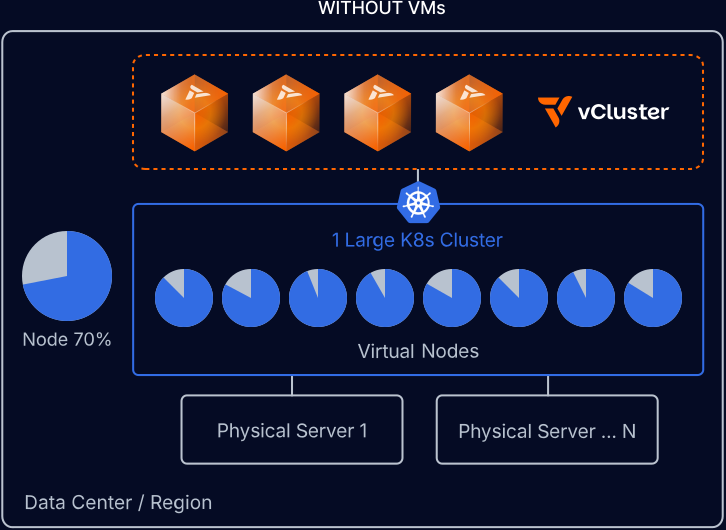
One big Kubernetes cluster per data center should be enough—but sharing is hard. That’s why teams spin up tiny clusters made up of VMs, wasting compute capacity and money. Now you can share one big cluster, no VMs required.
“vCluster enabled us to consolidate our Kubernetes infrastructure from nearly 200 VMs down to a single bare-metal cluster, cutting private cloud costs while improving performance and efficiency.”

CPU cores saved
VMware licensing costs
“We run 8,000 VMs just to host containerized workloads we already trust.”
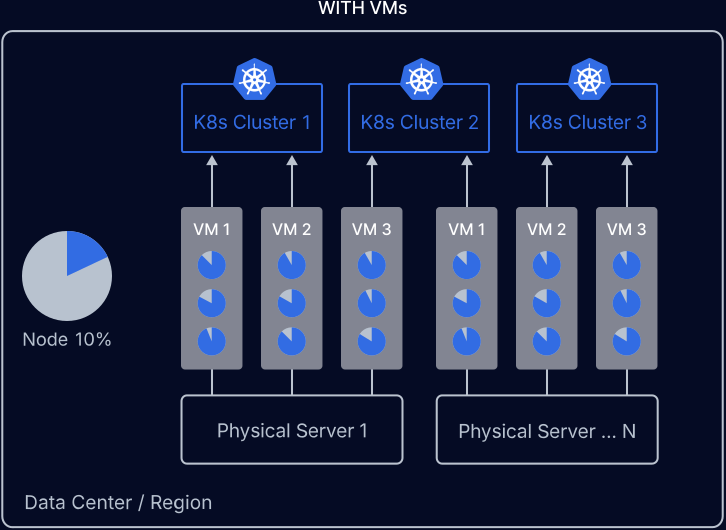
Each cluster runs on its own VMs, multiplying cost and complexity.
Most VM-backed clusters use less than 20% of CPU and memory.
VMware costs ~$4k per CPU core—and grows with every cluster.
Separate VM and Kubernetes teams add friction and risk.
Lightweight control planes that give every team a true Kubernetes experience—without spinning up a single VM.
vClusters spin up in under 3s—no more ticket queues.
Just a few pods, no guest OS or hypervisor overhead.
Each vCluster has its own API server, etcd, and RBAC.
CNCF-compliant; works on any bare metal or cloud K8s.
Developers create clusters with kubectl or CI—no waiting.
Add a security envelope around every tenant workload so you can safely and dynamically share the same physical nodes.
By eliminating VM overhead.
With dynamic virtual clusters.
Developers self serve new clusters in seconds.
vNode sandboxes each tenant at the kernel boundary.
No, vCluster only helps workloads already on Kubernetes. Legacy VMs stay where they are.
vNode combines user‑namespaces, seccomp filtering, and kernel hardening to contain escapes.
vCluster works with any CNCF‑conformant Kubernetes distribution using containerd ≥ 1.7 and Linux kernel ≥ 6.1. Support for CRI‑O is on our roadmap.
Yes, qualified teams receive a guided POC and 30‑day evaluation licence.
Book a 30 minute discovery call and learn how quickly you can move to bare metal Kubernetes.
