ai-cloud
AI Cloud Provider Platform for Secure Tenant Clusters
Launch an AI cloud service on your infrastructure. vMetal orchestrates machines, and vCluster gives customers independent Kubernetes tenant clusters with dedicated Private Nodes.
Launch an AI cloud service on your infrastructure. vMetal orchestrates machines, and vCluster gives customers independent Kubernetes tenant clusters with dedicated Private Nodes.
Selling raw GPU compute is not enough. Your customers expect more.
Selling bare metal GPUs alone is a race to the bottom. Converging GPU specs mean margins erode unless you offer managed Kubernetes.
Namespace isolation is too weak. Separate physical clusters are too expensive. Standard Kubernetes forces you to choose.
Building a GPU cloud platform in-house requires significant engineering investment.
vMetal manages machine provisioning below your AI cloud. vCluster supplies independent Kubernetes tenant clusters with dedicated Private Nodes, while Platform coordinates onboarding, templates and access. vCluster Labs software powers 100K+ GPUs.
From bare metal provisioning to kernel-native workload isolation, vCluster covers every layer your AI cloud platform requires.
Each tenant has an independent Kubernetes API, data store and RBAC boundary. Lightweight control-plane hosting reduces dedicated server requirements for AI cloud customers; Private Nodes keep production workers tenant-specific.
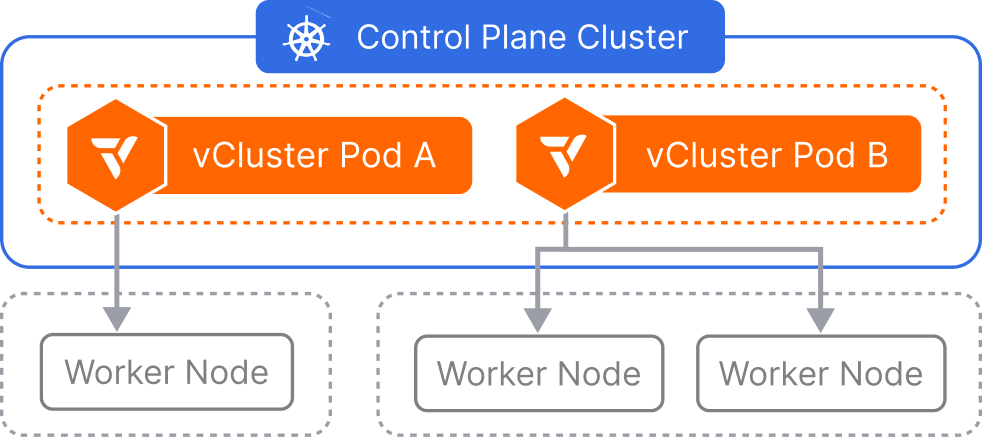
vMetal exposes one Machine API above bare metal and VM provisioning drivers. Registered inventory, images and credentials enable repeatable machine lifecycle workflows for AI cloud customers. Network automation uses supported integrations such as Netris.
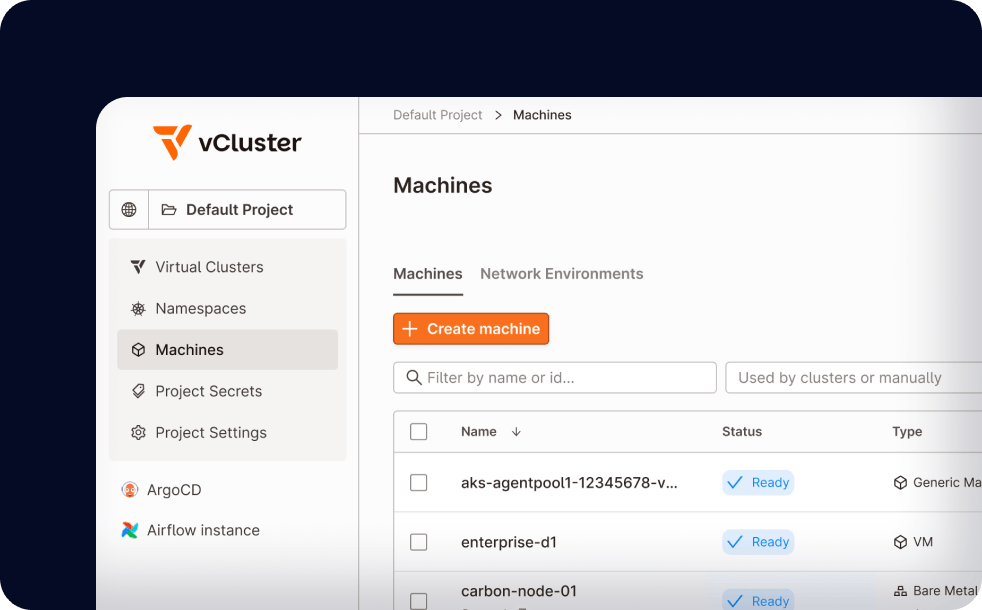
vNode uses Linux user namespaces and seccomp to restrict workload privileges and system calls. It adds runtime hardening for AI cloud customers without a guest kernel or hypervisor, complementing dedicated workers rather than allocating GPUs.
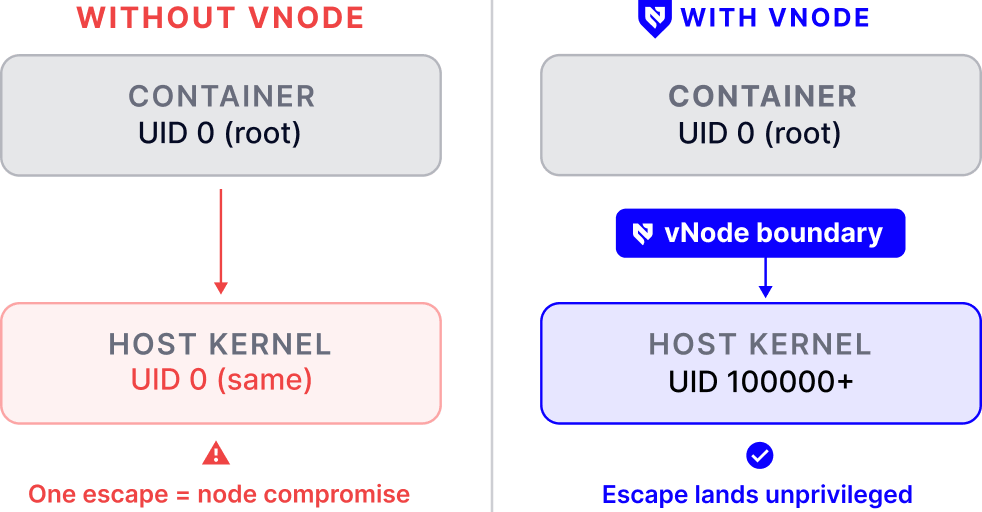
Use supported workload templates for AI cloud customers, including the NVIDIA Run:AI partner integration. Configure GPU, network and storage prerequisites, and validate the selected template for Private Nodes before offering it to production customers.
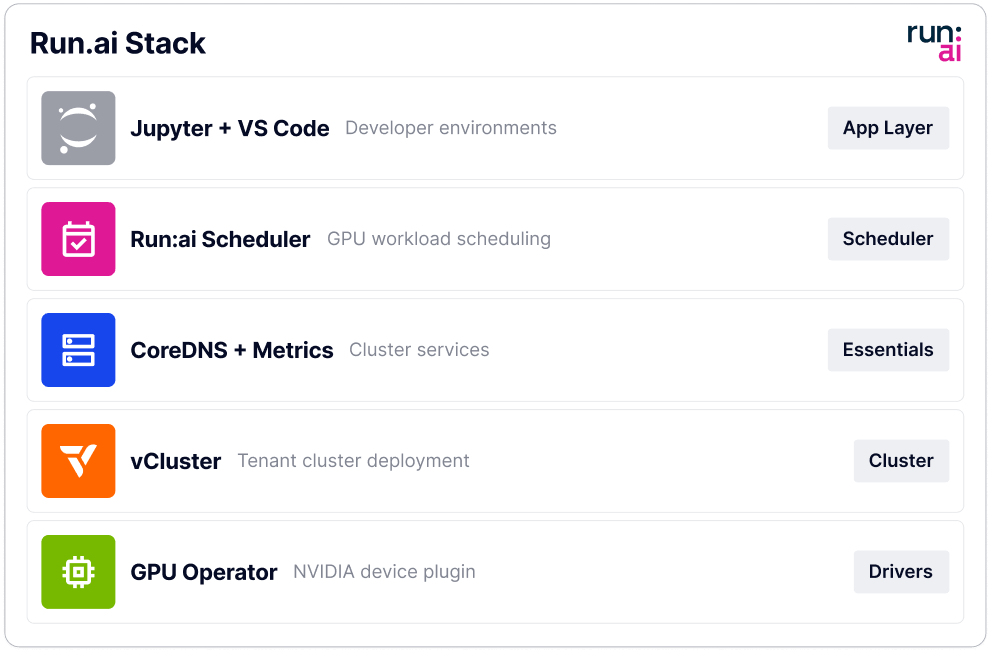
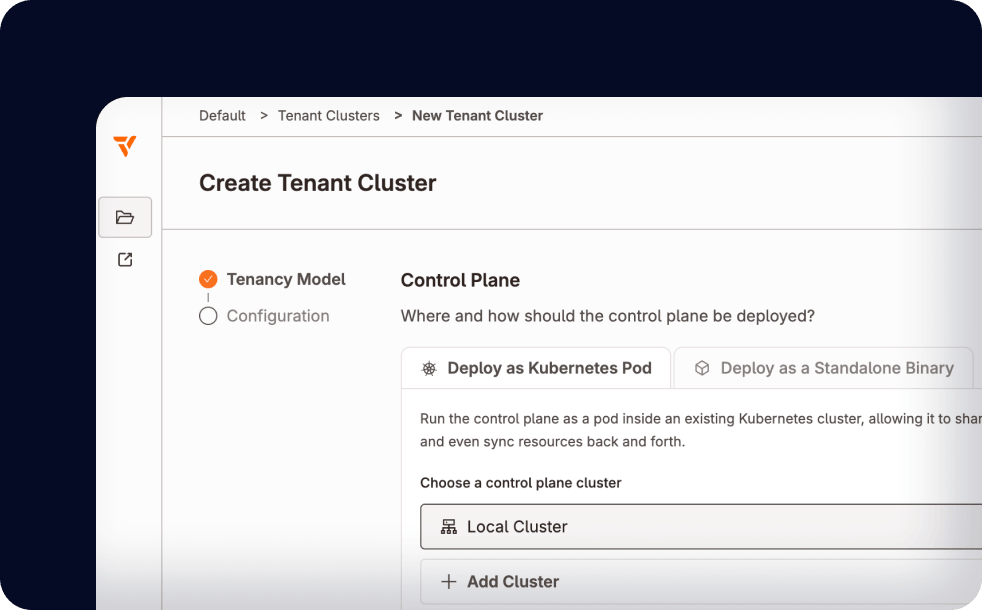
Give tenants an AWS-grade self-service experience. Your customers provision their own Kubernetes environments through a portal, without filing support tickets or waiting on your platform team.
This isn’t a side project. Behind every vCluster deployment is 5+ years of deep K8s engineering, security hardening, and battle-tested infrastructure work at massive scale.
Talk to our team about your stack
Deploy vCluster on your infra in minutes
Go live with a hyperscaler-grade tenant experience in days
Namespaces divide resources within a Kubernetes cluster, but share its API and cluster-wide administrative scope. RBAC, quotas and network policies remain useful controls. vCluster adds a separate tenant API and data store, with Private Nodes dedicating production workers. This reduces dependencies between tenant environments while platform administrators still manage the underlying infrastructure and its failure domains.
Boost Run went from decision to production launch in under 45 days for its managed Kubernetes service. That is a customer example rather than a promised implementation time. Your launch depends on machine inventory, driver configuration, networking, storage, templates and service integrations. vMetal and vCluster connect machine orchestration with tenant cluster delivery, reducing the infrastructure workflows you need to build yourself.
Yes. vCluster Standalone runs as a single binary directly on Linux, with no dependency on k3s, kubeadm, or any external Kubernetes distribution. vMetal handles PXE boot, OS installation, and network automation for your GPU servers, so the entire path from physical rack to tenant-ready Kubernetes clusters is covered in one integrated stack.
Private Nodes are the recommended production model and the model for every customer-facing tenant: each tenant gets dedicated worker nodes with its own CNI and CSI. Shared Nodes are kept for your own trusted internal teams running dev, test and CI/CD. At the workload layer, vNode helps prevent container breakout and limits blast radius using user namespaces, seccomp and cgroups, with no hypervisor overhead.
vCluster Labs software powers 100K+ GPUs and 1M+ CPUs, serving 50+ GPU clouds & Fortune 500s combined. In production, Lintasarta operates 170+ tenant clusters, while Boost Run completed its managed Kubernetes launch in under 45 days from the decision. These named deployments provide scale and launch examples for teams evaluating the platform for their own infrastructure.
Yes. vCluster supports air-gapped and FIPS deployments for environments with strict compliance requirements. Tenant control planes can run as VMs rather than pods for OS-level kernel separation. vNode helps prevent container breakout and limits blast radius with user namespaces, seccomp and cgroup enforcement. Hardware network isolation (VLANs, VXLANs, VRFs, ACLs) comes through the Netris integration, giving each tenant its own segmented network.
See how AI cloud providers go from GPU racks to tenant-ready Kubernetes on vCluster.
