ai-factory

AI Factory Infrastructure for Enterprise Teams

Give enterprise AI teams self-service GPU infrastructure. vMetal provisions machines, and vCluster provides separate Kubernetes environments with dedicated Private Nodes for production workloads.

Trusted by the fastest-growing AI cloud providers
Problem

Why AI Factories Stall

Building a production-grade AI factory on GPU infrastructure exposes three hard problems.

DIY Requires Significant Investment

Building a GPU cloud platform in-house requires significant engineering investment, and the timeline usually runs well past the first estimate.

Isolation or Efficiency

Standard Kubernetes forces you to choose between strong tenant isolation and operational efficiency. Namespace isolation is too weak. Separate clusters are too expensive.

Customers Expect Cloud UX

AI teams expect self-service Kubernetes and familiar tooling. Manual onboarding and unclear tenant boundaries make the infrastructure harder to use.

Solution

One Platform from Bare Metal to AI Factory

vMetal supplies the machine layer for an enterprise AI factory. vCluster provides self-service Kubernetes environments with dedicated Private Nodes, and vNode can add runtime isolation for supported workloads. vCluster Labs serves 50+ GPU clouds & Fortune 500s.

Built for AI Factory Scale

From GPU rack provisioning to isolated tenant environments and pre-validated AI platforms, every layer your AI factory needs is included.

Bare Metal

Zero-Touch GPU Rack Provisioning

vMetal exposes one Machine API above bare metal and VM provisioning drivers. Registered inventory, images and credentials enable repeatable machine lifecycle workflows for enterprise AI teams. Network automation uses supported integrations such as Netris.

  • Stable Machine API
  • Bare metal and VM provisioning
  • Driver-specific lifecycle automation
Tenant Isolation

Independent Kubernetes Control Planes Per Team

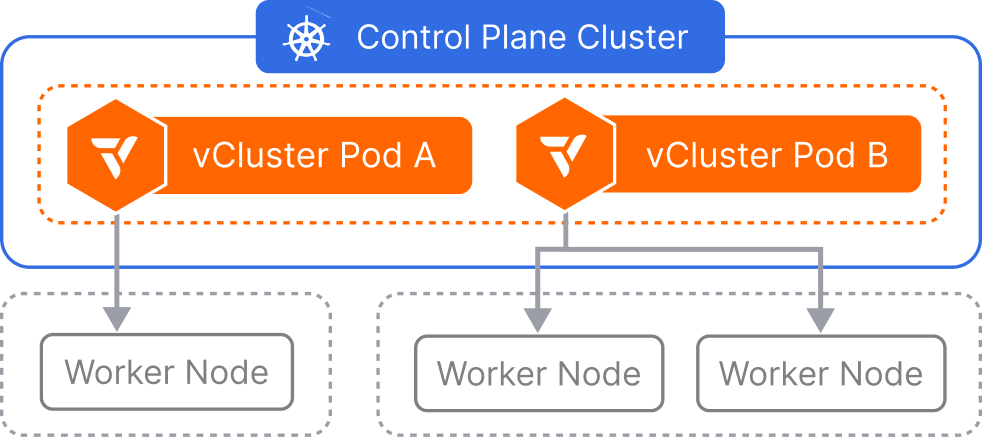
Each tenant has an independent Kubernetes API, data store and RBAC boundary. Lightweight control-plane hosting reduces dedicated server requirements for enterprise AI teams; Private Nodes keep production workers tenant-specific.

  • Independent tenant API and data store
  • Tenant-scoped scheduling on Private Nodes
  • No dedicated control-plane servers per tenant
AI Workload Integration

Supported AI Workload Templates

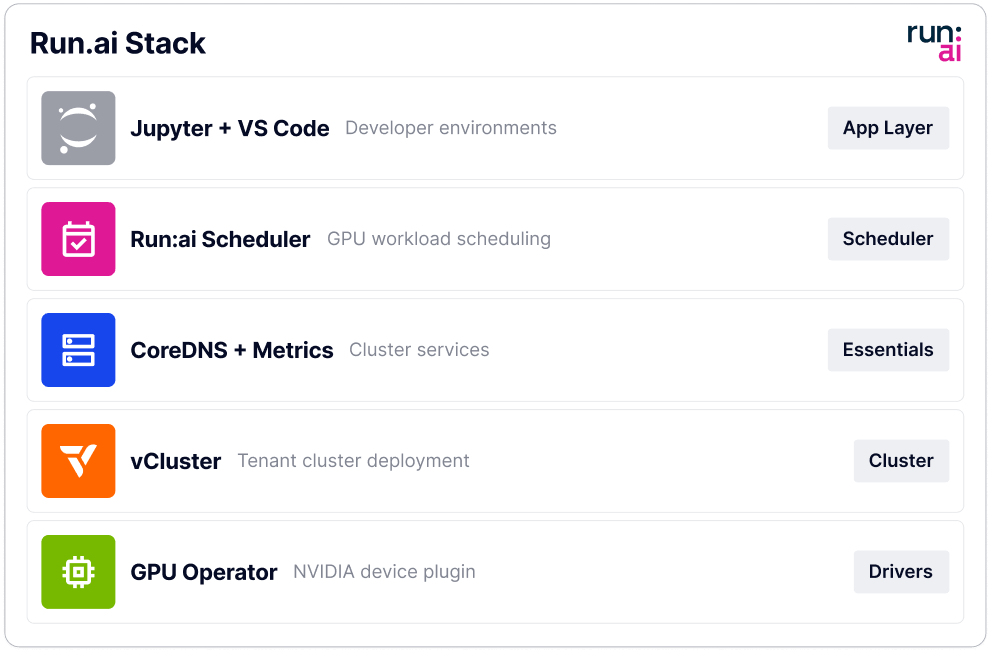
Use supported workload templates for enterprise AI teams, including the NVIDIA Run:AI partner integration. Configure GPU, network and storage prerequisites, and validate the selected template for Private Nodes before offering it to production customers.

  • Native NVIDIA Run:AI catalog
  • Validate Private Node configuration
  • Release-specific integration prerequisites
Workload Security

Kernel-Level Isolation Without a Hypervisor

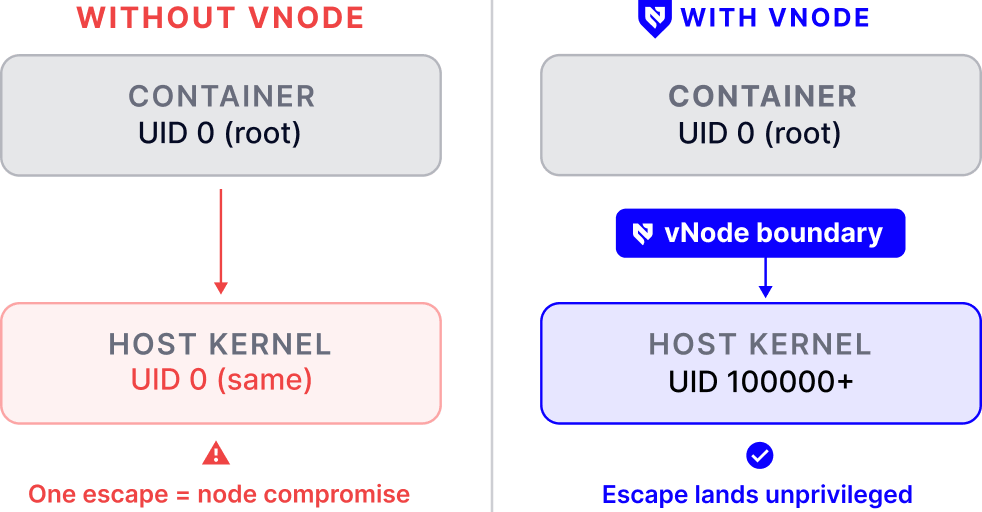
vNode uses Linux user namespaces and seccomp to restrict workload privileges and system calls. It adds runtime hardening for enterprise AI teams without a guest kernel or hypervisor, complementing dedicated workers rather than allocating GPUs.

  • Linux user namespaces and seccomp
  • No guest kernel or hypervisor
  • Helps limit workload breakout
Tenant Experience

Self-Service Portal for AI Factory Tenants

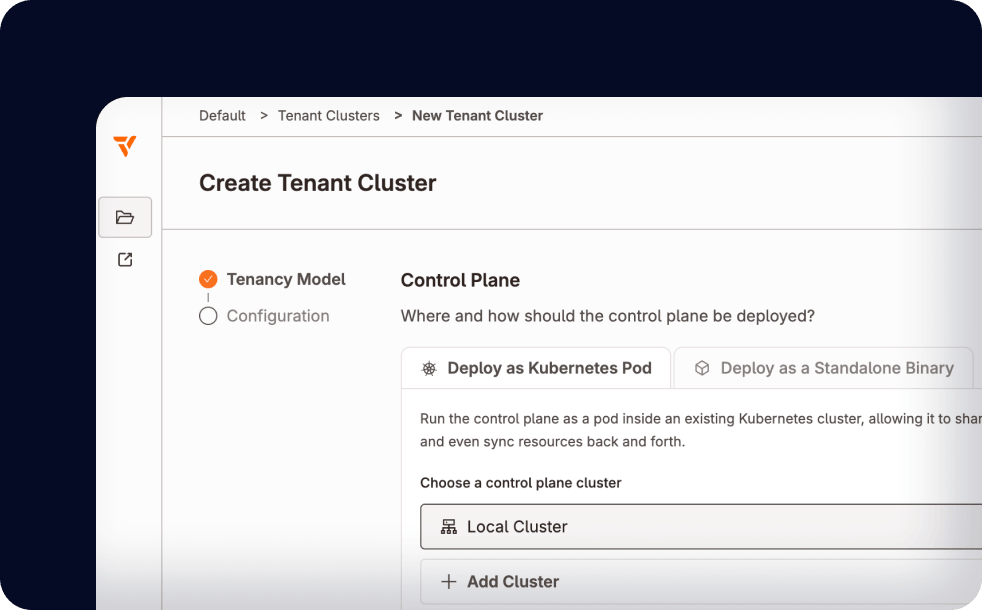
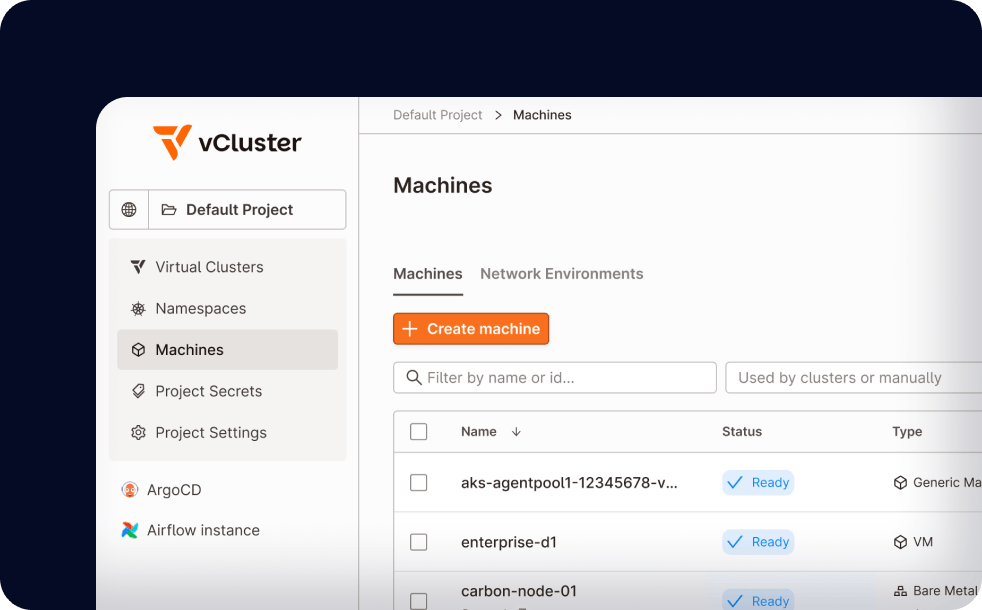
Give every AI factory team an EKS-like self-service experience. Tenants provision their own environments through a managed portal without waiting on platform engineering or filing infrastructure tickets.

  • Approved templates and access policies
  • Dedicated production tenant workers
  • Readiness depends on available capacity
Why vCluster

This isn’t a side project. Behind every vCluster deployment is 5+ years of deep K8s engineering, security hardening, and battle-tested infrastructure work at massive scale.

100K+
GPUs Powered
50+
GPU Clouds & F500s
<45
Days to Launch
30K
GitHub Stars

Get Started in 3 Steps

1
Schedule a Demo

Talk to our team about your stack

2
Deploy vCluster

Deploy vCluster on your infra in minutes

3
Onboard Your Tenants

Go live with a hyperscaler-grade tenant experience in days

FAQs

What is an AI factory and how does vCluster support it?

An AI factory is enterprise infrastructure for developing, training and serving AI workloads. vMetal orchestrates the machines, while vCluster supplies tenant environments for teams, projects or training runs. Kubernetes is one cluster type, with the selected catalog and release determining other offerings. Private Nodes dedicate production workers, and self-service templates let teams request approved environments without operating the infrastructure themselves.

How long does it take to launch an AI factory with vCluster?

An enterprise AI factory launch depends on GPU inventory, provisioning drivers, networking, storage, identity and the workload environments teams need. vMetal orchestrates the machine layer, while vCluster provides tenant environments and self-service templates. Validate capacity, application readiness and operational ownership before rollout. The NVIDIA DGX reference architecture is the approved supporting asset for this audience.

How does vCluster isolate AI workloads on the same GPU fleet?

Each enterprise team receives its own tenant environment. For Kubernetes, that includes an independent API, backing store and RBAC scope, with dedicated worker capacity through Private Nodes. Workers may be physical or virtual; dedicated bare metal provides exclusive physical servers. Optional vNode runtime hardening and configured network segmentation add boundaries selected for the team’s workloads and security requirements.

Is the Kubernetes distribution CNCF certified?

vCluster is a CNCF-certified Kubernetes distribution and exposes standard Kubernetes APIs in tenant environments. This supports familiar clients, Helm charts and cluster-scoped resources such as CRDs. Certification covers Kubernetes conformance rather than an entire AI platform or customer deployment. Validate the selected version, networking, storage, GPU drivers and runtime integrations for the workloads you plan to support.

Can vCluster support compliance requirements in an AI factory?

Supported plans include air-gapped deployment and FIPS features. Private Nodes, tenant-scoped access and optional network segmentation provide controls you can include in a regulated deployment. Select supported images and configurations, and validate the full environment against your requirements. These capabilities do not establish certification of the customer's service, application, hardware or operational procedures.

Does vCluster replace the need for k3s or kubeadm on bare metal?

Yes. vCluster Standalone runs as a single binary directly on Linux bare metal with no external Kubernetes dependency. It replaces k3s, kubeadm and k0s as the base layer for AI factory deployments on GPU hardware. Combined with vMetal's zero-touch provisioning, you no longer install and maintain a separate bootstrapping layer before tenant clusters can be created.

Launch Your AI Factory Faster

See how GPU cloud teams go from bare metal to production AI infrastructure.