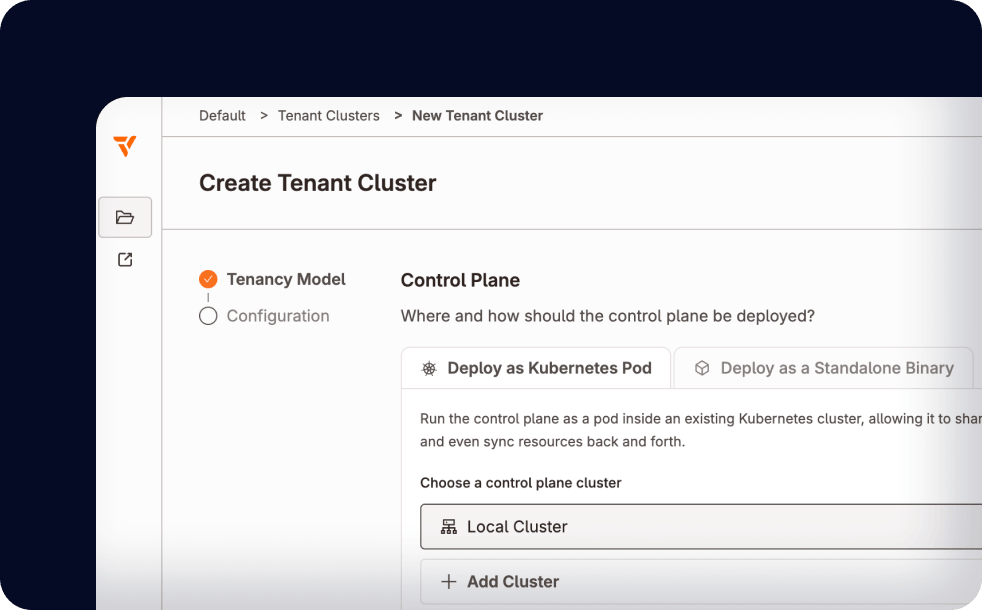
Kubernetes Control Plane as a Service for AI Clouds
Offer Kubernetes control planes as a service. vMetal supplies infrastructure, while vCluster separates tenant APIs and assigns dedicated production worker capacity through Private Nodes.
Traditional Kubernetes provisioning breaks down at GPU cloud scale.
Tenants can see platform internals they should not: cluster-wide agents, other tenants' nodes and pods sharing the same blast radius.
Provisioning a full physical cluster per tenant is slow, resource-heavy, and blocks you from scaling without ballooning infrastructure costs.
Building a GPU cloud platform in-house requires significant engineering investment. It delays time-to-market.
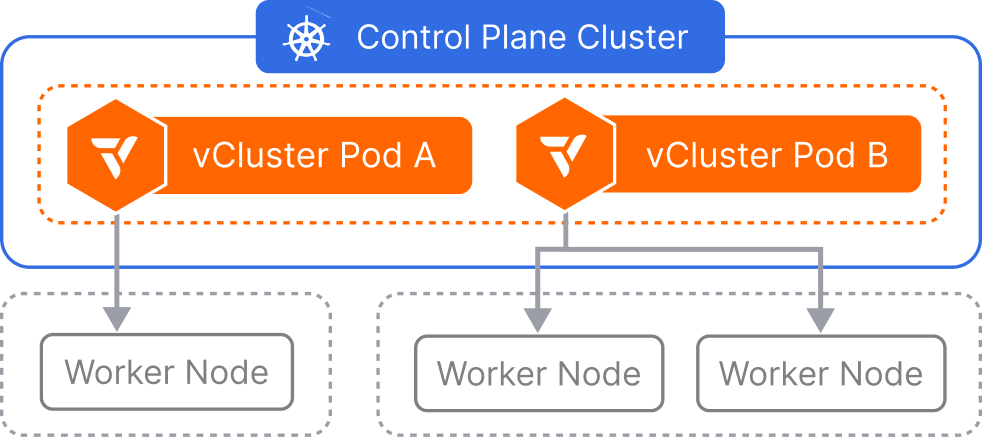
vCluster hosts independent tenant APIs and data stores as lightweight control-plane workloads. vMetal provides infrastructure, and Private Nodes dedicate production workers while Platform manages access and templates. Lintasarta runs 170+ tenant clusters in production.
Purpose-built for AI cloud providers delivering isolated, CNCF-certified Kubernetes environments on GPU hardware at scale.
Each tenant has an independent Kubernetes API, data store and RBAC boundary. Lightweight control-plane hosting reduces dedicated server requirements for control plane services; Private Nodes keep production workers tenant-specific.

Every tenant cluster runs a CNCF-certified Kubernetes control plane. Tenants use standard Kubernetes APIs and tooling without proprietary workarounds, the same experience they get on EKS or GKE.

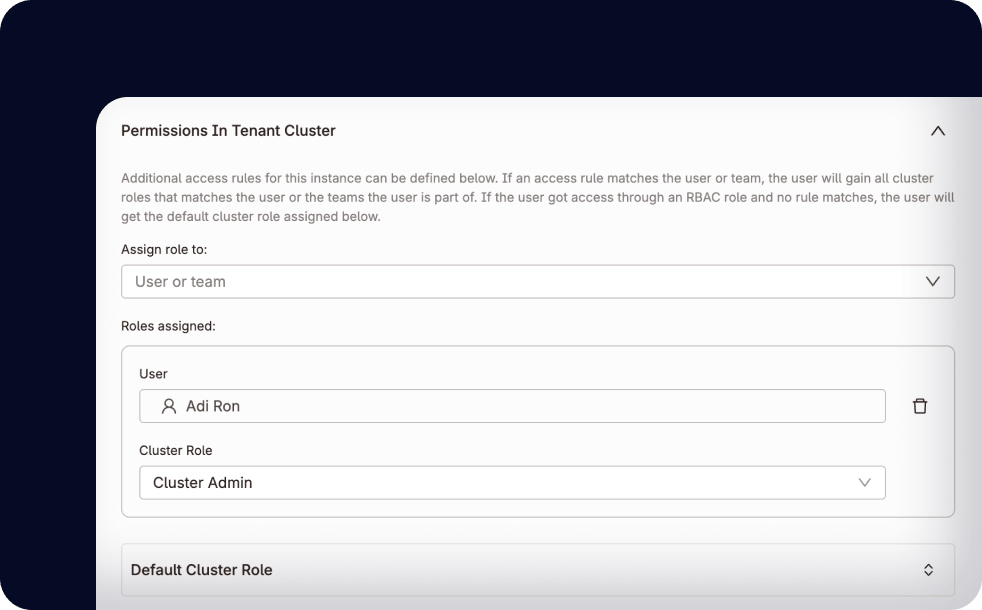
Give tenants cluster-admin within their own Kubernetes environment for control plane services. They manage CRDs, operators and RBAC there, while platform administrators retain control of tenant provisioning, infrastructure access and fleet policies.

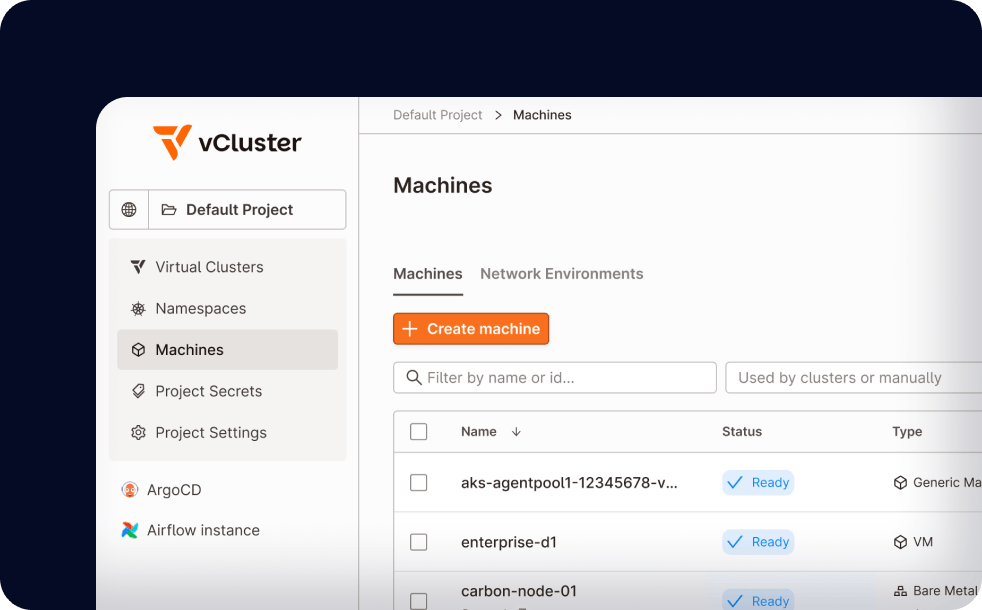
Coordinate tenant environments for control plane services through one UI, CLI and API. Templates, access policies and quotas provide central operator controls while tenant Kubernetes APIs and dedicated production workers remain separate.

Give your end customers an EKS-like self-service experience. Tenants provision and manage their own Kubernetes environments through a branded portal, reducing your support burden while meeting cloud-native expectations.

This isn’t a side project. Behind every vCluster deployment is 5+ years of deep K8s engineering, security hardening, and battle-tested infrastructure work at massive scale.
Talk to our team about your stack
Deploy vCluster on your infra in minutes
Go live with a hyperscaler-grade tenant experience in days
With Private Nodes, each tenant cluster runs its own Kubernetes scheduler against its own dedicated workers. The API, scheduler and backing store are components of the tenant control plane; they are not necessarily separate pods. Tenant priority and placement policies operate within that cluster. GPU allocation still depends on supported drivers and device resources, while vMetal supplies machine provisioning.
With namespace isolation, tenants are partitions inside one control plane: they share the API server, data store, and cluster-wide agents. With vCluster, each tenant gets a separate control plane, so there is no shared API server and each tenant has cluster-admin rights in its own cluster. Tenants can't see each other's resources, and a misconfiguration in one environment stays contained. Private Nodes add dedicated worker nodes with per-tenant CNI and storage, extending the boundary past the control plane.
Tenant control planes come up once its control plane and workers are ready, because they run as lightweight pods: there is no hardware to provision, no PXE boot cycle, and no OS install for the control plane itself. The control plane cluster is already running, and vCluster starts a new isolated control plane inside it. QumulusAI, for example, spins up isolated Kubernetes environments in about 1 minute.
Yes. Every tenant cluster is a CNCF-conformant Kubernetes control plane that exposes standard Kubernetes APIs. Tenants use Helm charts, operators, CRDs, and their usual tooling as they would on any certified distribution. It is real Kubernetes running as a lightweight process inside your control plane cluster, with no proprietary abstraction in between.
Private Nodes are worker nodes joined to one tenant cluster, with that tenant's own CNI and storage configuration. They can be physical machines or supported VMs. Use dedicated bare metal when the service requires exclusive physical servers. vMetal can provision the underlying machines, while platform policies define which capacity a tenant may request and how it is released.
Yes. vCluster Platform supports air-gapped and FIPS deployments for environments with strict compliance requirements. Control planes can also run as VMs instead of pods when tenants require OS-level separation. GPU cloud providers and enterprises can meet regulatory requirements and still keep the density of virtualized control planes.
See how AI cloud providers run many tenant clusters, each with its own control plane, on GPU hardware.