platform-eng
Kubernetes Fleet Management for AI Clouds
Manage tenant clusters across your AI cloud. vMetal supplies infrastructure, while vCluster Platform coordinates the fleet with Private Nodes for dedicated production workers.
Manage tenant clusters across your AI cloud. vMetal supplies infrastructure, while vCluster Platform coordinates the fleet with Private Nodes for dedicated production workers.
Managing dozens of tenant clusters exposes gaps that single-cluster tooling cannot fix.
Standard Kubernetes forces you to choose between tenant isolation and operational efficiency. Neither namespace partitions nor separate physical clusters scale.
As clusters multiply across data centers, teams lose unified visibility into health, quotas, and compliance across the entire fleet.
Slow cluster provisioning means delayed tenant onboarding. Every day without a managed Kubernetes offering is revenue left to competitors.
vMetal manages machine capacity, and vCluster Platform coordinates tenant clusters through one UI, CLI and API. Private Nodes provide dedicated production workers; templates and access policies keep fleet operations consistent. Lintasarta runs 170+ tenant clusters in production.
Every layer of vCluster Platform is designed to manage large fleets of tenant clusters with speed, isolation, and operational control.
Coordinate tenant environments for fleet operations through one UI, CLI and API. Templates, access policies and quotas provide central operator controls while tenant Kubernetes APIs and dedicated production workers remain separate.
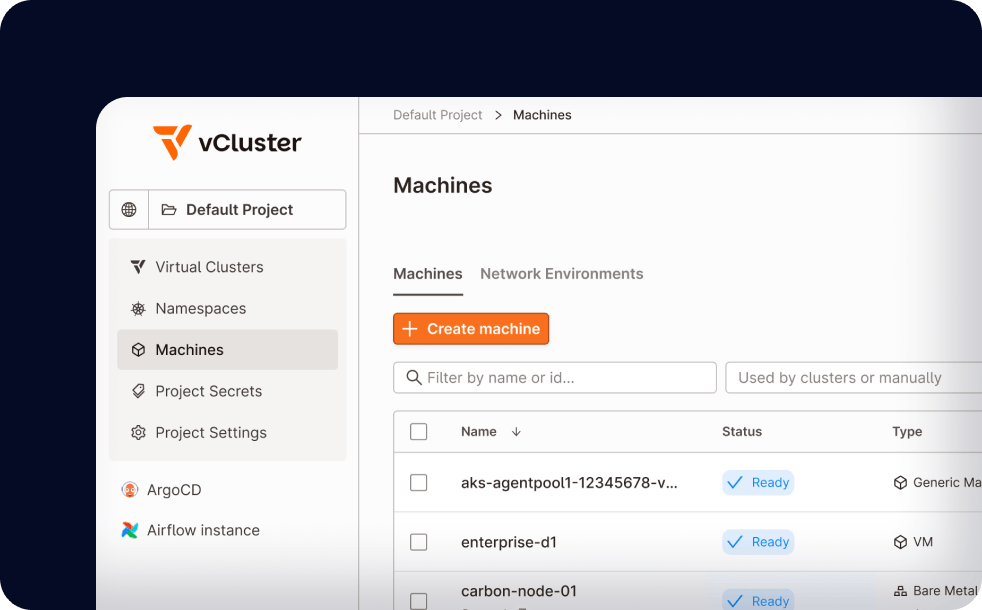
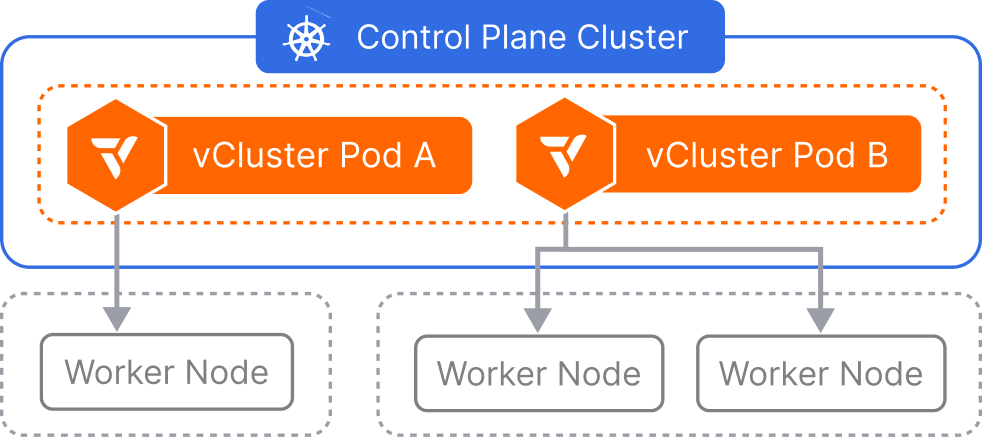
Each tenant has an independent Kubernetes API, data store and RBAC boundary. Lightweight control-plane hosting reduces dedicated server requirements for fleet operations; Private Nodes keep production workers tenant-specific.
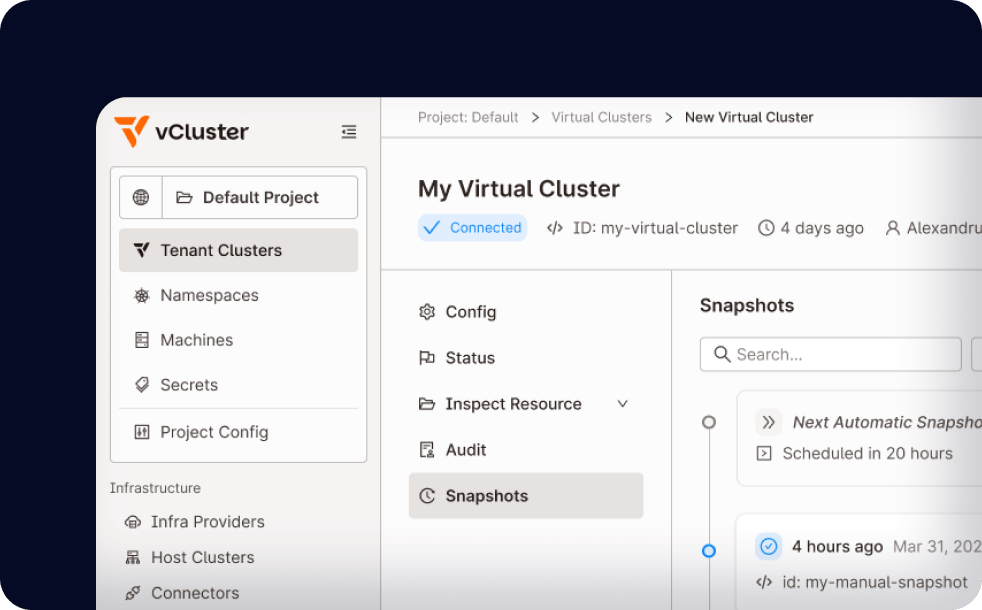
Use tenant control-plane snapshots and documented backup workflows for fleet operations. Combine these with monitoring integrations and separate workload-data protection; recovery planning must include persistent volumes, connected infrastructure and restore testing.
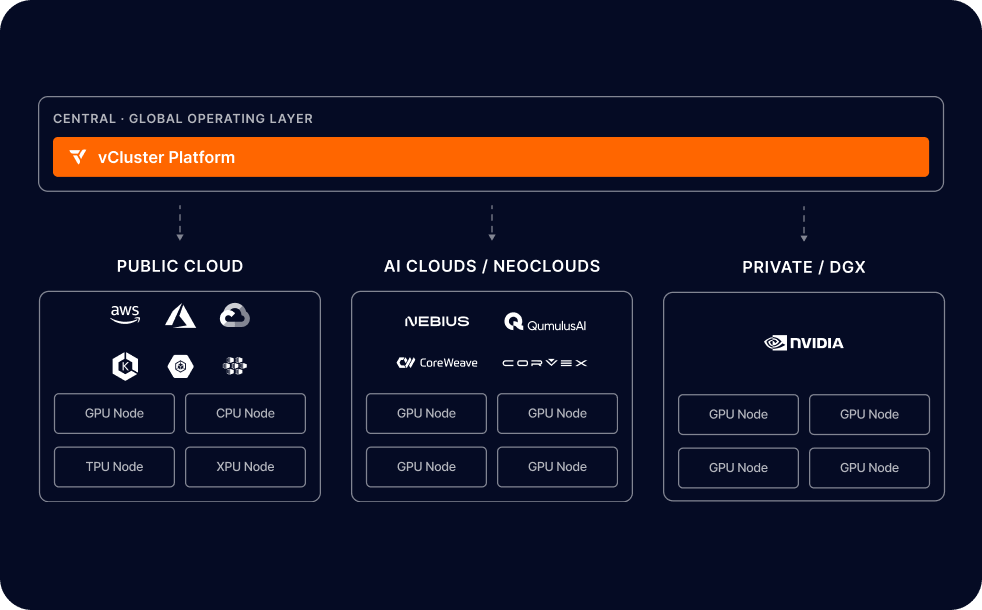
Manage fleet operations across supported clouds and data centers through one platform. Tenant control planes remain separate; plan worker placement, interconnects, data residency and failure domains for each location.
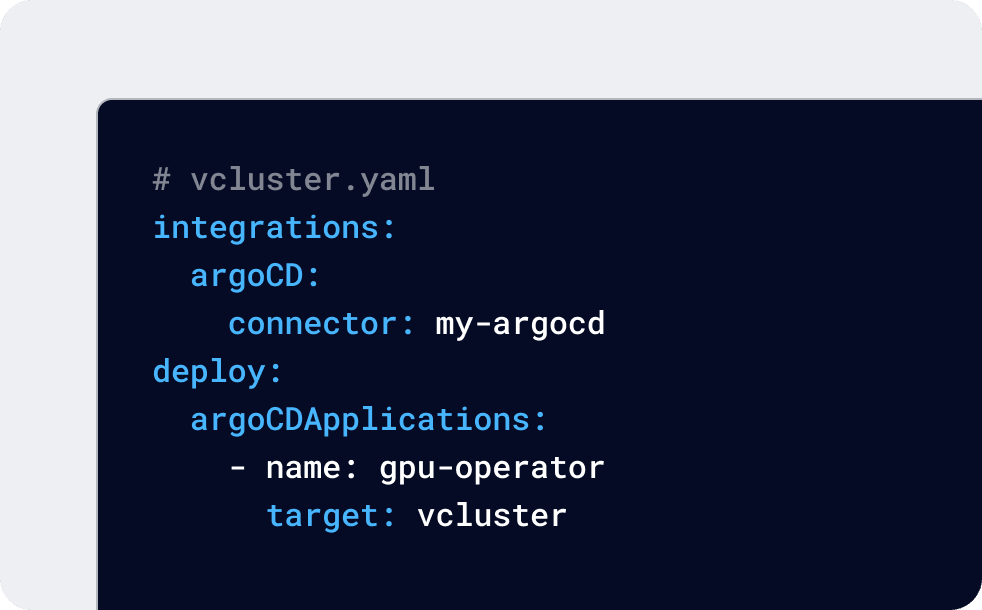
Use supported APIs, Terraform and GitOps workflows to automate fleet operations. Version tenant templates and infrastructure configuration, and validate credentials, provider support and deployment-specific integrations before promoting changes.
This isn’t a side project. Behind every vCluster deployment is 5+ years of deep K8s engineering, security hardening, and battle-tested infrastructure work at massive scale.
Talk to our team about your stack
Deploy vCluster on your infra in minutes
Go live with a hyperscaler-grade tenant experience in days
Kubernetes fleet management is the practice of provisioning, configuring, monitoring and operating many Kubernetes clusters from a central platform. Once you have dozens of tenant clusters spread across data centers, manual per-cluster operations stop working. A fleet management layer provides unified RBAC, policy enforcement, observability and lifecycle operations, so platform teams keep consistency and compliance without headcount growing with every cluster.
vCluster Platform coordinates tenant environments through a central UI, CLI and API. Operators use templates, access policies and quotas while each Kubernetes tenant retains its own API and dedicated production workers. vMetal manages supported machine provisioning below the fleet. Operational consistency still depends on template configuration, version management and the monitoring and recovery workflows you connect to the platform.
Namespace isolation shares one API server, one data store and one set of cluster-wide resources across all tenants, so tenants can see platform internals they should not. vCluster gives each tenant a separate API server, data store, RBAC and CRDs. Tenants can't see other tenants' workloads, nodes or configurations, which matches the model of a dedicated cluster without the provisioning cost. In production, Private Nodes add the hardware boundary, with each tenant on its own worker nodes, CNI and storage.
Yes. vCluster Platform supports multi-region and multi-cloud deployments through a central management platform. An optional encrypted VPN can secure traffic between control planes and distributed worker nodes across locations. AI cloud providers and enterprises can run one Kubernetes fleet across multiple data centers without a separate control plane cluster per region.
vCluster Platform is built for fast time to production. Boost Run went from decision to production launch in under 45 days, and Lintasarta runs 170+ tenant clusters in production on vCluster. Because control planes are lightweight pods rather than physical clusters, new tenant environments come up once its control plane and workers are ready, and the fleet grows without new control plane hardware per tenant.
vCluster is a CNCF-certified Kubernetes distribution and exposes standard Kubernetes APIs in tenant environments. This supports familiar clients, Helm charts and cluster-scoped resources such as CRDs. Certification covers Kubernetes conformance rather than an entire AI platform or customer deployment. Validate the selected version, networking, storage, GPU drivers and runtime integrations for the workloads you plan to support.
See how vCluster Platform runs a large fleet of tenant clusters with low per-cluster overhead.
