ai-cloud
Kubernetes for GPU as a Service
Offer Kubernetes alongside GPU capacity. vMetal supplies machines, and vCluster gives each customer an independent tenant cluster with dedicated Private Nodes for production workloads.
Offer Kubernetes alongside GPU capacity. vMetal supplies machines, and vCluster gives each customer an independent tenant cluster with dedicated Private Nodes for production workloads.
Plain Kubernetes pushes GPU providers into tradeoffs between isolation, utilization and time to market.
Raw GPU hours are a commodity. Customers pick the provider that also gives them a usable cloud experience on top.
Tenants share cluster-wide administrative resources in a namespace-only design. RBAC and admission policies must limit access beyond each tenant’s intended scope.
Building tenant provisioning, isolation and a portal in-house ties up a platform team for a long time before the first customer goes live.
vMetal supplies machines for your GPU service. vCluster provides independent Kubernetes tenant clusters with dedicated Private Nodes, while supported GPU drivers allocate devices inside each customer's environment. vCluster Labs software powers 100K+ GPUs.
From racking GPU servers to handing a customer a working AI environment, these are the pieces vCluster provides.
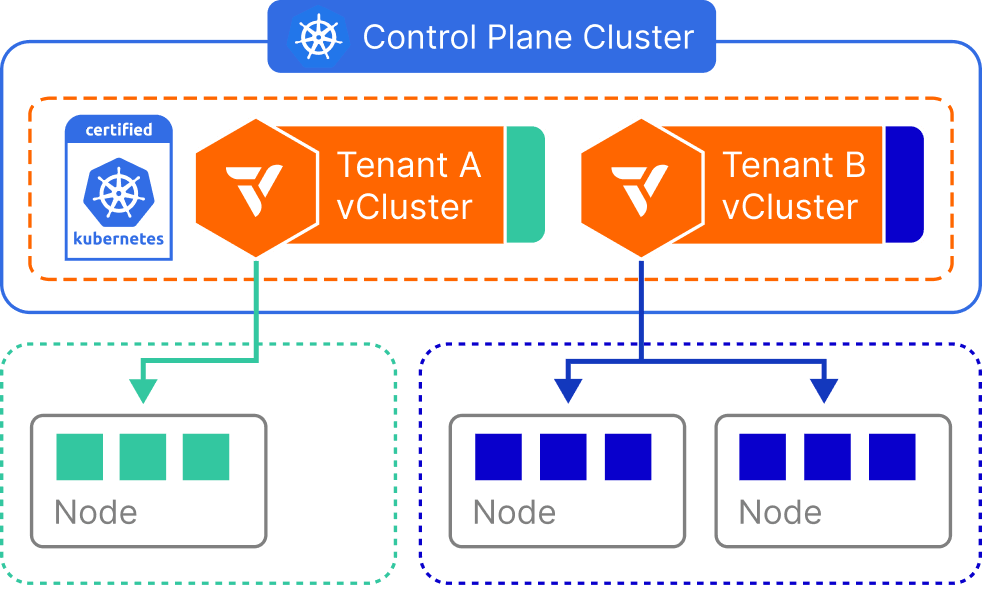
Each tenant has an independent Kubernetes API, data store and RBAC boundary. Lightweight control-plane hosting reduces dedicated server requirements for Kubernetes GPU services; Private Nodes keep production workers tenant-specific.
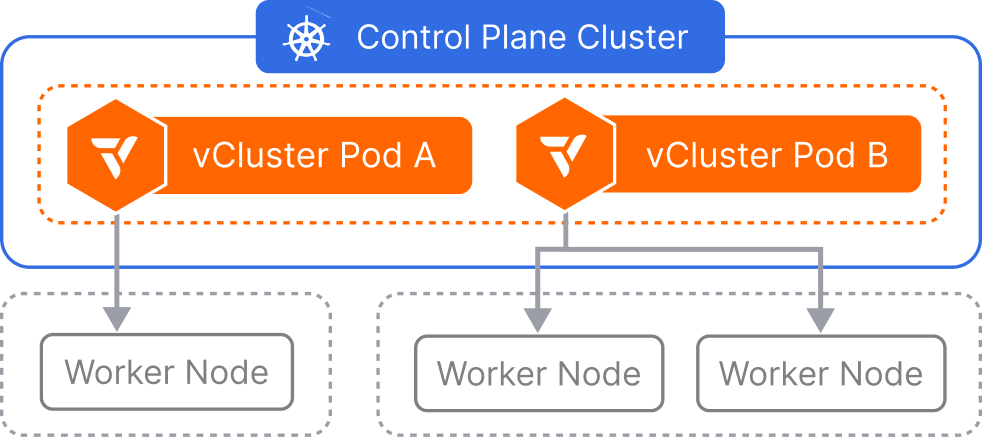
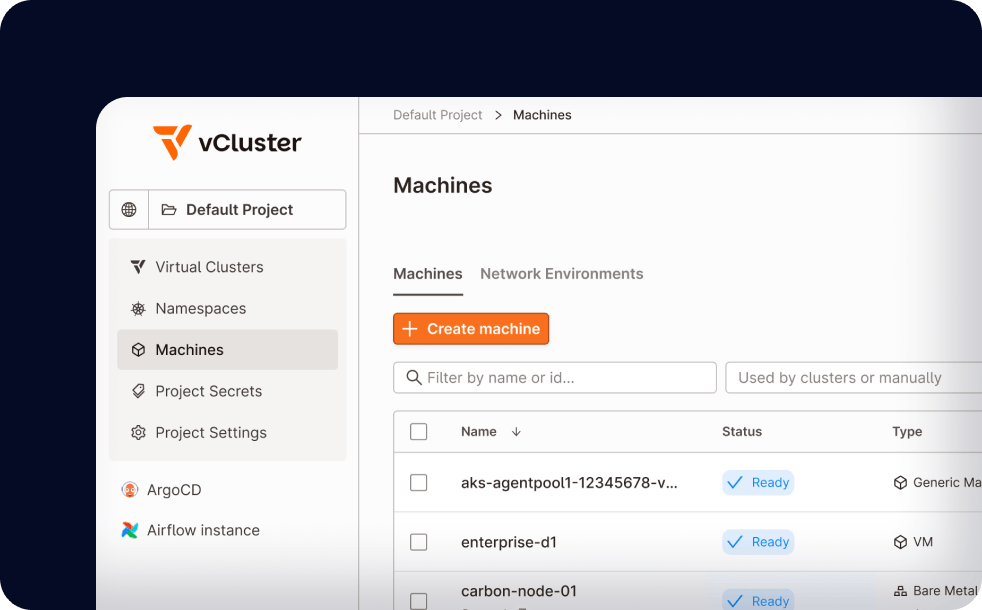
vMetal exposes one Machine API above bare metal and VM provisioning drivers. Registered inventory, images and credentials enable repeatable machine lifecycle workflows for Kubernetes GPU services. Network automation uses supported integrations such as Netris.
Private Nodes dedicate worker capacity to one tenant cluster, with its own CNI and storage configuration. For Kubernetes GPU services, select physical servers or VMs according to the required infrastructure boundary.
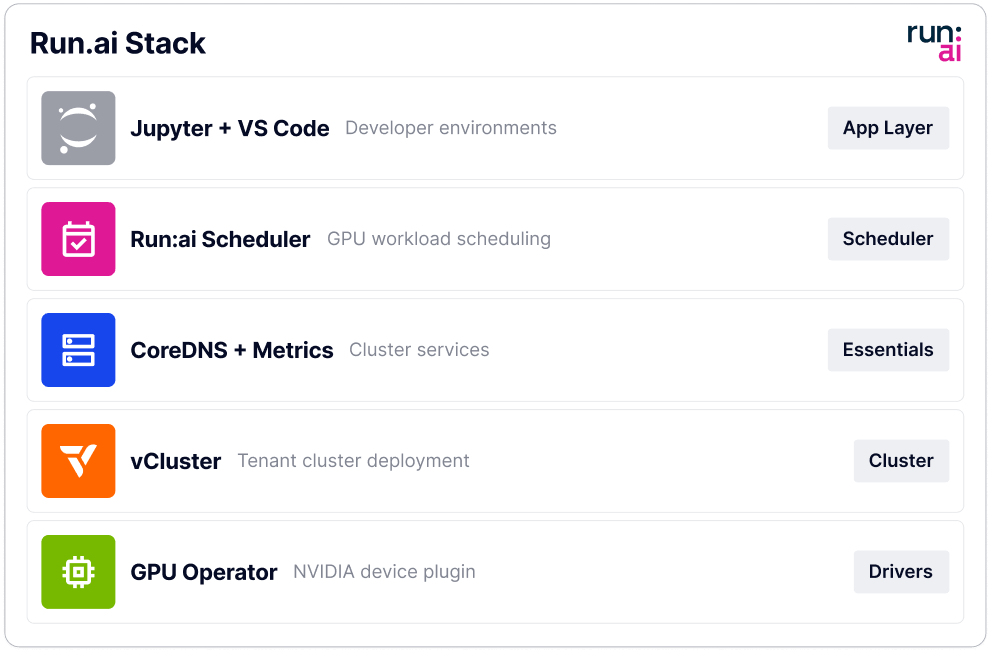
Use supported workload templates for Kubernetes GPU services, including the NVIDIA Run:AI partner integration. Configure GPU, network and storage prerequisites, and validate the selected template for Private Nodes before offering it to production customers.
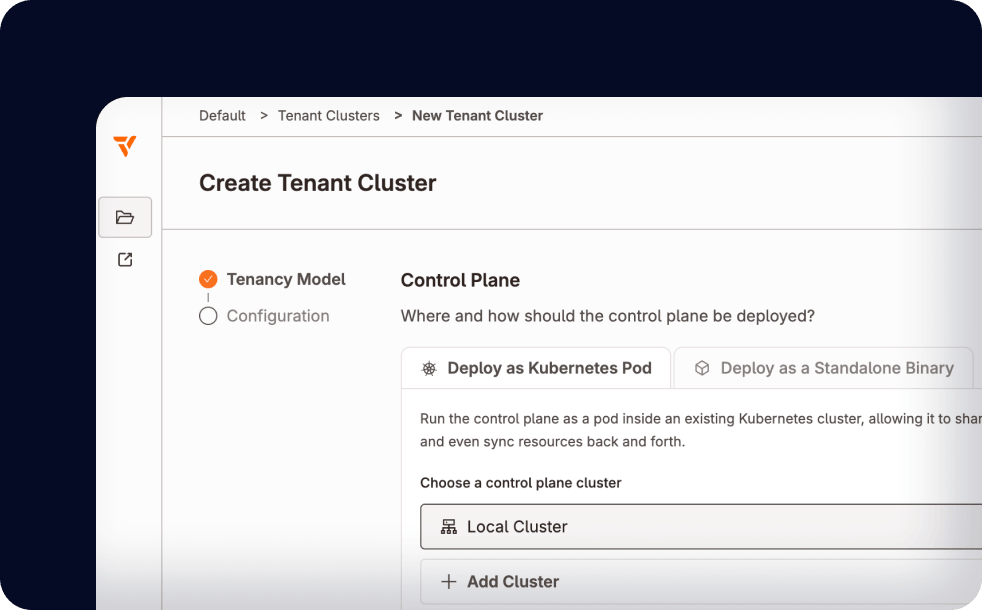
Give customers an EKS-like way to create and manage their own tenant clusters. You get the self-service layer AI customers expect without building and maintaining a portal yourself.
This isn’t a side project. Behind every vCluster deployment is 5+ years of deep K8s engineering, security hardening, and battle-tested infrastructure work at massive scale.
Talk to our team about your stack
Deploy vCluster on your infra in minutes
Go live with a hyperscaler-grade tenant experience in days
Most setups either give every customer a separately provisioned physical cluster, which is slow and expensive, or put customers in namespaces, which is a weak boundary. vCluster gives each customer a virtualized control plane with its own API server, data store and RBAC, and runs their workloads on Private Nodes. You get per-customer clusters without the cost of a full cluster build for each one.
vCluster Standalone runs as a Kubernetes binary directly on Linux without requiring another Kubernetes cluster, k3s or kubeadm. It can provide an initial Kubernetes foundation. vMetal is a separate infrastructure orchestration layer that requires vCluster Platform and a connected Kubernetes cluster for its Metal3/Ironic path. Hardware registration, images, credentials and driver setup remain prerequisites for machine provisioning.
vCluster gives each tenant an independent Kubernetes API, data store and RBAC scope. Private Nodes dedicate worker capacity to that tenant, including its own CNI and storage configuration. vMetal orchestrates the machines underneath. This separates tenant administration and worker placement; shared infrastructure, application permissions and network policies still require an explicit security design.
Boost Run went from decision to production launch in under 45 days. QumulusAI spins up isolated Kubernetes environments for its customers in about 1 minute. Because provisioning, tenant clusters and AI stacks are already integrated, most of the work is configuration rather than platform building.
Standard Kubernetes APIs support familiar deployment tools, but migration still requires validation of storage, networking, identity, GPU drivers and runtime-dependent operators. Create a tenant cluster with the required Private Nodes configuration, test representative workloads, and plan data movement and rollback before switching traffic. Boost Run's launch timeline is not a migration estimate for your existing environment.
NVIDIA Run:AI is available through the native Certified Stacks integration, with release-specific prerequisites and templates. Its bundled templates do not automatically supply dedicated Private Nodes. Configure and validate the production worker model, GPU access, networking and storage before offering it to customers. Ray and Jupyter can use compatible Kubernetes deployment tooling and require their own supported configuration.
See how GPU clouds use vCluster to sell isolated tenant clusters on Private Nodes.
