ai-cloud
GPU Server Provisioning for AI Clouds
Provision GPU servers through one Machine API. vMetal coordinates infrastructure drivers, and vCluster uses provisioned capacity as dedicated tenant workers through Private Nodes.
Provision GPU servers through one Machine API. vMetal coordinates infrastructure drivers, and vCluster uses provisioned capacity as dedicated tenant workers through Private Nodes.
GPU server provisioning becomes difficult when every infrastructure stack exposes a different lifecycle and API.
Selling raw compute alone gives customers no consistent machine or tenant cluster experience.
Manual OS installation, network setup, and cluster registration slow the path from available hardware to usable capacity.
Air-gapped and regulated environments need machine provisioning that runs on infrastructure the operator controls.
vMetal provides one Machine API above infrastructure-specific drivers. Registered servers move through provisioning and lifecycle operations, and vCluster attaches dedicated capacity to tenant clusters as Private Nodes. Lintasarta runs 170+ tenant clusters in production.
vMetal provides the Machine API and lifecycle layer. vCluster consumes those Machines as tenant cluster capacity.
vMetal exposes one Machine API above bare metal and VM provisioning drivers. Registered inventory, images and credentials enable repeatable machine lifecycle workflows for GPU machine provisioning. Network automation uses supported integrations such as Netris.
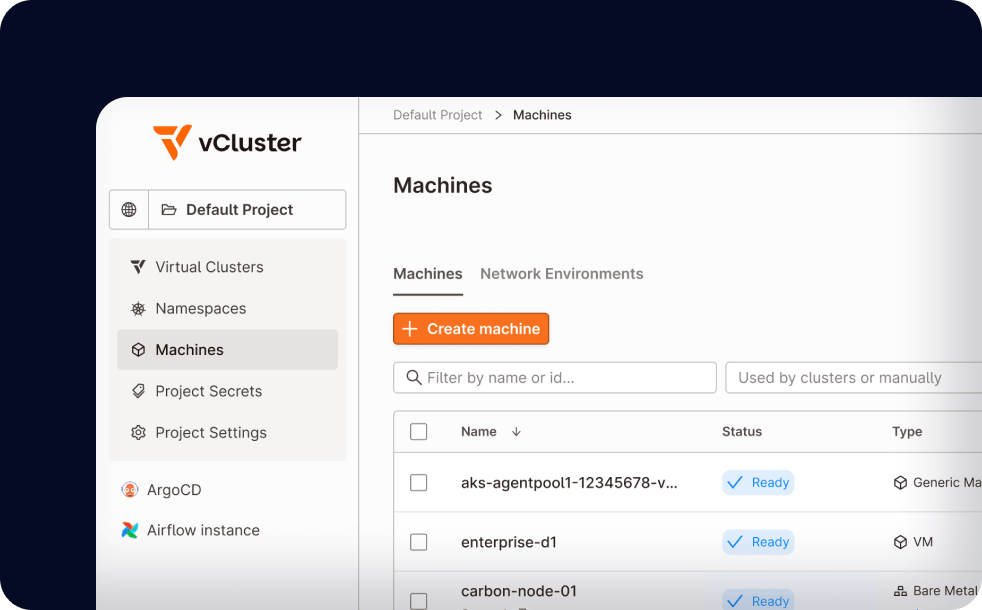
Karpenter-based Auto Nodes requests worker capacity according to configured policies. With the vMetal provider, Machine requests provision available infrastructure for GPU machine provisioning; inventory, driver readiness and release rules determine actual capacity.
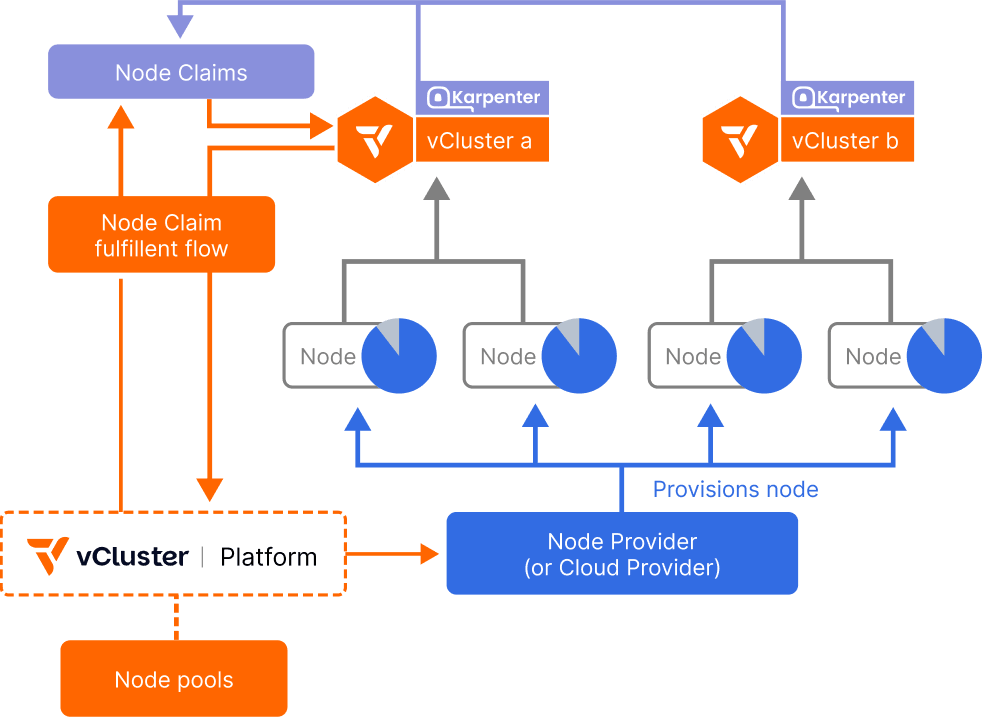
Private Nodes dedicate worker capacity to one tenant cluster, with its own CNI and storage configuration. For GPU machine provisioning, select physical servers or VMs according to the required infrastructure boundary.
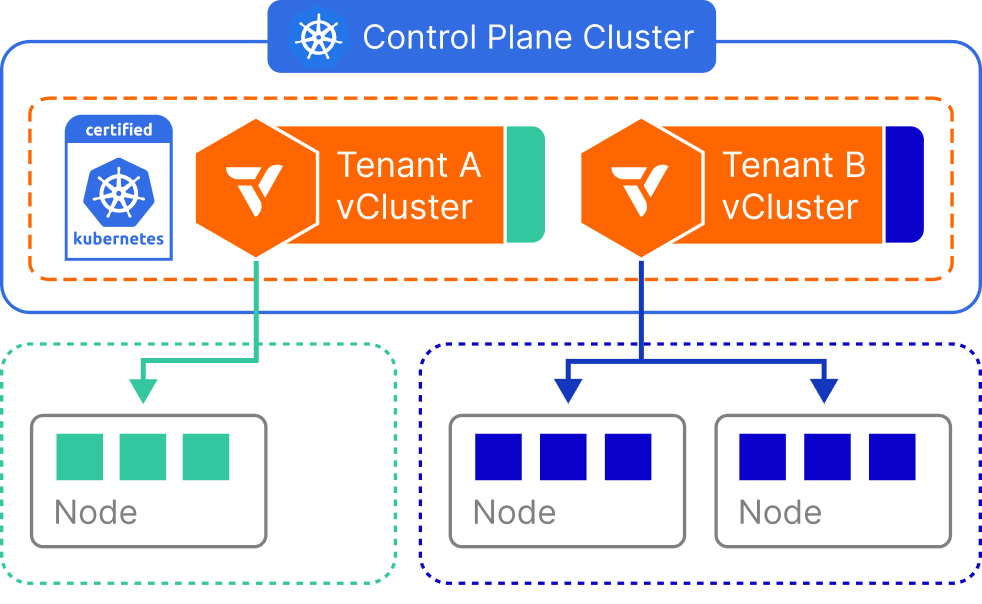
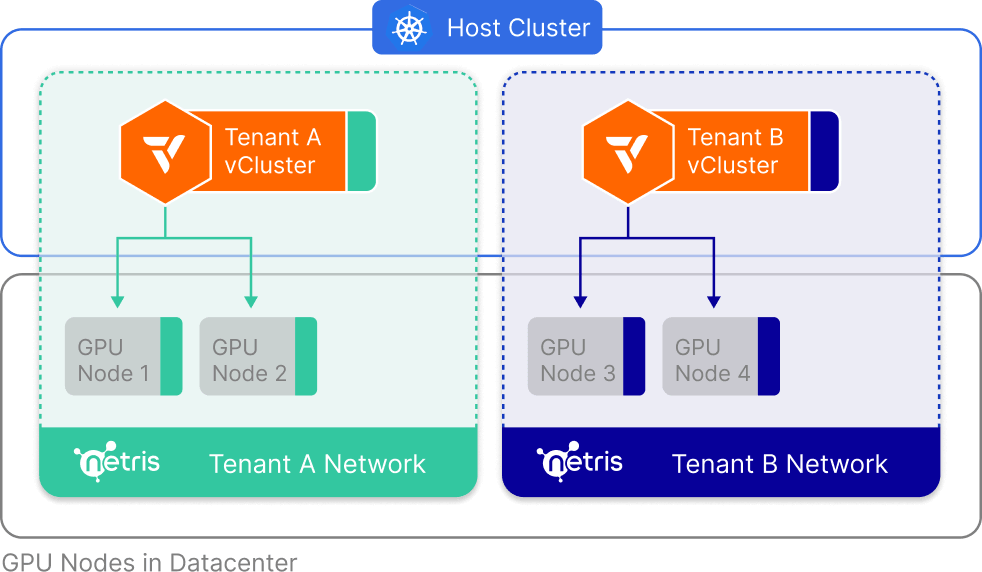
Tenant-owned CNI configuration and supported Netris integrations provide separate network controls for GPU machine provisioning. Ethernet segmentation can use VLANs, VRFs and ACLs; InfiniBand isolation uses fabric partitions rather than Ethernet constructs.
vCluster Platform supports air-gapped deployments and FIPS features on supported plans for infrastructure operated in controlled environments.
This isn’t a side project. Behind every vCluster deployment is 5+ years of deep K8s engineering, security hardening, and battle-tested infrastructure work at massive scale.
Talk to our team about your stack
Deploy vCluster on your infra in minutes
Go live with a hyperscaler-grade tenant experience in days
vMetal is the Infrastructure Orchestrator in vCluster Platform: the layer that provisions and manages Bare Metal Machines and VMs. A Machine is a claim on one server, and the selected driver (such as Metal3, KubeVirt, NVIDIA NICo, BCM, MAAS, OpenStack, or VMware) handles the infrastructure-specific work behind a stable API.
Supported plans include air-gapped deployment and FIPS features. Private Nodes, tenant-scoped access and optional network segmentation provide controls you can include in a regulated deployment. Select supported images and configurations, and validate the full environment against your requirements. These capabilities do not establish certification of the customer's service, application, hardware or operational procedures.
Offer Kubernetes tenant environments and compatible workload stacks through templates you configure and support. Private Nodes dedicate production workers, while vMetal supplies underlying infrastructure. The native Certified Stacks catalog documents NVIDIA Run:AI, with release-specific prerequisites. Ray and inference workloads can run on Kubernetes, but this does not make every separately packaged cluster product generally available; packaged managed Slurm remains planned.
Auto Nodes uses Karpenter-based node management, with vCluster Platform handling infrastructure provisioning through a configured node provider. Providers include vMetal and other supported integrations. On the vMetal path, Machine requests allocate and provision available inventory as tenant Private Nodes. Scaling depends on configured policies and usable capacity; it does not create physical inventory or automatically diagnose hardware failures.
Provisioning time depends on server state, the selected driver, OS image, network setup, and startup automation. vMetal keeps the request and lifecycle model consistent across those choices, and once Machines exist, tenant clusters on top of them come up once its control plane and workers are ready.
Private Nodes give a tenant its own worker networking configuration. Supported Netris integrations can add Ethernet segmentation through VLANs, VRFs and ACLs on compatible infrastructure. These controls require explicit setup and do not reserve all fabric bandwidth. InfiniBand uses partition keys and fabric management rather than Ethernet segmentation; design the relevant fabric controls alongside tenant cluster access policies.
See how vMetal and vCluster handle GPU server provisioning end to end.
