ai-cloud
Bare Metal Karpenter GPU Autoscaling for AI Clouds
Scale registered bare metal GPU capacity with workload demand. Karpenter-based Auto Nodes uses vMetal provisioning to add dedicated Private Nodes within your configured policies.
Scale registered bare metal GPU capacity with workload demand. Karpenter-based Auto Nodes uses vMetal provisioning to add dedicated Private Nodes within your configured policies.
Standard Kubernetes autoscaling wasn't built for bare metal GPU server fleets.
Static pools can leave capacity idle. Scaling needs inventory, provisioning and release policies that reflect GPU workload demand.
Demand-driven node management needs a provider that can provision registered physical inventory and return usable workers to a tenant cluster.
Every hour a GPU rack sits unscheduled while teams manually provision servers is revenue your AI cloud is not generating.
Auto Nodes uses Karpenter-based node management with Platform provisioning. With the vMetal provider, it requests registered machine capacity and attaches provisioned workers as Private Nodes, subject to inventory and scaling policies. vCluster Labs software powers 100K+ GPUs.
Each layer has one job: vMetal provisions machines, Auto Nodes decides when, and vCluster turns the capacity into isolated tenant clusters.
Karpenter-based Auto Nodes requests worker capacity according to configured policies. With the vMetal provider, Machine requests provision available infrastructure for demand-driven bare metal capacity; inventory, driver readiness and release rules determine actual capacity.
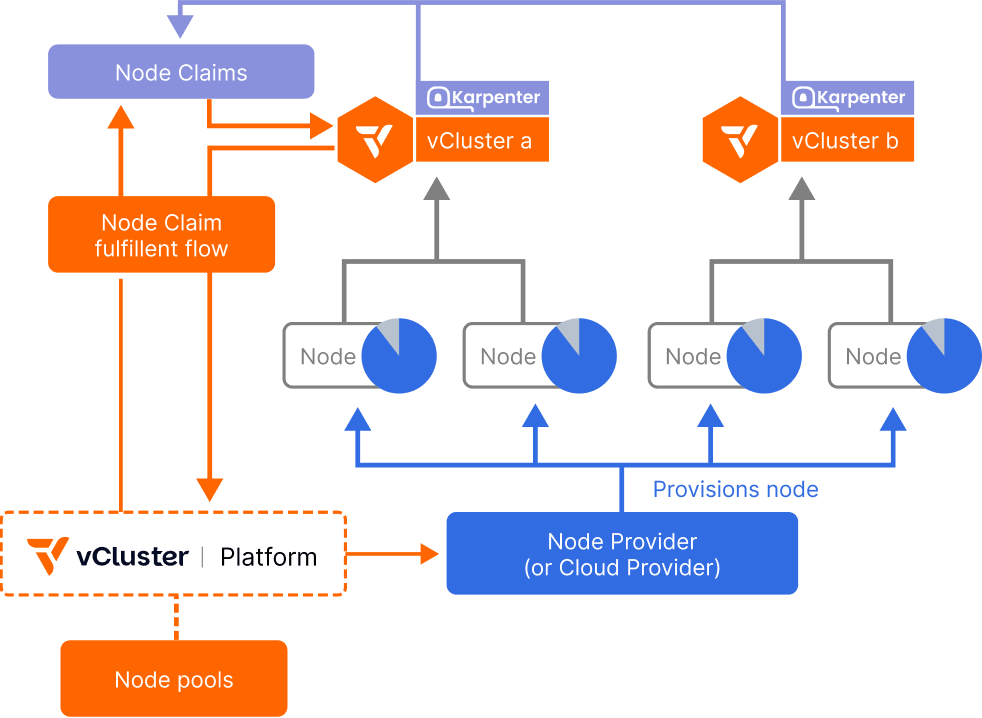
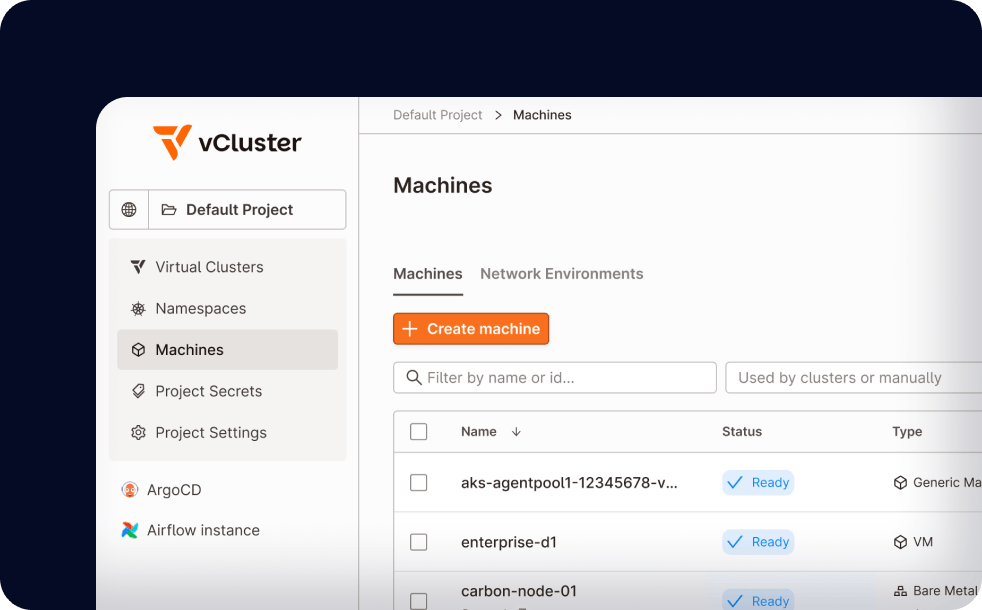
vMetal exposes one Machine API above bare metal and VM provisioning drivers. Registered inventory, images and credentials enable repeatable machine lifecycle workflows for demand-driven bare metal capacity. Network automation uses supported integrations such as Netris.
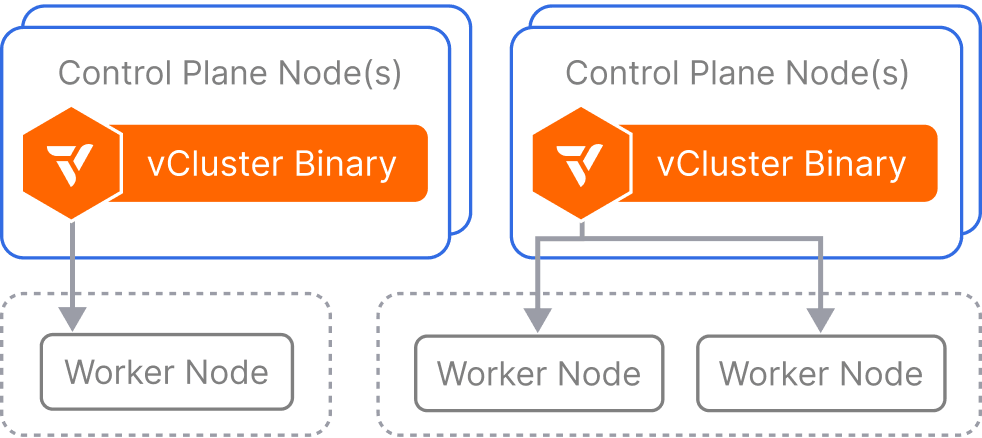
vCluster Standalone runs Kubernetes as a CNCF-certified binary on Linux, without an existing Kubernetes cluster. It supplies a Kubernetes foundation for demand-driven bare metal capacity; vMetal separately orchestrates machine and OS provisioning.
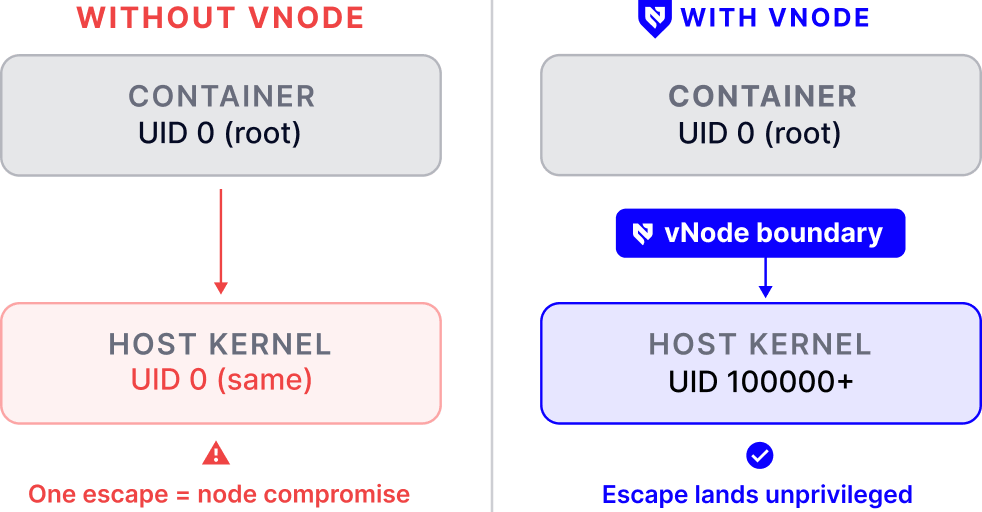
vNode uses Linux user namespaces and seccomp to restrict workload privileges and system calls. It adds runtime hardening for demand-driven bare metal capacity without a guest kernel or hypervisor, complementing dedicated workers rather than allocating GPUs.
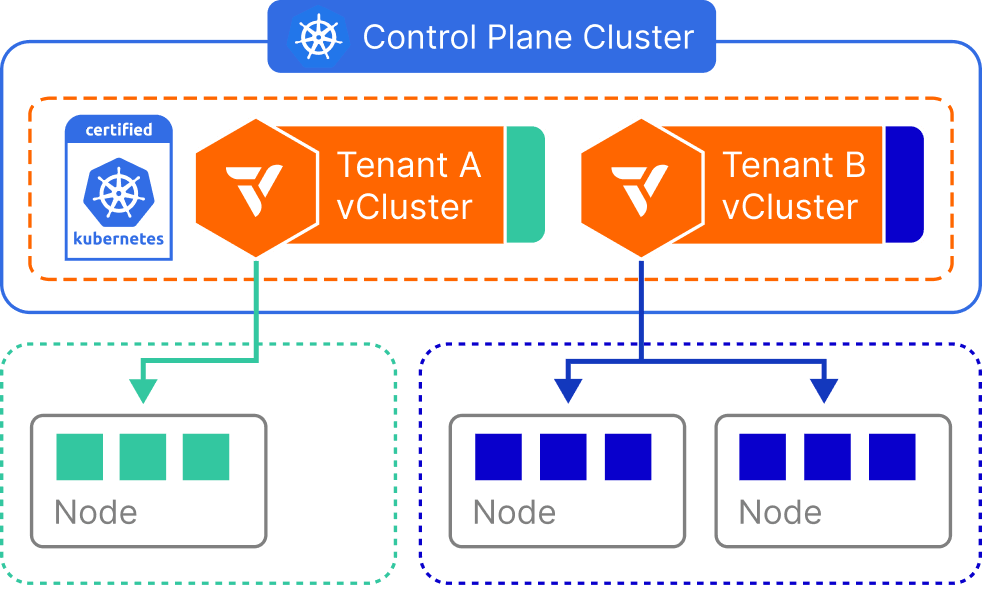
Private Nodes dedicate worker capacity to one tenant cluster, with its own CNI and storage configuration. For demand-driven bare metal capacity, select physical servers or VMs according to the required infrastructure boundary.
This isn’t a side project. Behind every vCluster deployment is 5+ years of deep K8s engineering, security hardening, and battle-tested infrastructure work at massive scale.
Talk to our team about your stack
Deploy vCluster on your infra in minutes
Go live with a hyperscaler-grade tenant experience in days
Auto Nodes uses Karpenter-based node management, with vCluster Platform handling infrastructure provisioning through a configured node provider. Providers include vMetal and other supported integrations. On the vMetal path, Machine requests allocate and provision available inventory as tenant Private Nodes. Scaling depends on configured policies and usable capacity; it does not create physical inventory or automatically diagnose hardware failures.
vMetal exposes a stable Machine API above infrastructure-specific drivers for bare metal and VMs. Drivers handle supported provisioning mechanics such as imaging, registration and cleaning. Operators configure inventory, credentials and images before automation runs. vCluster can then use provisioned machines as dedicated Private Nodes, connecting the infrastructure lifecycle to the tenant cluster that needs the capacity.
Auto Nodes can request worker capacity according to configured policies and supported resource requirements. With the vMetal provider, this can provision available machines as Private Nodes. Monitoring and repair tools must still identify the failed node, handle workloads and decide when replacement is appropriate. An autoscaling request is distinct from GPU diagnosis, hardware repair or guaranteed replacement inventory.
vCluster gives each tenant an independent Kubernetes API, data store and RBAC scope. Private Nodes dedicate worker capacity to that tenant, including its own CNI and storage configuration. vMetal orchestrates the machines underneath. This separates tenant administration and worker placement; shared infrastructure, application permissions and network policies still require an explicit security design.
vCluster Labs software powers 100K+ GPUs and 1M+ CPUs, serving 50+ GPU clouds & Fortune 500s combined. In production, Lintasarta operates 170+ tenant clusters, while Boost Run completed its managed Kubernetes launch in under 45 days from the decision. These named deployments provide scale and launch examples for teams evaluating the platform for their own infrastructure.
Private Nodes give a tenant its own worker networking configuration. Supported Netris integrations can add Ethernet segmentation through VLANs, VRFs and ACLs on compatible infrastructure. These controls require explicit setup and do not reserve all fabric bandwidth. InfiniBand uses partition keys and fabric management rather than Ethernet segmentation; design the relevant fabric controls alongside tenant cluster access policies.
See how Auto Nodes provisions GPU servers on demand for your AI workloads.
