platform-eng
Kubernetes GPU Scheduling for Isolated Tenant Clusters
Schedule GPU jobs independently for each customer. vMetal provisions capacity, and vCluster gives tenants separate schedulers with dedicated workers through Private Nodes.
Schedule GPU jobs independently for each customer. vMetal provisions capacity, and vCluster gives tenants separate schedulers with dedicated workers through Private Nodes.
Namespace-level isolation can't fix the contention built into shared GPU clusters.
Tenants depend on one API and worker pool. Contention on common workers can affect neighboring GPU workloads.
Provisioning a full physical cluster per tenant multiplies infrastructure cost and slows time to production significantly.
Quotas and priorities govern one scheduler, but do not give tenants independent scheduling policies and control planes.
vMetal provisions GPU machines. vCluster gives each tenant its own API, data store and scheduler, with Private Nodes dedicating workers and their networking and storage configuration. vCluster Labs software powers 100K+ GPUs.
vCluster isolates each layer GPU scheduling touches, from the control plane down to the node and the workload runtime.
Each tenant has an independent Kubernetes API, data store and RBAC boundary. Lightweight control-plane hosting reduces dedicated server requirements for GPU scheduling; Private Nodes keep production workers tenant-specific.
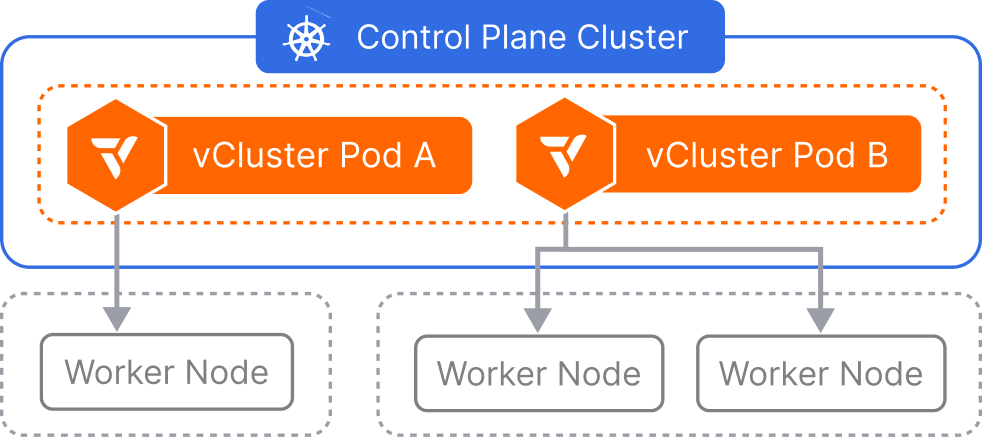
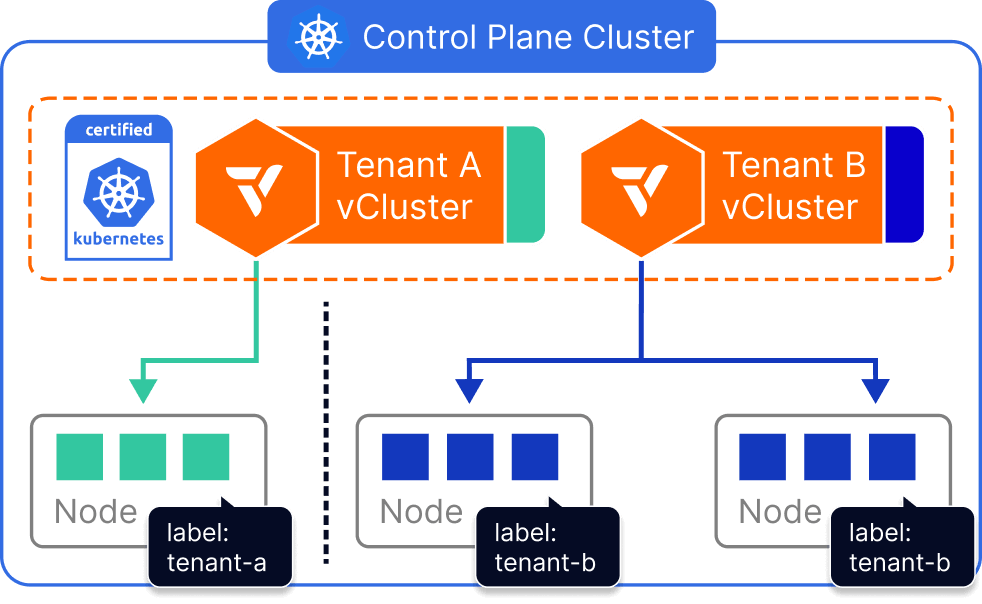
Dedicate GPU workers to each tenant through Private Nodes. This removes cross-tenant workload placement from those workers for GPU scheduling; network bandwidth, storage and GPU partitioning still need explicit policies.
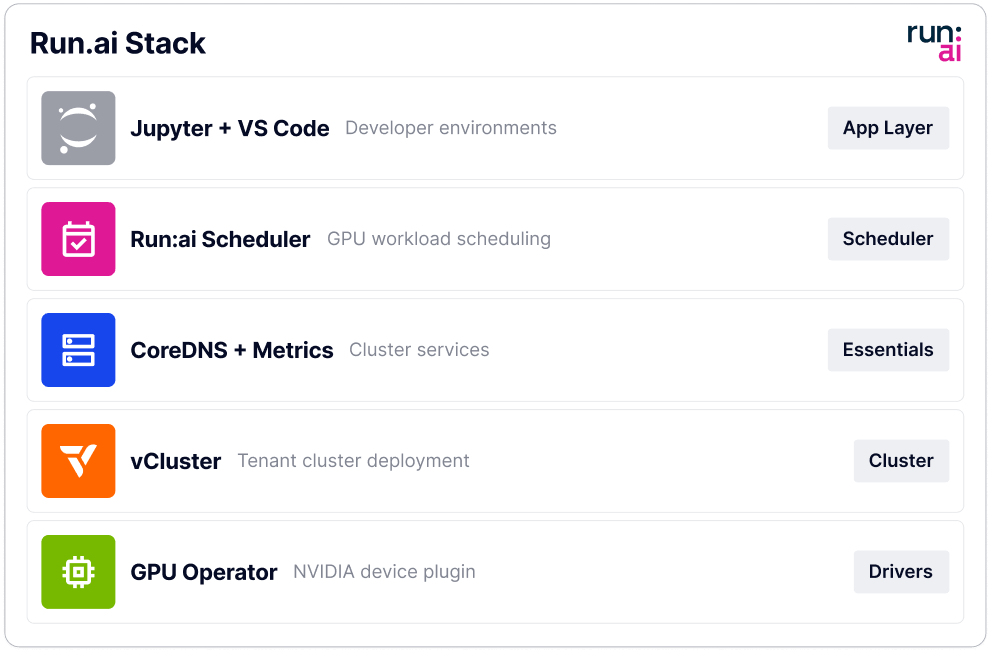
Use supported workload templates for GPU scheduling, including the NVIDIA Run:AI partner integration. Configure GPU, network and storage prerequisites, and validate the selected template for Private Nodes before offering it to production customers.
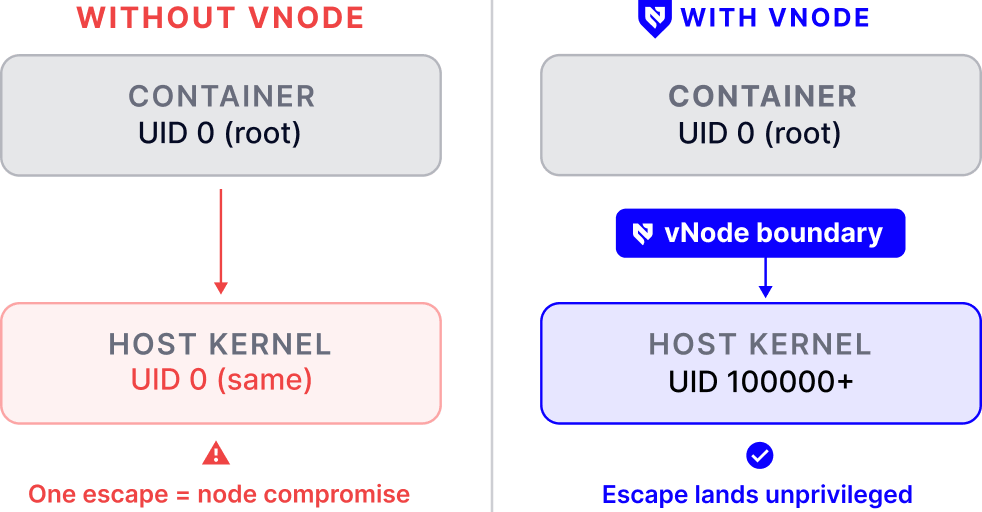
vNode uses Linux user namespaces and seccomp to restrict workload privileges and system calls. It adds runtime hardening for GPU scheduling without a guest kernel or hypervisor, complementing dedicated workers rather than allocating GPUs.
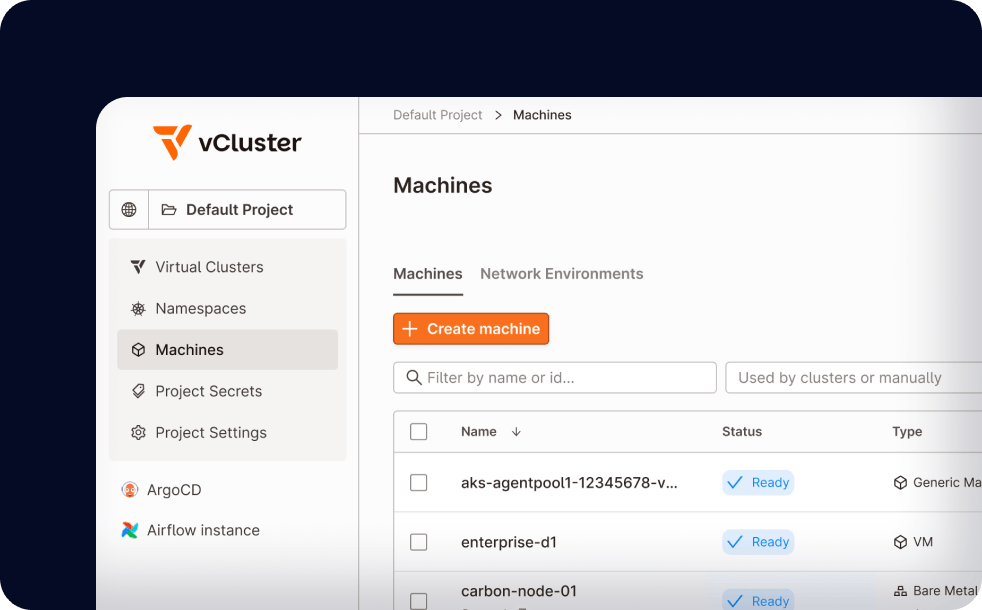
Coordinate tenant environments for GPU scheduling through one UI, CLI and API. Templates, access policies and quotas provide central operator controls while tenant Kubernetes APIs and dedicated production workers remain separate.
This isn’t a side project. Behind every vCluster deployment is 5+ years of deep K8s engineering, security hardening, and battle-tested infrastructure work at massive scale.
Talk to our team about your stack
Deploy vCluster on your infra in minutes
Go live with a hyperscaler-grade tenant experience in days
With Private Nodes, each tenant cluster runs its own Kubernetes scheduler against its own dedicated workers. The API, scheduler and backing store are components of the tenant control plane; they are not necessarily separate pods. Tenant priority and placement policies operate within that cluster. GPU allocation still depends on supported drivers and device resources, while vMetal supplies machine provisioning.
Kubernetes supports PriorityClasses, resource quotas and scheduling policies within a common cluster. Those controls do not give each tenant an independent API or scheduler. vCluster with Private Nodes separates tenant control planes and dedicates workers, letting customers manage placement policies within their own environment. GPU driver configuration and capacity planning remain necessary within each tenant's nodes.
Tenant clusters expose standard Kubernetes scheduling controls, including node selectors, affinity, topology spread and extended resources. With Private Nodes, customers can configure supported GPU device plugins or DRA drivers on their own workers. Hardware topology and driver capabilities determine which devices can be allocated; Kubernetes conformance alone does not certify a particular GPU configuration or guarantee workload performance.
Yes. With Private Nodes, the recommended production model, each tenant's GPU nodes join only that tenant's cluster, so no other tenant's workloads can be scheduled onto those servers. You configure this per tenant cluster, which lets GPU cloud operators build service levels on dedicated GPU capacity. For internal dev, test and CI work by trusted teams, Shared Nodes are also available.
Dedicated Private Nodes remove cross-tenant workload placement from those workers. Bare metal avoids a hypervisor layer, but this is not a throughput or latency guarantee. GPU drivers, workload configuration, network fabrics and storage can still influence performance. vNode adds runtime hardening using the Linux kernel; benchmark the selected stack against the workload and service levels you intend to offer.
vCluster Labs software powers 100K+ GPUs and 1M+ CPUs, serving 50+ GPU clouds & Fortune 500s combined. In production, Lintasarta operates 170+ tenant clusters, while Boost Run completed its managed Kubernetes launch in under 45 days from the decision. These named deployments provide scale and launch examples for teams evaluating the platform for their own infrastructure.
See how vCluster gives every tenant its own scheduler and dedicated GPU nodes.
