platform-eng

K8s Multi Cluster Management for GPU Clouds

Manage many Kubernetes clusters without separate control-plane servers per tenant. vMetal provisions machines, and vCluster Platform coordinates tenant environments with dedicated Private Nodes.

Trusted by the fastest-growing AI cloud providers
Problem

Multi Cluster Operations Need Consistent Controls

The usual options trade isolation against cost, and both get harder to operate as the fleet grows.

Namespace Isolation Is Too Weak

Putting tenants in namespaces of one big cluster means they can see cluster-wide agents and CRDs. That is a thin boundary for paying GPU customers.

Separate Clusters Are Too Expensive

A full cluster per tenant means another set of control plane machines, another upgrade path and another bill, every time.

Fleet Operations Become Unmanageable

Dozens of clusters across regions and clouds lead to fragmented visibility, drifting policies and a growing maintenance backlog.

Solution

One Platform for Many Tenant Clusters

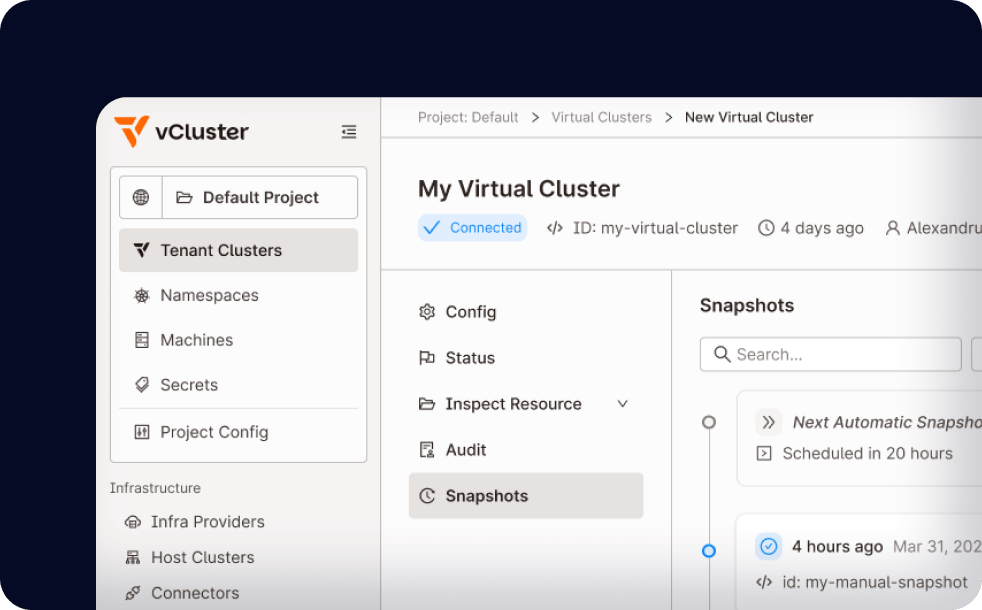
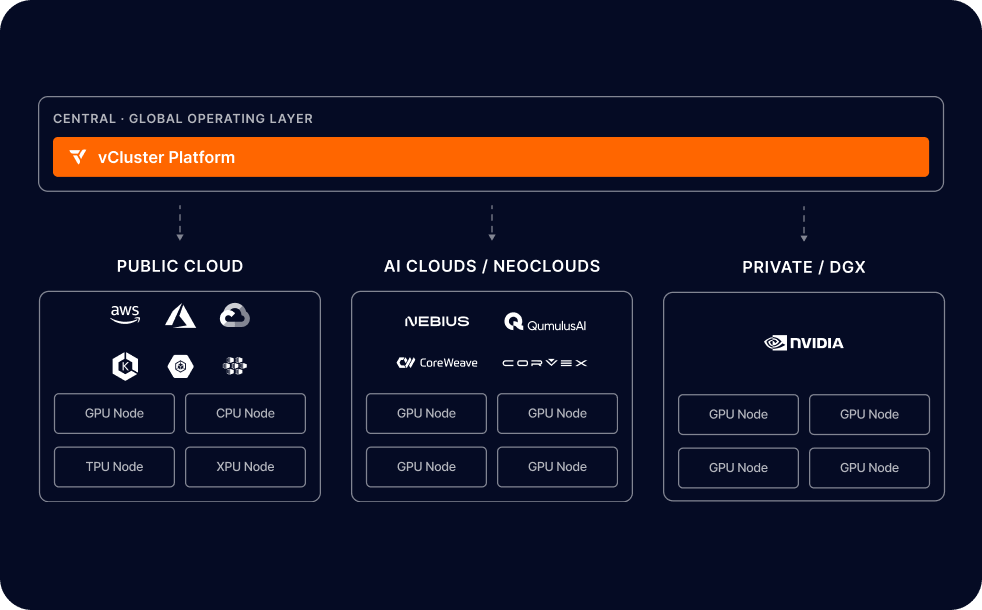
vCluster Platform manages many tenant control planes through one interface. vMetal orchestrates infrastructure, Private Nodes dedicate production workers, and documented snapshot workflows support control-plane recovery. Lintasarta runs 170+ tenant clusters in production.

Built for Scale Across Every Cluster

From per-tenant control planes to fleet-wide Day 2 work, these features cover the multi cluster lifecycle.

Tenant Isolation

Isolated Control Planes Per Tenant

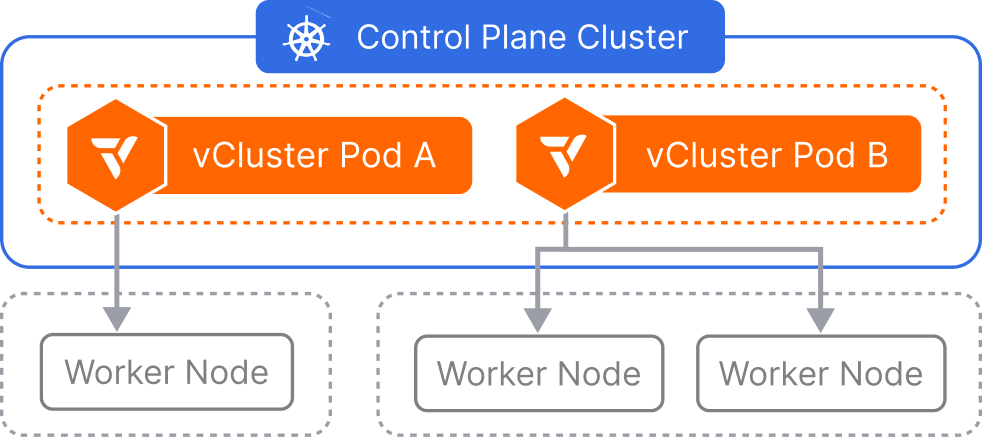
Each tenant has an independent Kubernetes API, data store and RBAC boundary. Lightweight control-plane hosting reduces dedicated server requirements for multi-cluster operations; Private Nodes keep production workers tenant-specific.

  • Independent tenant API and data store
  • Tenant-scoped scheduling on Private Nodes
  • No dedicated control-plane servers per tenant
Platform Operations

Central Fleet Management at Scale

Coordinate tenant environments for multi-cluster operations through one UI, CLI and API. Templates, access policies and quotas provide central operator controls while tenant Kubernetes APIs and dedicated production workers remain separate.

  • Unified UI, CLI and API
  • SSO, quotas and templates
  • Works across regions and clouds
Reliability

Snapshots and Recovery Workflows

Use tenant control-plane snapshots and documented backup workflows for multi-cluster operations. Combine these with monitoring integrations and separate workload-data protection; recovery planning must include persistent volumes, connected infrastructure and restore testing.

  • Tenant control-plane snapshots
  • Separate workload-data backups
  • Documented restore procedures
Distributed Infrastructure

Fleet Management Across Clouds and Regions

Manage multi-cluster operations across supported clouds and data centers through one platform. Tenant control planes remain separate; plan worker placement, interconnects, data residency and failure domains for each location.

  • One plane across regions
  • Consistent policies everywhere
  • No per-region silos
Standards Compliance

CNCF-Certified K8s Per Tenant

Every tenant cluster is a conformant, CNCF-certified Kubernetes control plane that exposes standard Kubernetes APIs. kubectl, Helm and GitOps tooling work unchanged, so you aren't managing compatibility exceptions across the fleet.
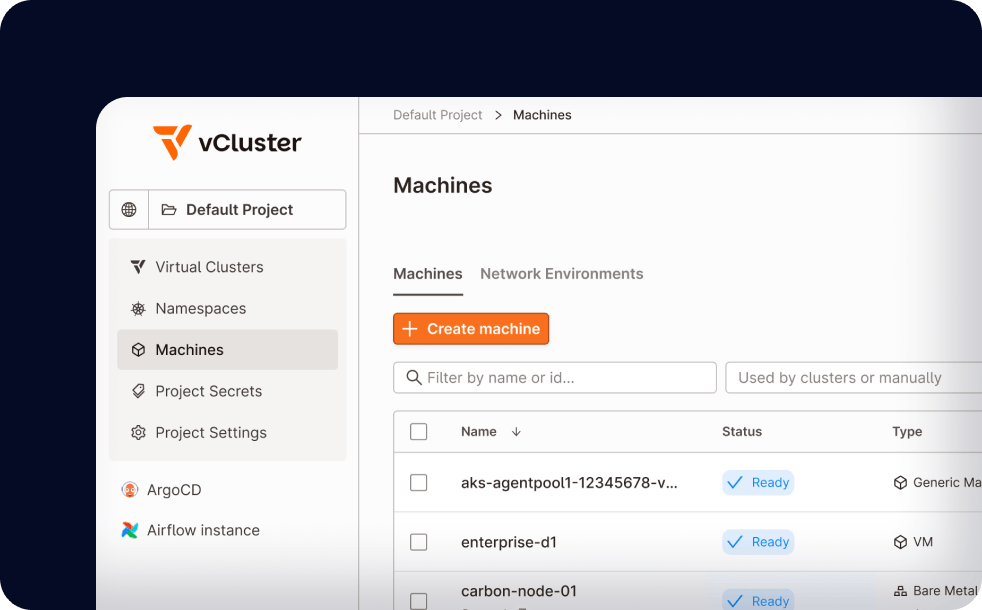
  • Standard Kubernetes APIs
  • CNCF-certified per tenant
  • Standard tooling works

Why vCluster

This isn’t a side project. Behind every vCluster deployment is 5+ years of deep K8s engineering, security hardening, and battle-tested infrastructure work at massive scale.

100K+
GPUs Powered
50+
GPU Clouds & F500s
<45
Days to Launch
30K
GitHub Stars

Get Started in 3 Steps

1
Schedule a Demo

Talk to our team about your stack

2
Deploy vCluster

Deploy vCluster on your infra in minutes

3
Onboard Your Tenants

Go live with a hyperscaler-grade tenant experience in days

FAQs

How is vCluster different from traditional k8s multi cluster management tools?

Most multi cluster tools manage a fleet of clusters you have already built. vCluster also creates them: each tenant cluster is a virtualized control plane running as a pod in a control plane cluster, with its workloads on Private Nodes. You get new isolated clusters once its control plane and workers are ready, and manage them alongside the rest of the fleet.

Does each tenant get a real Kubernetes cluster or just a namespace?

Tenants can receive cluster-admin within their own Kubernetes environment, including permission to install CRDs and supported operators. With Private Nodes, worker-level GPU tooling belongs to that tenant's dedicated nodes. Platform administrators retain infrastructure controls and define supported configurations. Private Node clusters do not sync workload resources to the control plane cluster, so integrations must support direct tenant worker operation.

How does vCluster handle multi-region and multi-cloud cluster management?

vCluster Platform can coordinate tenant environments across supported clouds and data centers. Each Kubernetes tenant has its own control plane; a central fleet interface does not mean one tenant API or one failure domain. Plan worker placement, routing, storage and data residency for each location. An optional encrypted VPN can connect control planes and workers where appropriate for the deployment.

What isolation options are available for tenant workloads?

Private Nodes are the recommended production model: each tenant gets dedicated worker nodes with its own CNI and CSI. Trusted internal teams can run dev, test and CI clusters on shared nodes with resource quotas. For an extra workload boundary, vNode uses Linux user namespaces and seccomp, without a hypervisor, and helps prevent container breakout.

Is vCluster production-proven for GPU environments at scale?

vCluster Labs software powers 100K+ GPUs and 1M+ CPUs, serving 50+ GPU clouds & Fortune 500s combined. In production, Lintasarta operates 170+ tenant clusters, while Boost Run completed its managed Kubernetes launch in under 45 days from the decision. These named deployments provide scale and launch examples for teams evaluating the platform for their own infrastructure.

Can vCluster integrate with GitOps and IaC workflows for cluster provisioning?

Use supported APIs, Terraform and GitOps workflows to manage tenant templates and infrastructure configuration. Keep credentials, provider settings and capacity policies versioned where appropriate, and validate changes before promotion. Private Nodes define the production worker boundary; GitOps does not supply hardware diagnosis or repair by itself. Your monitoring and recovery systems must connect failures to approved remediation actions.

Manage Every K8s Cluster From One Platform

See how GPU clouds run their whole tenant cluster fleet from one vCluster Platform.