platform-eng

Self Service Tenant Cluster Provisioning for AI Clouds

Let customers request approved Kubernetes environments without a ticket. vMetal supplies infrastructure, and vCluster templates provision tenant control planes with dedicated workers through Private Nodes.

Trusted by the fastest-growing AI cloud providers
Problem

Why Provisioning Breaks AI Cloud Margins

Manual tenant provisioning slows onboarding and makes policy harder to apply consistently.

Slow Provisioning Kills Revenue

Ticket-based provisioning adds avoidable handoffs between customers and infrastructure teams.

Namespace Isolation Is Too Weak

Namespace-only designs share control-plane and node-level components, which is unsuitable for untrusted tenants.

Separate Cluster Stacks Add Work

Building a separate management stack for every tenant increases operational work and fragments policy.

Solution

One Portal to Provision Any Tenant Cluster

vCluster Platform templates give customers a self-service path to approved Kubernetes environments. vMetal supplies infrastructure, Private Nodes dedicate workers, and operators define access, capacity limits and readiness requirements. vCluster Labs serves 50+ GPU clouds & Fortune 500s.
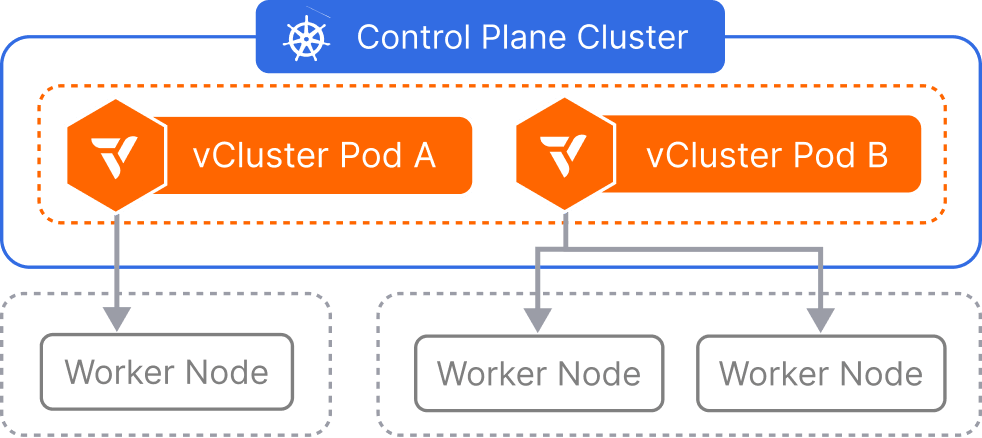
Built for Self-Service Tenant Cluster Provisioning

vCluster combines self-service cluster delivery with hard tenant isolation and centralized fleet operations.

Tenant Experience

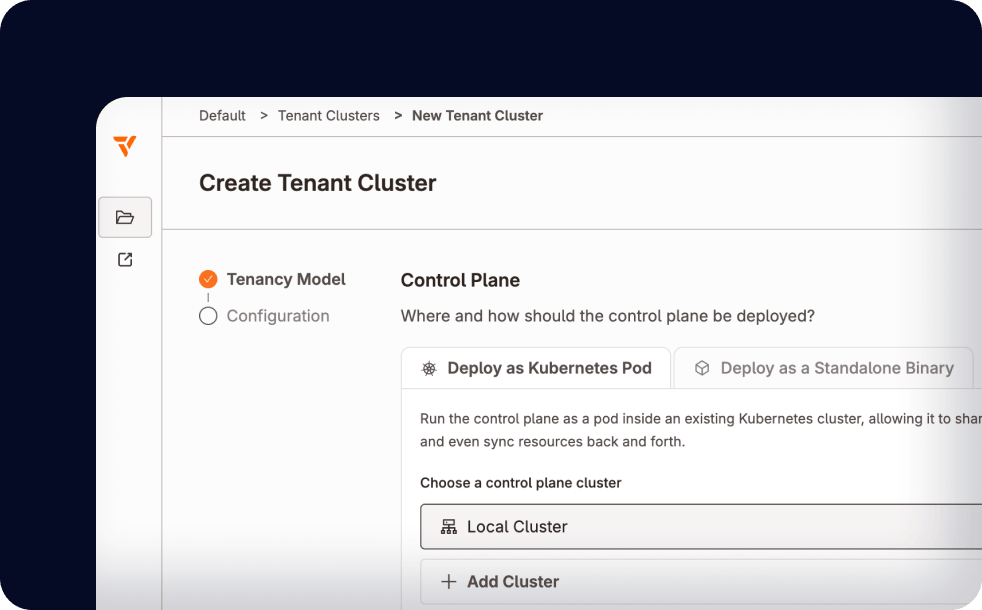
Template Based Self-Service for Every Tenant

Tenants create approved cluster products through the built-in UI and CLI, or through a custom portal backed by vCluster APIs.

  • Approved templates and access policies
  • Dedicated production tenant workers
  • Readiness depends on available capacity
Speed and Scale

Dedicated Tenant Control Planes

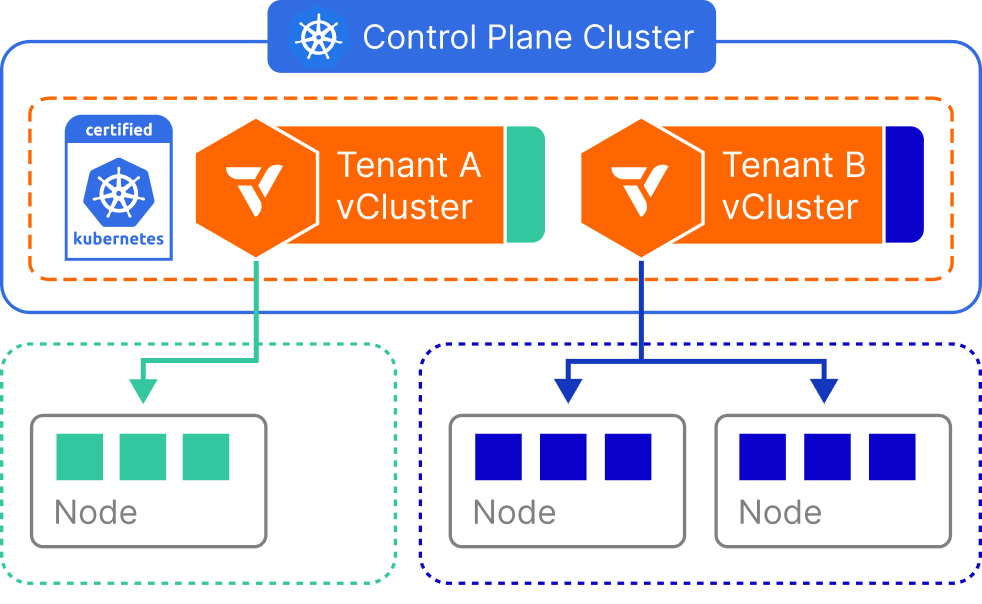
Each tenant cluster gets its own virtualized Kubernetes control plane, API server, and RBAC boundary.

  • Independent tenant API and data store
  • Tenant-scoped scheduling on Private Nodes
  • No dedicated control-plane servers per tenant
Worker Isolation

Dedicated Worker Nodes Per Tenant

Private Nodes dedicate worker capacity to one tenant cluster, with its own CNI and storage configuration. For self-service cluster requests, select physical servers or VMs according to the required infrastructure boundary.

  • Dedicated worker nodes per tenant
  • Tenant-owned CNI and storage configuration
  • Physical servers or supported VMs
Tenant Autonomy

Cluster Admin Within Tenant Boundaries

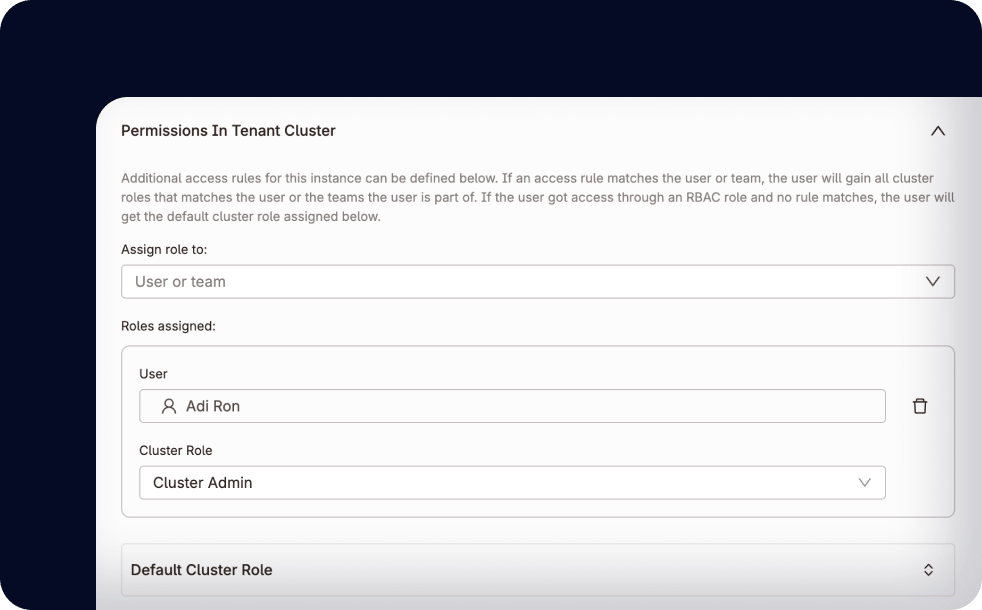
Give tenants cluster-admin within their own Kubernetes environment for self-service cluster requests. They manage CRDs, operators and RBAC there, while platform administrators retain control of tenant provisioning, infrastructure access and fleet policies.

  • Tenant-scoped cluster-admin access
  • Independent CRDs and RBAC
  • Platform infrastructure stays operator-managed
Operator Control

Central Fleet Management Across All Tenants

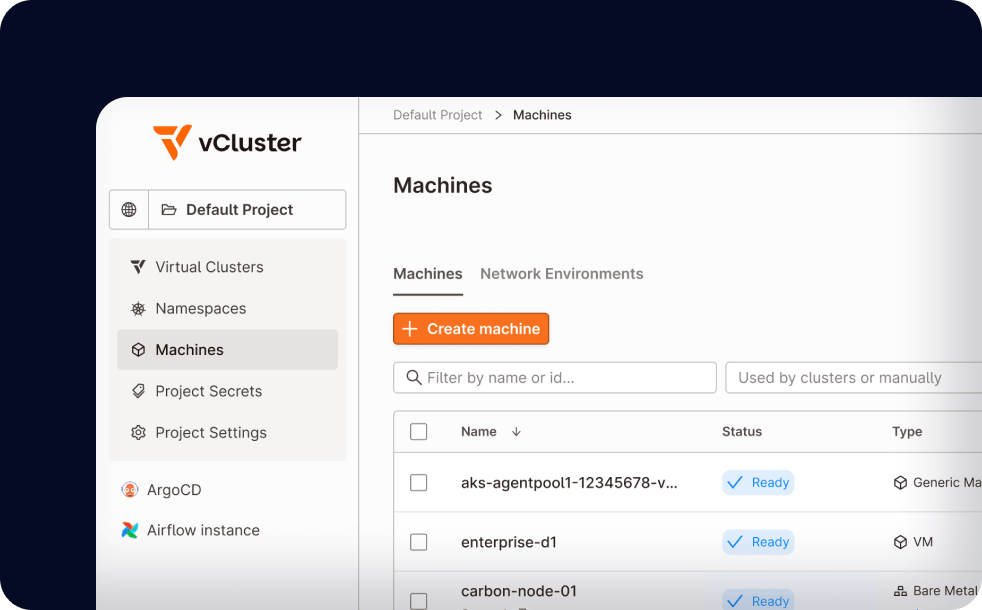
Coordinate tenant environments for self-service cluster requests through one UI, CLI and API. Templates, access policies and quotas provide central operator controls while tenant Kubernetes APIs and dedicated production workers remain separate.

  • Unified UI, CLI, and API
  • Quota and policy enforcement
  • Cluster templates for fast onboarding

Why vCluster

This isn’t a side project. Behind every vCluster deployment is 5+ years of deep K8s engineering, security hardening, and battle-tested infrastructure work at massive scale.

100K+
GPUs Powered
50+
GPU Clouds & F500s
<45
Days to Launch
30K
GitHub Stars

Get Started in 3 Steps

1
Schedule a Demo

Talk to our team about your stack

2
Deploy vCluster

Deploy vCluster on your infra in minutes

3
Onboard Your Tenants

Go live with a hyperscaler-grade tenant experience in days

FAQs

What is self-service tenant cluster provisioning and why does it matter for AI clouds?

Operators expose approved Kubernetes templates through vCluster Platform interfaces or an integrated customer portal. Templates define supported configurations, while access and capacity policies govern requests. vMetal can provision machines and Private Nodes dedicate production workers. Customers receive their own Kubernetes environment once its control plane, networking, storage and worker capacity are ready; application stacks have additional prerequisites.

How does vCluster isolate tenant clusters created through self-service?

vCluster gives each tenant an independent Kubernetes API, data store and RBAC scope. Private Nodes dedicate worker capacity to that tenant, including its own CNI and storage configuration. vMetal orchestrates the machines underneath. This separates tenant administration and worker placement; shared infrastructure, application permissions and network policies still require an explicit security design.

What cluster types can tenants provision through the self-service portal?

Offer Kubernetes tenant environments and compatible workload stacks through templates you configure and support. Private Nodes dedicate production workers, while vMetal supplies underlying infrastructure. The native Certified Stacks catalog documents NVIDIA Run:AI, with release-specific prerequisites. Ray and inference workloads can run on Kubernetes, but this does not make every separately packaged cluster product generally available; packaged managed Slurm remains planned.

How quickly can an AI cloud provider launch a self-service tenant portal with vCluster?

Boost Run went from decision to production launch in under 45 days for its managed Kubernetes service. That is a customer example rather than a promised implementation time. Your launch depends on machine inventory, driver configuration, networking, storage, templates and service integrations. vMetal and vCluster connect machine orchestration with tenant cluster delivery, reducing the infrastructure workflows you need to build yourself.

Is vCluster Platform compatible with GitOps and infrastructure-as-code workflows?

Use supported APIs, Terraform and GitOps workflows to manage tenant templates and infrastructure configuration. Keep credentials, provider settings and capacity policies versioned where appropriate, and validate changes before promotion. Private Nodes define the production worker boundary; GitOps does not supply hardware diagnosis or repair by itself. Your monitoring and recovery systems must connect failures to approved remediation actions.

How does vCluster handle multi-region or multi-cloud tenant provisioning?

vCluster Platform can coordinate tenant environments across supported clouds and data centers. Each Kubernetes tenant has its own control plane; a central fleet interface does not mean one tenant API or one failure domain. Plan worker placement, routing, storage and data residency for each location. An optional encrypted VPN can connect control planes and workers where appropriate for the deployment.

Launch Your Self-Service Tenant Portal Today

See how vCluster Platform delivers isolated tenant clusters on your GPU infrastructure.