ai-cloud
VMware Replacement for AI on Bare Metal Kubernetes
Move Kubernetes AI workloads from VMware to bare metal. vMetal provisions servers, and vCluster provides separate tenant control planes with dedicated Private Nodes.
Move Kubernetes AI workloads from VMware to bare metal. vMetal provisions servers, and vCluster provides separate tenant control planes with dedicated Private Nodes.
Legacy hypervisor stacks weren't built for GPU-dense, high-throughput AI workloads.
GPU passthrough, drivers and networking require explicit configuration. A bare metal Kubernetes design removes a hypervisor layer and changes operating responsibilities.
Namespace isolation is too weak. Separate VM clusters are too expensive. Neither scales for high-density AI infrastructure.
A delayed GPU cloud launch means lost revenue, and a complex virtualization stack adds months to the path from bare metal racks to paying tenants.
vMetal provisions bare metal for Kubernetes AI workloads and can also provision VMs. vCluster supplies separate tenant control planes with Private Nodes; vNode adds runtime hardening without becoming a VM boundary. Lintasarta runs 170+ tenant clusters in production.
A complete path from bare metal GPU racks to isolated tenant Kubernetes environments, built for AI cloud providers and enterprises.
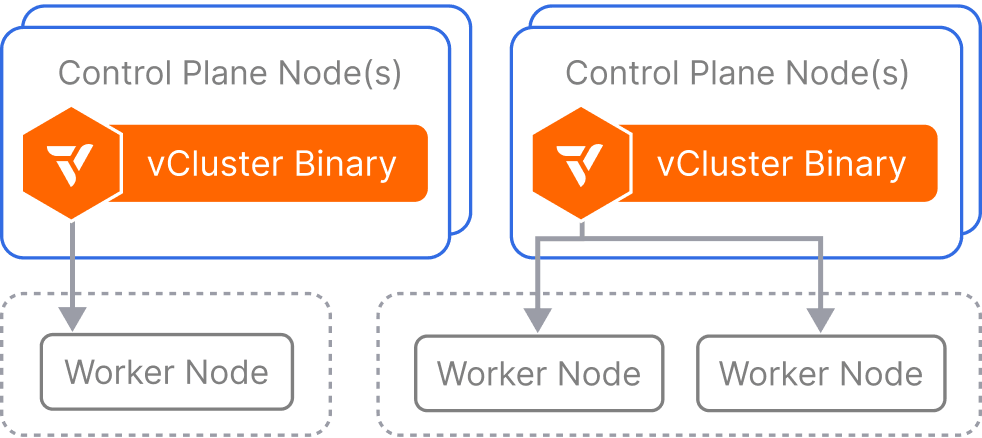
vCluster Standalone runs Kubernetes as a CNCF-certified binary on Linux, without an existing Kubernetes cluster. It supplies a Kubernetes foundation for Kubernetes AI migration; vMetal separately orchestrates machine and OS provisioning.
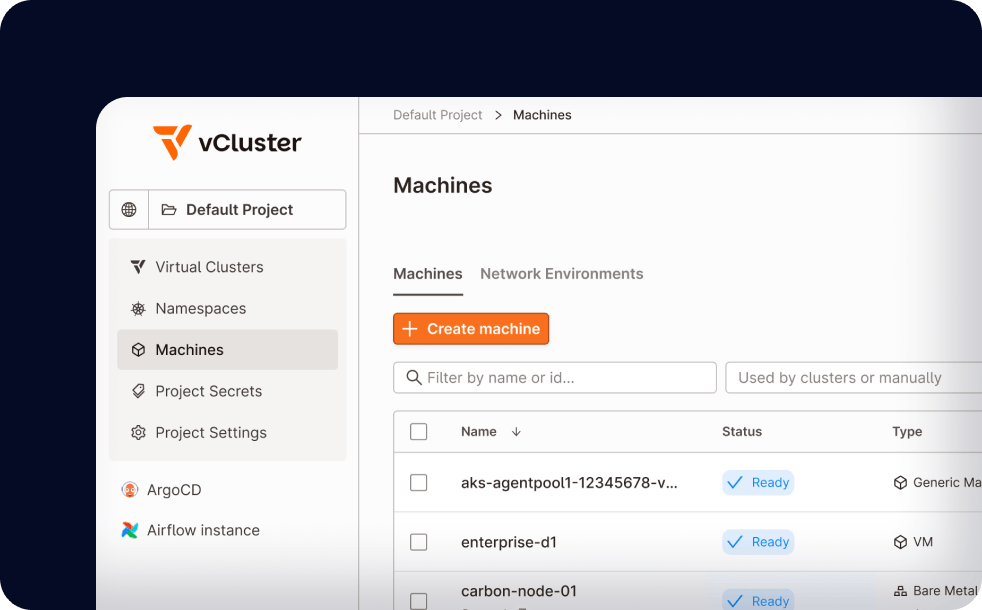
vMetal exposes one Machine API above bare metal and VM provisioning drivers. Registered inventory, images and credentials enable repeatable machine lifecycle workflows for Kubernetes AI migration. Network automation uses supported integrations such as Netris.
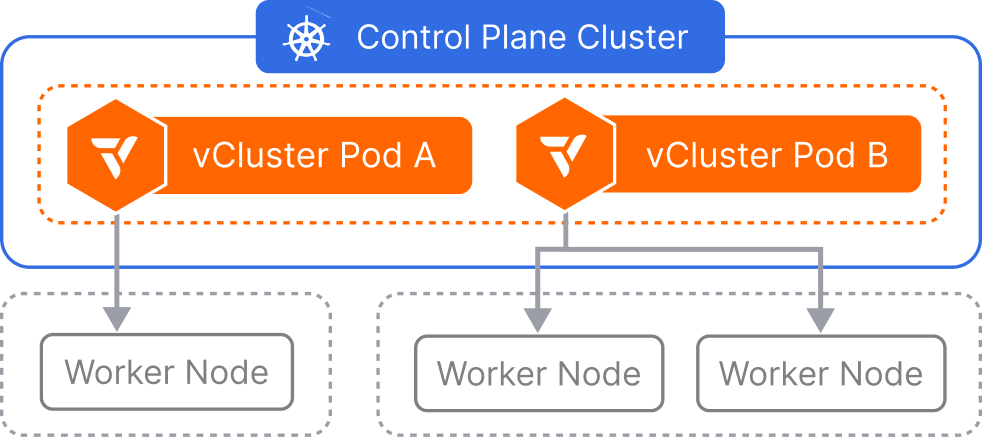
Each tenant has an independent Kubernetes API, data store and RBAC boundary. Lightweight control-plane hosting reduces dedicated server requirements for Kubernetes AI migration; Private Nodes keep production workers tenant-specific.
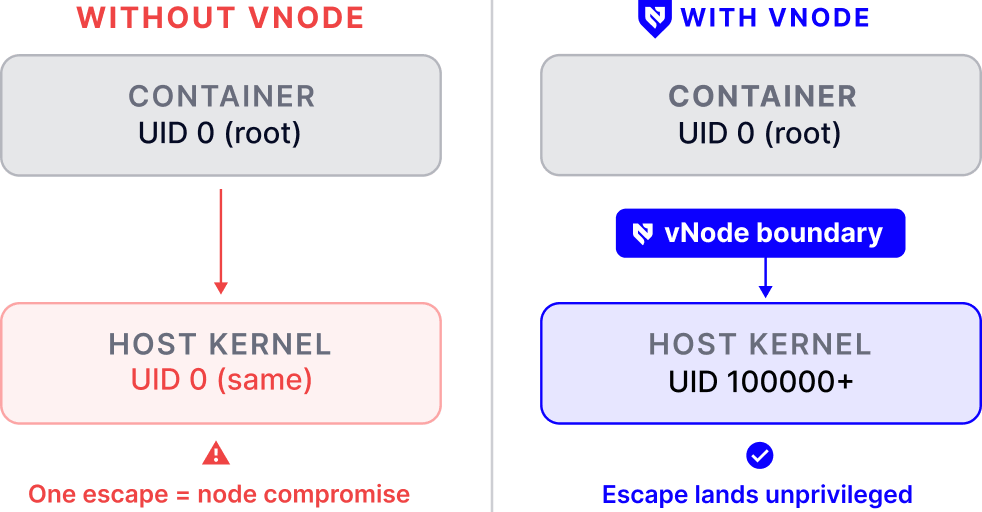
vNode uses Linux user namespaces and seccomp to restrict workload privileges and system calls. It adds runtime hardening for Kubernetes AI migration without a guest kernel or hypervisor, complementing dedicated workers rather than allocating GPUs.
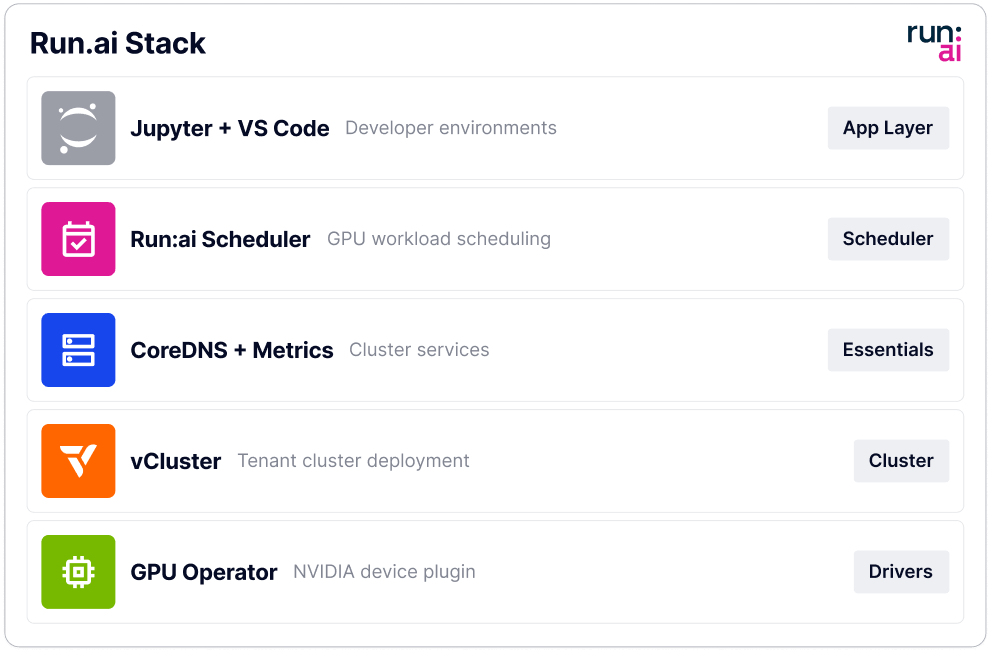
Use supported workload templates for Kubernetes AI migration, including the NVIDIA Run:AI partner integration. Configure GPU, network and storage prerequisites, and validate the selected template for Private Nodes before offering it to production customers.
This isn’t a side project. Behind every vCluster deployment is 5+ years of deep K8s engineering, security hardening, and battle-tested infrastructure work at massive scale.
Talk to our team about your stack
Deploy vCluster on your infra in minutes
Go live with a hyperscaler-grade tenant experience in days
Instead of running AI workloads inside VMs, vCluster runs CNCF-certified Kubernetes tenant clusters as lightweight processes directly on bare metal GPU servers. Each tenant gets an isolated environment with its own API server, data store and RBAC, and in production its own Private Nodes, so GPU workloads run on the hardware without a hypervisor in between. Where you still need VMs, vMetal provisions them through the same Machine API it uses for bare metal.
vCluster gives each tenant an independent Kubernetes API, data store and RBAC scope. Private Nodes dedicate worker capacity to that tenant, including its own CNI and storage configuration. vMetal orchestrates the machines underneath. This separates tenant administration and worker placement; shared infrastructure, application permissions and network policies still require an explicit security design.
No. vCluster Standalone runs as a single binary directly on bare metal Linux with no external Kubernetes dependency. There is no need for k3s, kubeadm, or any other base layer. Combined with vMetal for zero-touch bare metal provisioning, the full path from raw GPU hardware to production tenant Kubernetes clusters requires no VMware and no intermediate tooling.
Boost Run used vCluster to go from decision to a production managed Kubernetes launch in under 45 days, and Lintasarta runs 170+ tenant clusters in production. Your timeline depends on existing infrastructure and team size, but an integrated stack from bare metal provisioning through tenant clusters to workload isolation removes most of the build work.
NVIDIA Run:AI is available through the native Certified Stacks integration, with release-specific prerequisites and templates. Its bundled templates do not automatically supply dedicated Private Nodes. Configure and validate the production worker model, GPU access, networking and storage before offering it to customers. Ray and Jupyter can use compatible Kubernetes deployment tooling and require their own supported configuration.
vCluster Labs software powers 100K+ GPUs and 1M+ CPUs, serving 50+ GPU clouds & Fortune 500s combined. In production, Lintasarta operates 170+ tenant clusters, while Boost Run completed its managed Kubernetes launch in under 45 days from the decision. These named deployments provide scale and launch examples for teams evaluating the platform for their own infrastructure.
See how vCluster runs isolated tenant clusters directly on bare metal GPUs.
