ai-cloud
The VMware Replacement for GPU Clouds
Replace VMware-backed Kubernetes for GPU services where appropriate. vMetal provisions bare metal or VMs, and vCluster provides independent tenant clusters with dedicated Private Nodes.
Replace VMware-backed Kubernetes for GPU services where appropriate. vMetal provisions bare metal or VMs, and vCluster provides independent tenant clusters with dedicated Private Nodes.
VM-per-tenant designs were built for general enterprise workloads, and GPU clouds run into a few recurring issues with them.
GPU device access, drivers and networking must match the selected infrastructure. Moving to bare metal changes that design rather than guaranteeing faster workloads.
Namespace policies and full separate stacks make different tradeoffs. Define tenant API, worker and network boundaries for the GPU service you operate.
Building a managed GPU platform on top of a VM stack takes months of integration work while customers wait.
vMetal provisions bare metal and VMs behind one Machine API. vCluster runs separate Kubernetes tenant control planes with dedicated Private Nodes, providing an alternative architecture for GPU services rather than replacing every hypervisor function. vCluster Labs serves 50+ GPU clouds & Fortune 500s.
Each part of the stack maps to something you ran on VMware, from server provisioning to tenant isolation.
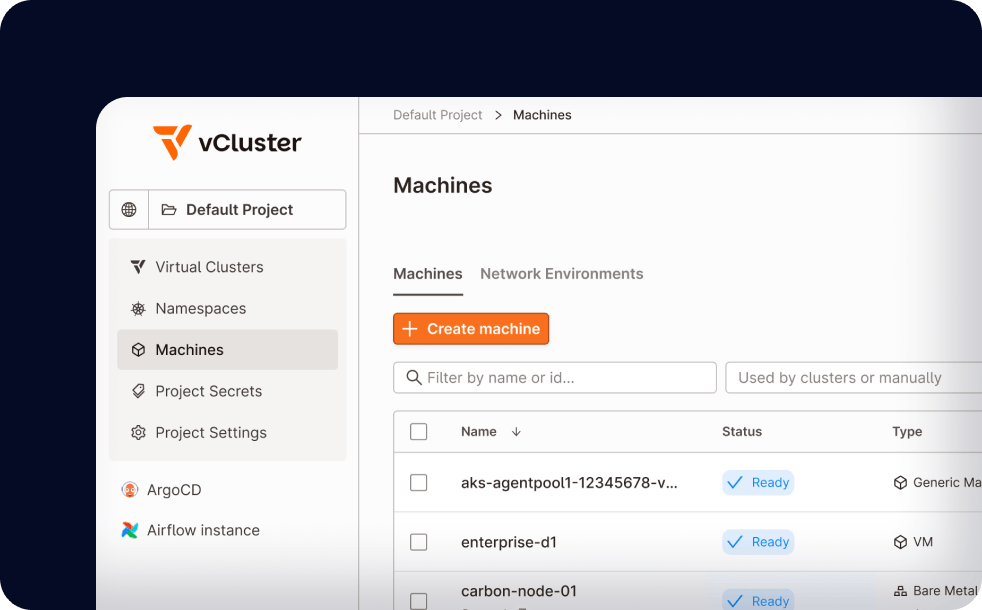
vMetal exposes one Machine API above bare metal and VM provisioning drivers. Registered inventory, images and credentials enable repeatable machine lifecycle workflows for GPU service migration. Network automation uses supported integrations such as Netris.
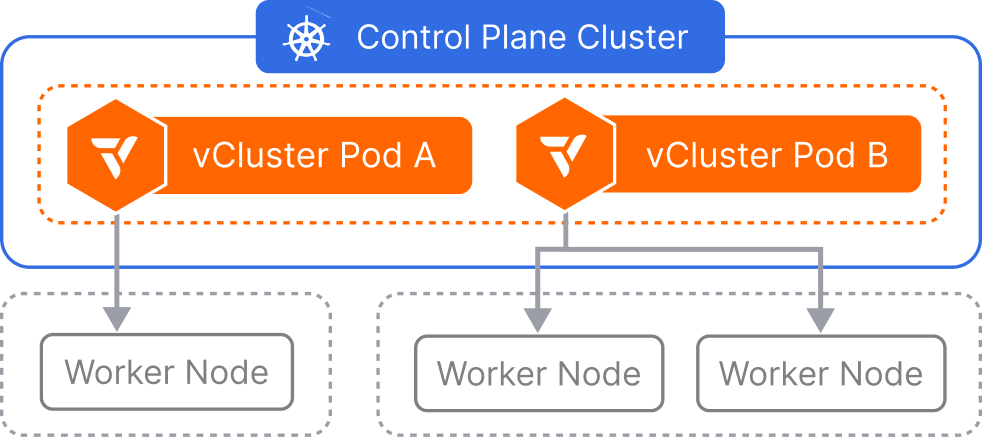
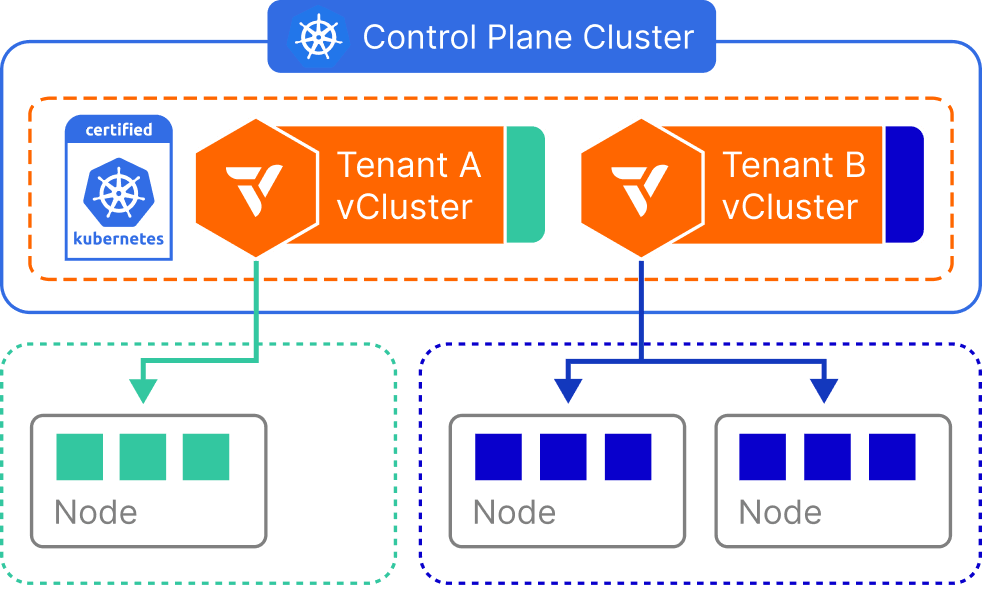
Each tenant gets its own Kubernetes control plane running as a lightweight pod, in place of a VM-per-tenant build. Its workloads run on Private Nodes, with dedicated worker nodes and per-tenant CNI and storage.
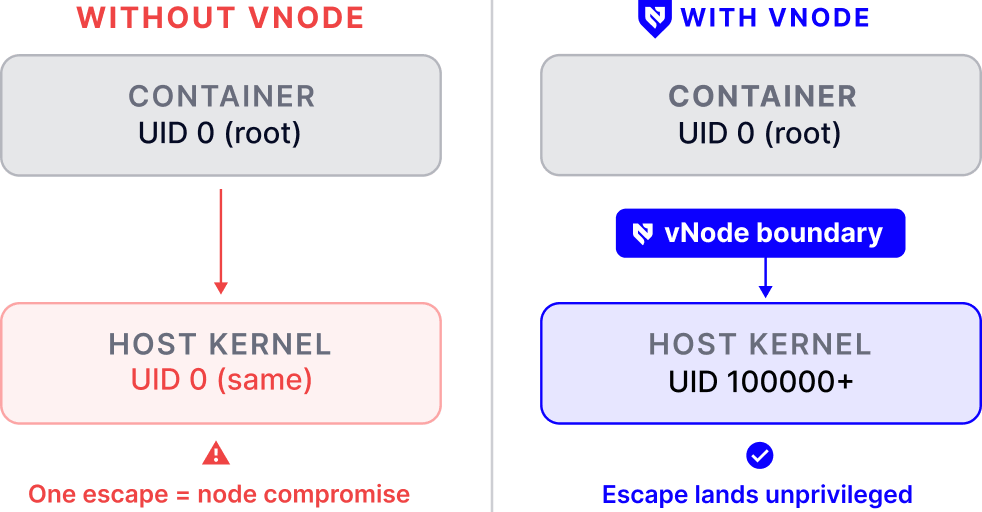
vNode uses Linux user namespaces and seccomp to restrict workload privileges and system calls. It adds runtime hardening for GPU service migration without a guest kernel or hypervisor, complementing dedicated workers rather than allocating GPUs.
Private Nodes dedicate worker capacity to one tenant cluster, with its own CNI and storage configuration. For GPU service migration, select physical servers or VMs according to the required infrastructure boundary.
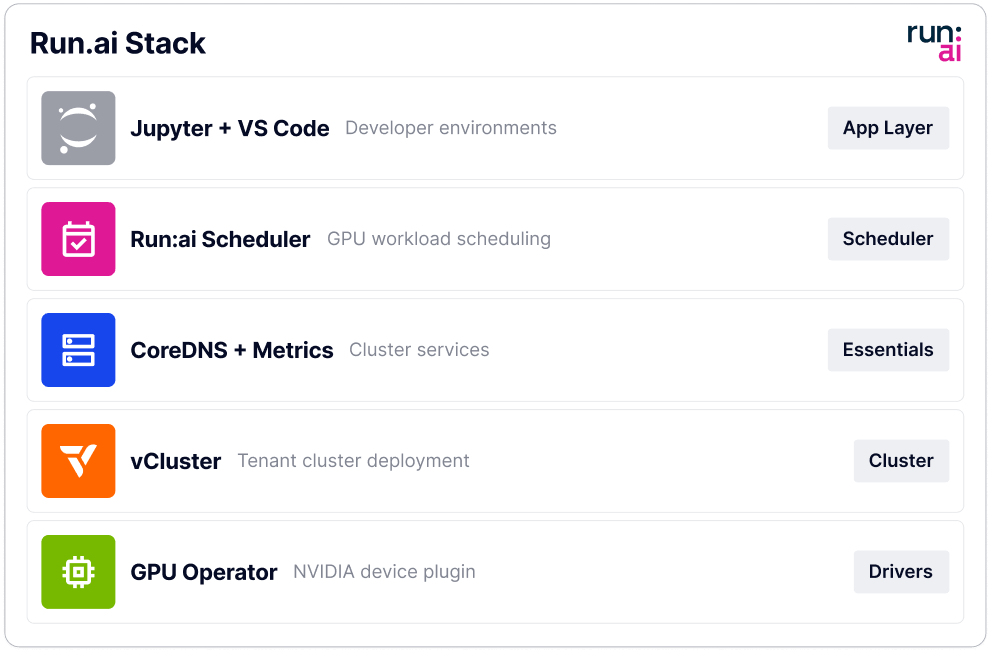
Use supported workload templates for GPU service migration, including the NVIDIA Run:AI partner integration. Configure GPU, network and storage prerequisites, and validate the selected template for Private Nodes before offering it to production customers.
This isn’t a side project. Behind every vCluster deployment is 5+ years of deep K8s engineering, security hardening, and battle-tested infrastructure work at massive scale.
Talk to our team about your stack
Deploy vCluster on your infra in minutes
Go live with a hyperscaler-grade tenant experience in days
Instead of a VM per tenant, each tenant gets a CNCF-certified Kubernetes tenant cluster. Its control plane is virtualized and runs as a pod, and its workloads run on Private Nodes. vMetal provisions the bare metal machines or VMs underneath, vCluster Platform orchestrates the tenant clusters, and vNode can add a workload boundary without a hypervisor.
It doesn't have to. Each tenant has its own API server, data store, RBAC and CRDs. Private Nodes, the recommended production model, give each tenant dedicated worker nodes with their own CNI and storage, so there is no cross-tenant contention on the hardware. vNode adds a workload boundary with Linux user namespaces and seccomp and helps prevent container breakout.
Standard Kubernetes APIs support familiar deployment tools, but migration still requires validation of storage, networking, identity, GPU drivers and runtime-dependent operators. Create a tenant cluster with the required Private Nodes configuration, test representative workloads, and plan data movement and rollback before switching traffic. Boost Run's launch timeline is not a migration estimate for your existing environment.
Yes. Customer tenants run on Private Nodes, each with dedicated worker nodes and no exposure to other tenants' workloads. Your own internal dev, test and CI clusters can run on shared nodes with resource quotas to save cost. That gives you per-tenant clusters without going back to a VM-per-tenant model.
NVIDIA Run:AI is available through the native Certified Stacks integration, with release-specific prerequisites and templates. Its bundled templates do not automatically supply dedicated Private Nodes. Configure and validate the production worker model, GPU access, networking and storage before offering it to customers. Ray and Jupyter can use compatible Kubernetes deployment tooling and require their own supported configuration.
vCluster is an alternative architecture for Kubernetes GPU workloads, rather than a general replacement for every VMware capability. vMetal can provision bare metal or VMs, and Private Nodes dedicate workers to tenant clusters. vNode adds runtime hardening without a guest kernel. Inventory existing virtualization, networking, storage and availability requirements before deciding which workloads should move and which integrations remain necessary.
See how GPU clouds move tenants from VMs to tenant clusters on Private Nodes.
