ai-cloud
Zero Touch Bare Metal Provisioning for AI Clouds
Automate bare metal provisioning after hardware registration and driver setup. vMetal manages Machine requests, and vCluster assigns provisioned tenant workers through Private Nodes.
Automate bare metal provisioning after hardware registration and driver setup. vMetal manages Machine requests, and vCluster assigns provisioned tenant workers through Private Nodes.
Manual bare metal provisioning creates inconsistent server state and slows capacity delivery.
Unprovisioned GPU servers cannot serve tenant workloads or be offered as available capacity.
Manual PXE, OS, and network steps introduce variation between servers and data centers.
Without a stable Machine model, each new infrastructure driver requires different automation and lifecycle handling.
After hardware and driver setup, vMetal automates Machine provisioning and supported cluster attachment. vCluster uses dedicated Private Nodes for customer workloads, connecting server automation to tenant environments. vCluster Labs serves 50+ GPU clouds & Fortune 500s.
vMetal automates the repeatable Machine lifecycle from request through provisioning, cluster attachment, release, and reclaim.
vMetal exposes one Machine API above bare metal and VM provisioning drivers. Registered inventory, images and credentials enable repeatable machine lifecycle workflows for automated server onboarding. Network automation uses supported integrations such as Netris.
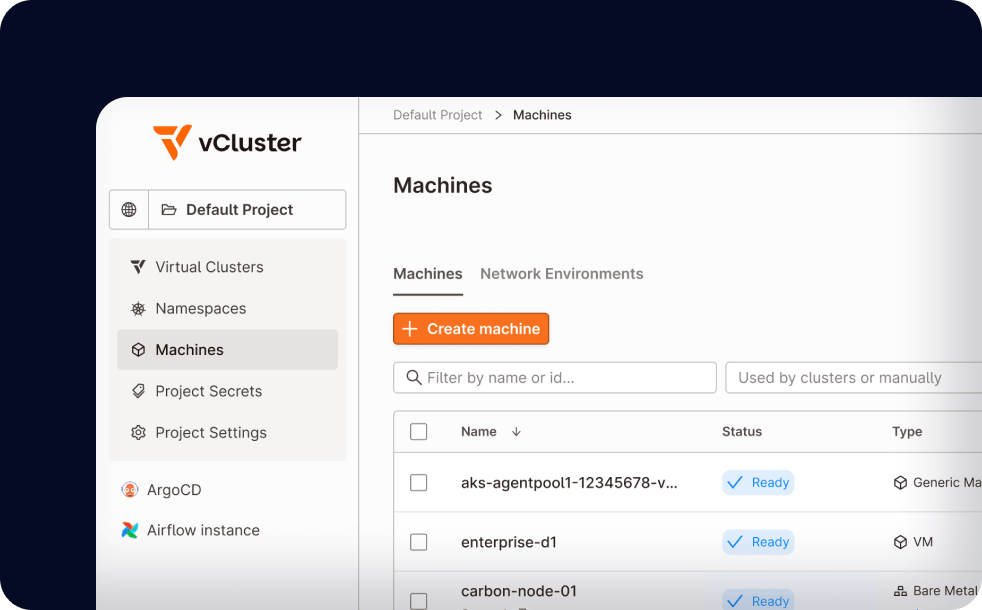
Karpenter-based Auto Nodes requests worker capacity according to configured policies. With the vMetal provider, Machine requests provision available infrastructure for automated server onboarding; inventory, driver readiness and release rules determine actual capacity.
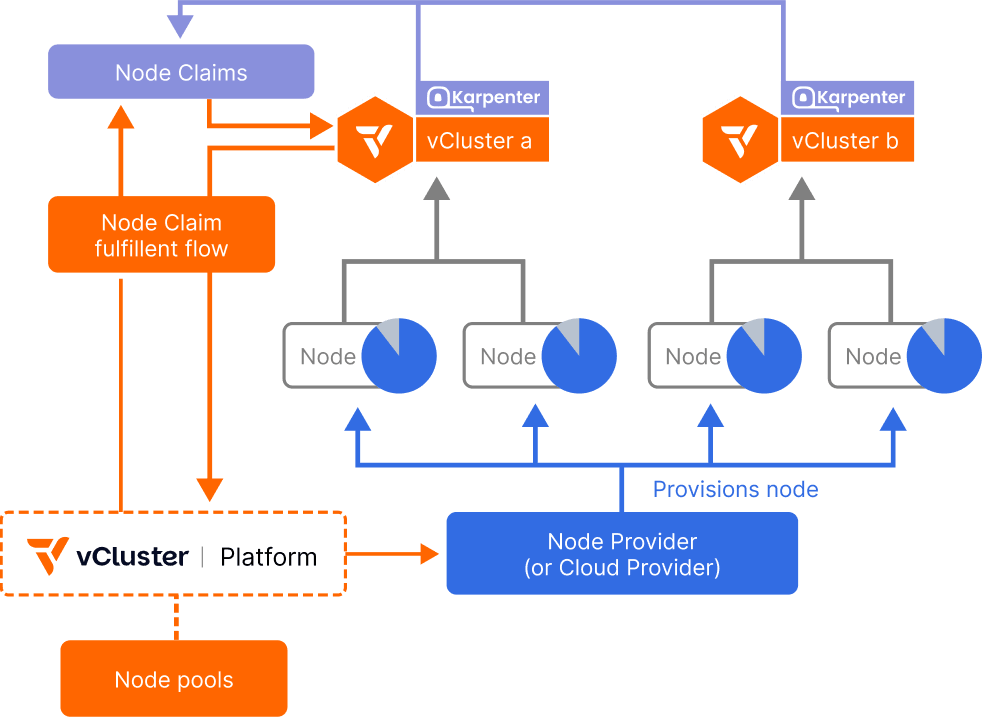
Tenant-owned CNI configuration and supported Netris integrations provide separate network controls for automated server onboarding. Ethernet segmentation can use VLANs, VRFs and ACLs; InfiniBand isolation uses fabric partitions rather than Ethernet constructs.
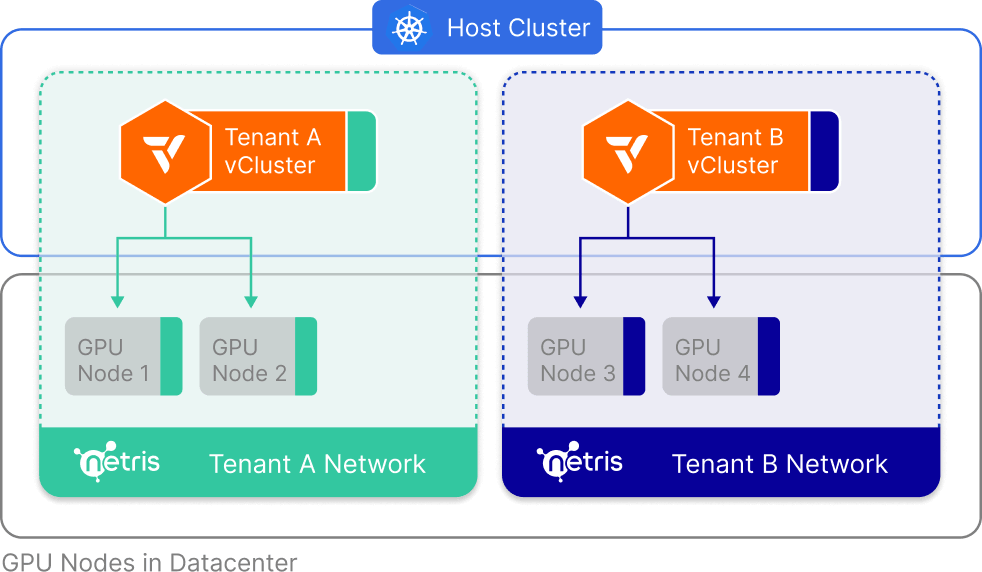
vCluster Standalone runs Kubernetes as a CNCF-certified binary on Linux, without an existing Kubernetes cluster. It supplies a Kubernetes foundation for automated server onboarding; vMetal separately orchestrates machine and OS provisioning.
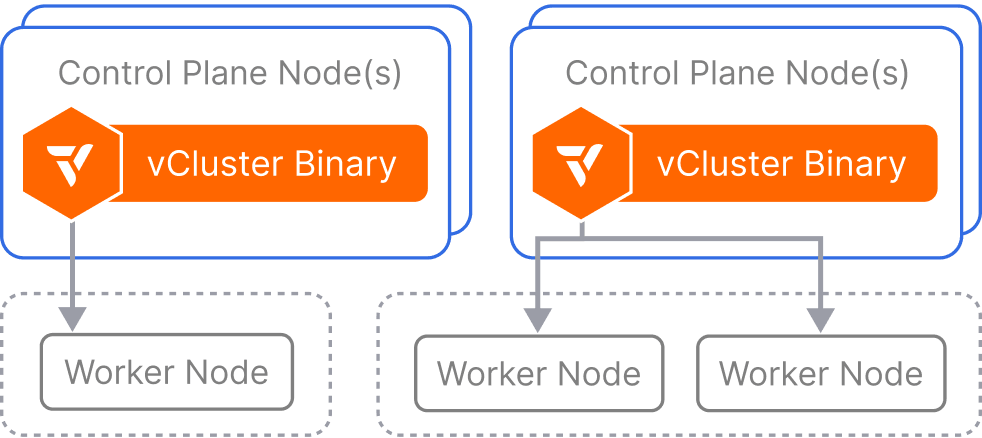
Manage tenant cluster templates, access and operations through one UI, CLI and API. Relate affected tenant environments to their worker capacity, while vMetal tracks machine lifecycle state and infrastructure monitoring supplies hardware diagnostics.
This isn’t a side project. Behind every vCluster deployment is 5+ years of deep K8s engineering, security hardening, and battle-tested infrastructure work at massive scale.
Talk to our team about your stack
Deploy vCluster on your infra in minutes
Go live with a hyperscaler-grade tenant experience in days
vMetal exposes a stable Machine API above infrastructure-specific drivers for bare metal and VMs. Drivers handle supported provisioning mechanics such as imaging, registration and cleaning. Operators configure inventory, credentials and images before automation runs. vCluster can then use provisioned machines as dedicated Private Nodes, connecting the infrastructure lifecycle to the tenant cluster that needs the capacity.
vMetal requires vCluster Platform and a connected Kubernetes cluster for its Metal3/Ironic provisioning components. If you are starting without Kubernetes, vCluster Standalone can bootstrap that foundation as a binary on Linux. Once infrastructure drivers, hardware inventory, images and credentials are configured, vMetal can automate supported provisioning workflows and supply machines for tenant Private Nodes.
Offer Kubernetes tenant environments and compatible workload stacks through templates you configure and support. Private Nodes dedicate production workers, while vMetal supplies underlying infrastructure. The native Certified Stacks catalog documents NVIDIA Run:AI, with release-specific prerequisites. Ray and inference workloads can run on Kubernetes, but this does not make every separately packaged cluster product generally available; packaged managed Slurm remains planned.
vCluster gives each tenant an independent Kubernetes API, data store and RBAC scope. Private Nodes dedicate worker capacity to that tenant, including its own CNI and storage configuration. vMetal orchestrates the machines underneath. This separates tenant administration and worker placement; shared infrastructure, application permissions and network policies still require an explicit security design.
Boost Run went from decision to production launch in under 45 days for its managed Kubernetes service. That is a customer example rather than a promised implementation time. Your launch depends on machine inventory, driver configuration, networking, storage, templates and service integrations. vMetal and vCluster connect machine orchestration with tenant cluster delivery, reducing the infrastructure workflows you need to build yourself.
Private Nodes give a tenant its own worker networking configuration. Supported Netris integrations can add Ethernet segmentation through VLANs, VRFs and ACLs on compatible infrastructure. These controls require explicit setup and do not reserve all fabric bandwidth. InfiniBand uses partition keys and fabric management rather than Ethernet segmentation; design the relevant fabric controls alongside tenant cluster access policies.
See how vMetal automates bare metal provisioning from rack to production-ready inventory.
