vCluster: The Performance Paradox – How Virtual Clusters Save Millions Without Sacrificing Speed

Jul 31, 2025
|
4
min Read
.png)
This is the vCluster performance paradox, and it’s a question that deserves a clear, no-nonsense answer. As a technology designed to solve Kubernetes multi-tenancy, bare metal CPU and GPU sharing and ephemeral environments to Kubernetes with a lighter footprint, vCluster promises significant economic advantages. In this blog post, we'll demystify how vCluster achieves these savings and, crucially, how it’s engineered to deliver robust performance even in high-density environments.
Let’s try to understand how vCluster can save Enterprises a very large amount of development and operations costs. This isn’t just a marketing number but a direct result of fundamental architectural shifts that vCluster enables.
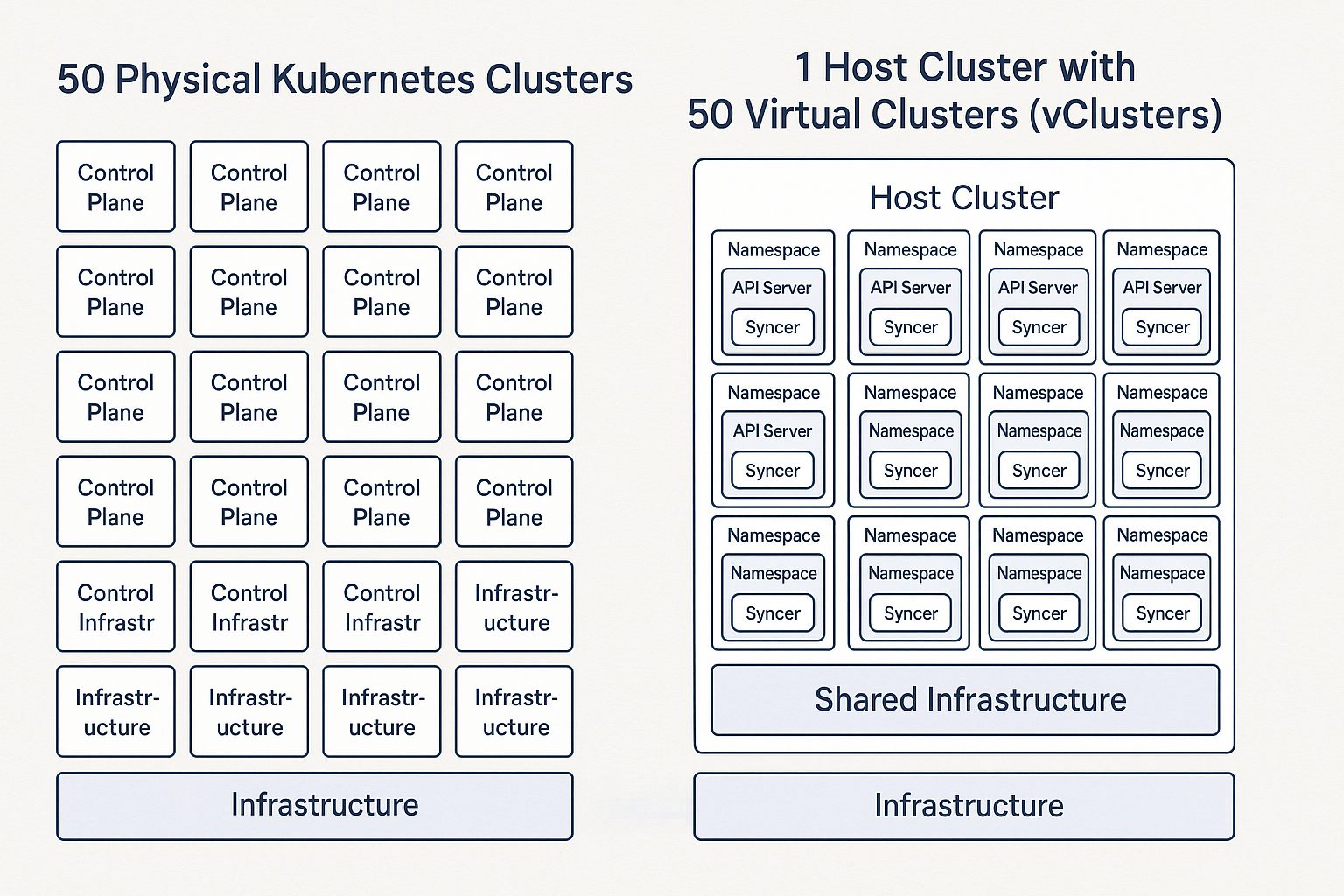
Imagine managing 50 separate Kubernetes clusters. In a traditional setup, this means you're operating 50 distinct control planes on AWS, GCP, or bare metal. Each control plane (comprising the API server, etcd, scheduler, and controllers) demands dedicated compute resources – often multiple virtual machines or even bare metal servers, replicated for high availability. This quickly escalates into substantial infrastructure costs, especially with cloud-managed Kubernetes services like Amazon EKS, Google GKE, or Azure AKS, where the control plane itself carries an hourly fee. Moreover, if you fall behind with your Kubernetes upgrades, this fee can skyrocket.
With vCluster, this paradigm flips. You manage just one powerful host Kubernetes cluster. The 50 virtual clusters you create within it run incredibly lightweight control planes which are CNCF certified. These vCluster control planes exist as simple pods, consuming minimal resources directly on the host cluster's worker nodes. This drastic reduction in dedicated control plane infrastructure is the single largest contributor to cost savings.
Traditional, isolated clusters often lead to significant resource waste. Teams or environments (dev, test, staging) tend to provision clusters to meet peak demand, inevitably leaving nodes idle or underutilized for much of the time. Even with powerful autoscaling tools like Kubernetes Cluster Autoscaler or Karpenter (which, despite its advantages, doesn't yet have seamless integration with all cloud providers), achieving genuinely optimal utilization remains a challenge. These tools help, but the fundamental isolation of separate clusters still means you're often paying for unused capacity.
vCluster tackles this head-on. By consolidating all workloads onto a single, larger host cluster, you achieve superior "bin packing" of pods. Resources on the host cluster's nodes are dynamically shared across all 50 vClusters.A killer feature here is vCluster's "sleep mode." For ephemeral or development environments, vCluster can automatically scale down all pods within an inactive virtual cluster to zero, effectively pausing resource consumption until it's accessed again. This intelligent management of idle resources dramatically reduces your cloud spend.
Traditionally when you provision a Kubernetes cluster you are required to install cert-manger, Istio, ingress controller, Kubeflow and with 50 Kubernetes clusters, you repeat the process 50 times across those 50 clusters each consuming resources. But in the vCluster scenario, you install these once on the host cluster, and share across all 50 virtual clusters providing a significant resource benefit..
For example you do not need a separate Ingress controller running in each of your 50 vClusters. Instead, a single, shared Ingress controller (e.g., NGINX Ingress, Traefik) deployed on the host cluster can serve traffic for all vClusters. The vCluster Syncer takes care of synchronizing the Ingress resources from the virtual cluster to the host, ensuring the host's Ingress controller routes traffic correctly. This drastically reduces resource consumption and simplifies network management.
Beyond infrastructure, the operational overhead of managing 50 independent Kubernetes clusters is immense. Each requires its own set of upgrades, patching, security configurations, monitoring, and troubleshooting. This consumes valuable time from highly paid DevOps and SRE teams.
vCluster streamlines operations:
By reducing management complexity and workload, thus freeing up engineering talent, vCluster allows your teams to focus on innovation rather than infrastructure maintenance.
While it is called a virtual cluster, there is no virtualization in a traditional sense, no virtual machines or hypervisors to introduce overhead for the applications you will deploy.
Now for the critical question: how does vCluster achieve these efficiencies without bogging down performance? The answer lies in its clever architecture and strategic use of Kubernetes' capabilities.
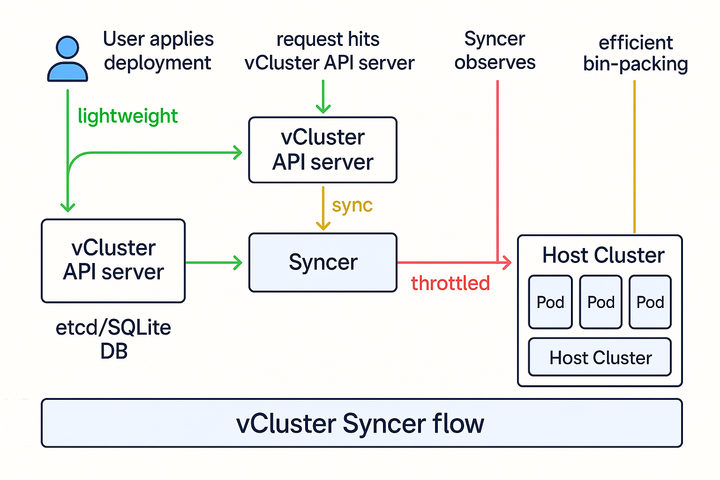
This is where understanding the magic is critical. When a user or an application within a vCluster makes an API request (e.g., kubectl get pods, kubectl create deployment), this request first goes to the vCluster's own lightweight API server. The vCluster's API server processes these high-level requests and stores them in its own internal etcd (or SQLite database).
The real innovation is Syncer. This process is responsible for reconciling the state of resources inside the vCluster with the state of resources on the host cluster.
For example:
So, while direct user interaction is with the vCluster's API, the Syncer does generate traffic to the host cluster's API server. This is the crucial point for performance considerations.
You might wonder about network impact with multiple virtual clusters. Here's how it shakes out:
vCluster comes with reasonable defaults but you can improve vCluster's benefits by:
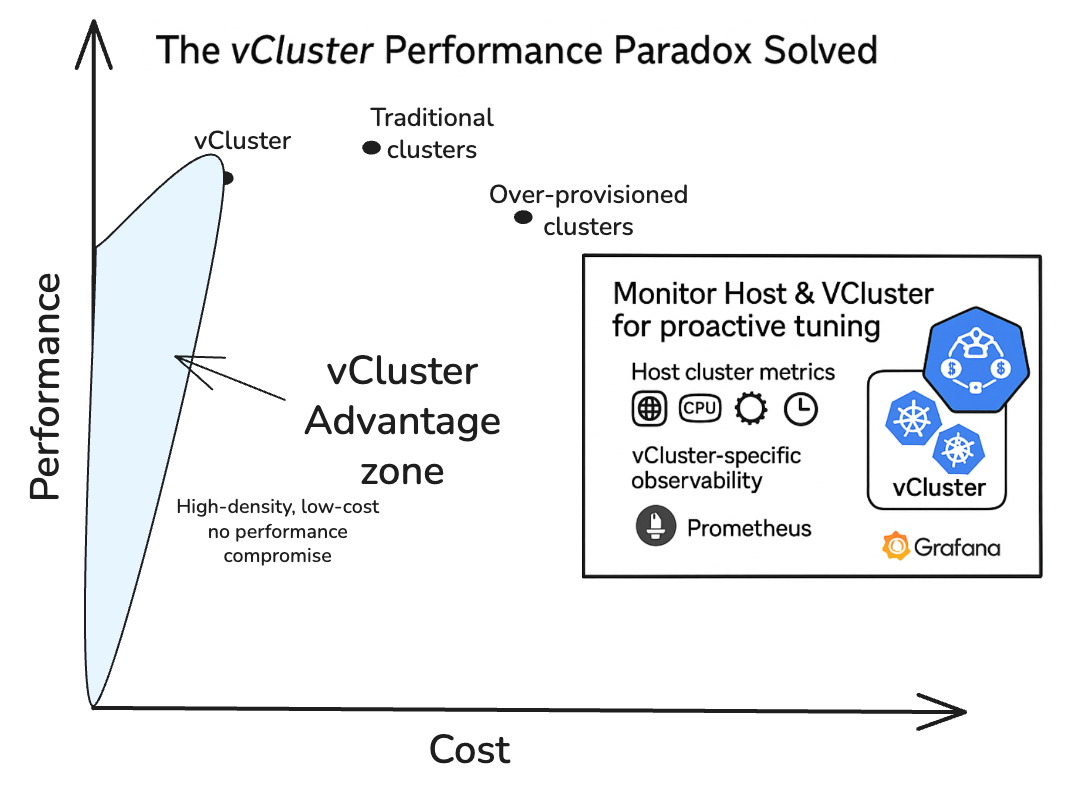
The claim of vCluster enabling huge cost savings is not an exaggeration; it's a testament to its efficiency in reducing control plane overhead, maximizing resource utilization, and streamlining operations. There is often a "performance paradox" in multi-tenant Kubernetes environments where achieving cost savings is assumed to come at the expense of performance. vCluster resolves this paradox through its intelligent architecture, particularly the role of the Syncer and the vital application of API server rate limiting.
vCluster isn't about sacrificing performance for cost. Instead, it's about optimizing how Kubernetes resources are consumed and managed, enabling multi-tenancy and ephemeral environments that are both highly cost-efficient and performant. For organizations looking to scale their Kubernetes footprint without spiraling costs, vCluster offers a compelling and practical solution.
So, the next time you hear about vCluster and its economic benefits, you can confidently explain that its performance capabilities are not an afterthought, but an integral part of its design.
Deploy your first virtual cluster today.
