Introducing vNode: Virtual Nodes for Secure Kubernetes Multi-Tenancy

Apr 1, 2025
|
3
min Read
When we first launched vCluster in 2021, our mission was clear: make Kubernetes multi-tenancy easier, safer, and more cost-efficient. Since then, we've helped organizations around the globe manage Kubernetes with greater flexibility and security. But as Kubernetes usage expanded, we noticed another critical gap—one that no existing solution fully addressed: the trade-off between strict workload isolation and resource efficiency at the node level.
Today, I'm thrilled to introduce vNode, our newest addition to the vCluster Labs suite of Kubernetes-native virtualization tools. vNode takes Kubernetes multi-tenancy to the next level by enabling stronger isolation of tenant workloads directly at the node layer, without the complexity or overhead of traditional solutions.
We've spoken with countless teams struggling with the frustrating dilemma in Kubernetes multi-tenancy: either tenants share nodes—risking security and noisy neighbors—or they are placed onto separate, expensive nodes. Solutions like Kata Containers, gVisor, or Sysbox each have their place, but they're either too heavyweight, too slow, or too limiting in many cases.
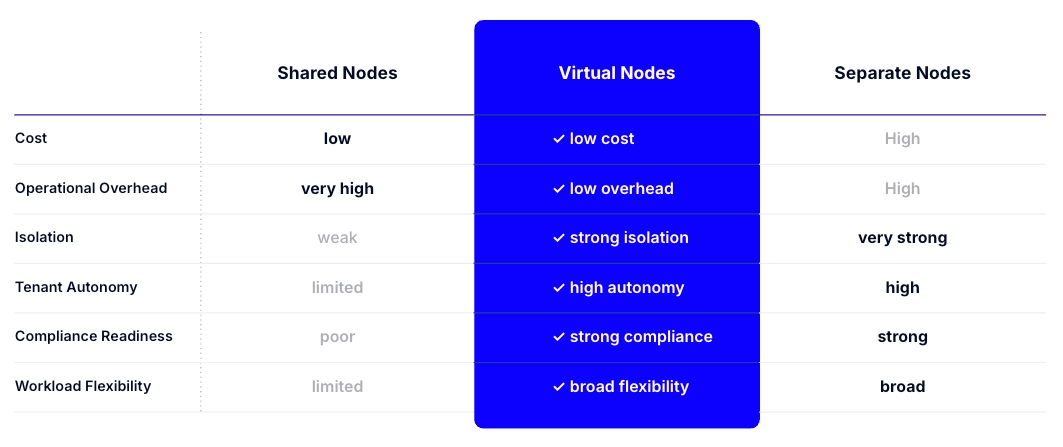
We built vNode to break this trade-off. Instead of costly separate nodes or cumbersome micro-VMs, vNode uses lightweight isolation through user namespaces, efficiently partitioning a single physical node into multiple securely isolated virtual nodes.
If you're part of a platform engineering team aiming for secure, efficient multi-tenancy, vNode is designed for you. It's especially beneficial in scenarios where strong isolation at the node level is critical, such as:
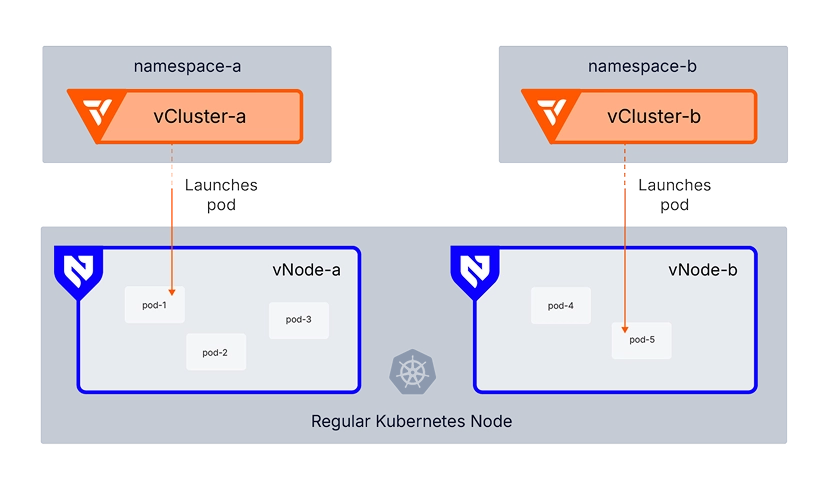
Under the hood, vNode introduces a lightweight runtime on each physical node, splitting it into isolated virtual nodes, each mapped to non-privileged users via Linux user namespaces. This allows tenants to securely run privileged workloads—such as Docker-in-Docker or even Kubernetes control planes—without risking interference or cross-tenant security issues.
Compared to other workload isolation solutions vNode has the following advantages:
By combining vNode with vCluster, teams can now achieve comprehensive Kubernetes multi-tenancy. While vCluster provides isolation at the Kubernetes control plane, vNode complements this by ensuring tenant workloads are securely isolated at the node level—optimizing resource utilization and security simultaneously.
With vNode, we’re delivering the missing piece in Kubernetes multi-tenancy, bridging the gap between security, efficiency, and performance. It’s our next step in helping organizations run cloud-native infrastructure at scale, without compromise.
We're excited to see how you'll use vNode to reshape your Kubernetes environments. Interested in exploring vNode further? We’re opening up early access—sign up for the private beta at vNode.com.
Happy virtualizing,
Lukas Gentele
Co-founder and CEO, vCluster Labs
Deploy your first virtual cluster today.
