Private Customer Clouds

Turn bare metal offtake into private customer clouds.

Define a tenant, allocate their machines, networks, and images, and hand over the keys. You manage every customer’s capacity from one inventory, and every rack you add has a shorter path to revenue.

Trusted by the fastest-growing AI clouds
The problem

Delivering the metal is manual. Everything above it starts from scratch.

It works for your first 5 customers and breaks at your 10th.

Everything above the metal is a ticket

The offtake is signed. Then your engineers spend the length of the contract provisioning machines, rebuilding networks, and answering requests the customer could have handled themselves.

Hardware waits on people, not demand

The GPUs are sold before they land. Configuring them, wiring the network, and getting a customer onto them can take weeks.

The hardware advantage is temporary

Supply is tight today, so capacity sells itself. When it loosens, what you hand your customer is the only thing that separates you.

Stop building a cloud for every customer. Start handing them one.

The operators who win are not the ones with better hardware. They are the ones where onboarding a customer costs an afternoon instead of a week.

“Customers who commit to dedicated capacity want to run it themselves. Their platform teams want to divide capacity among internal groups and give developers a fast path to compute. vCluster gives our customers a self-service environment of their own on dedicated hardware.”

Seth Demsey
Seth Demsey
Co-Founder and Co-CEO, Corvex
Start where you are

Sell the metal. Sell what runs on it. Or both.

Bare metal stands on its own, and plenty of providers stop there. When you want to move up, it is the same platform and the same hardware underneath.

Bare metal

Turn racked GPUs into bookable inventory.

Bare Metal Machines

Virtual Machines

  • One inventory, whether NICo, Metal3 or KubeVirt provisions it
  • Machines assigned and reclaimed without a rebuild
  • An API that does not change when you add a hardware generation
Managed services

Sell environments and endpoints, not hardware.

Kubernetes Clusters

Slurm Clusters

Inference Clusters

  • Each customer gets an isolated cluster with its own API
  • Certified Stacks make standing one up a deployment, not an integration
  • Add a new cluster type without re-architecting what you run
How it fits together

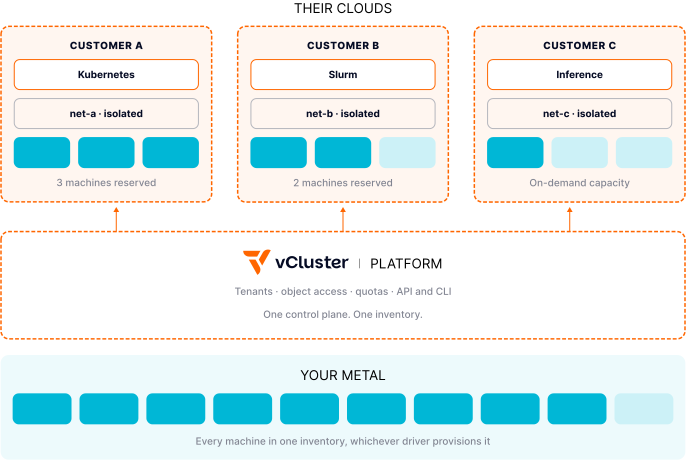
Your metal. Their cloud.

Every customer gets their own machines, network and clusters. You run all of them from one inventory and one control plane.

Two views

You see everything. They see only theirs.

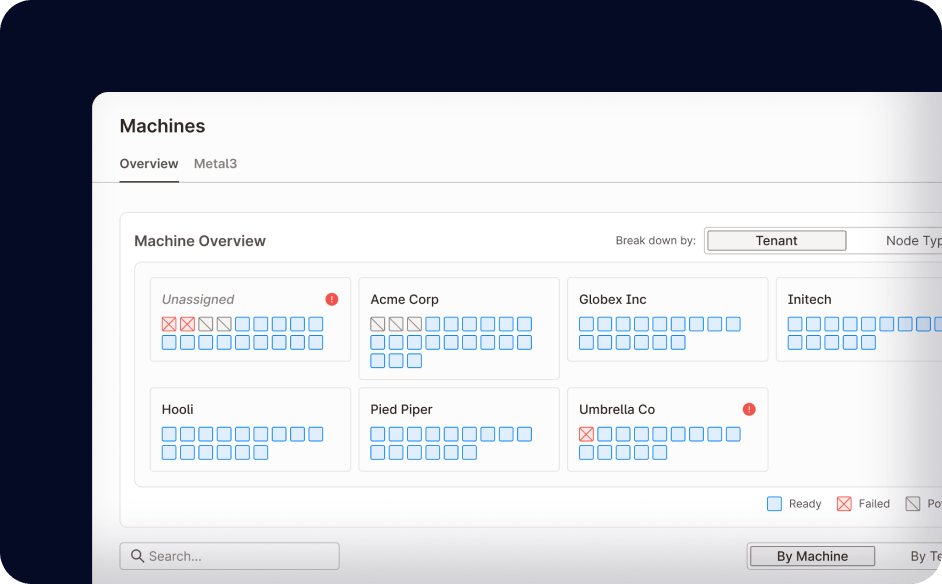
Sign in as the platform admin and every rack, machine, network and image in your datacenter sits in one list. Assign what you choose to a tenant, and that is all they will ever see.

Your view · Platform admin

The whole datacenter

One place to see what you own and decide who gets it.
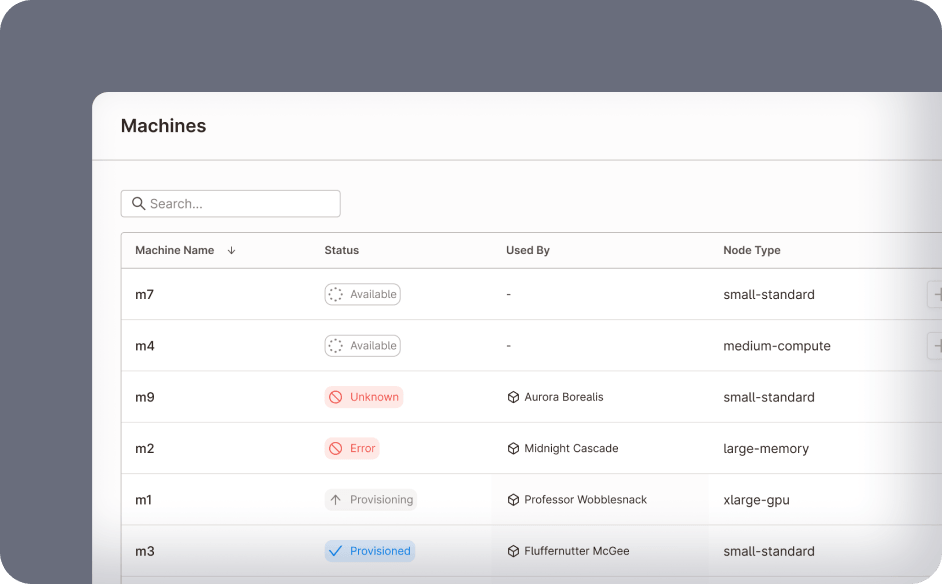
  • Every machine in every rack. All in one inventory, with power state, network and who holds each one.
  • Every tenant you run. Who holds which machines, networks and images, and how close they are to their quota.
  • Assign and unassign. Move capacity between customers as contracts start and end. No migration, no re-plumbing.
  • Any tenant’s view. Switch into a tenant and see their console exactly as they see it.
Their view · Tenant admin

A cloud with their name on it

Self-service on the machines you assigned, and nothing beyond them.
  • Their machines. Only the hardware you assigned them. Nothing else is visible, and nothing else is reachable.
  • Their network. One isolated network around everything they own, however many clusters they run in it.
  • Their clusters. Kubernetes, Slurm, inference, built by them on their own machines.
  • Their console. Their logo, their hostname, their users. They see their cloud, not your vendor.
The alternatives

Three ways operators do this today.

Each one costs you either your headcount, a year, or your margin.

Ticket-driven operations

Every provision, image and key routes through your team. There is no version of it that runs without a human.

What it costs you

A customer ceiling set by headcount

Build your own portal

A year of engineering on the one thing you are not selling. Then you maintain it forever.

What it costs you

A year, then a permanent team

A cluster per customer

Fast to start. Then it is twenty control planes, no shared inventory, and no way to move capacity without a migration.

What it costs you

Stranded capacity and your margin

Private customer clouds

One control plane, one hardware inventory, and a tenant boundary the API enforces on every request.

What it costs you

An afternoon per customer

  • Onboard a customer in an afternoon, not a week
  • Move capacity between tenants without a migration
  • Our console on day one, your own portal on the same API
  • Self-service for your customers, inside limits you set
  • Reserved and On-Demand from the same pool
  • Dedicated hardware, network and clusters per customer
What’s inside

You set it up once. They do the rest.

Three you define. Three you hand over. Three they run without a ticket.

  • You define
    Create the tenant and set what they are allowed to touch.
    Tenants

    One object defines a customer, and everything below it inherits the boundary.

    Object access and quotas

    Grant by name, by label or all. Cap what any tenant can hold.

    Tenant branding

    Their logo, their hostname, their SSO. They never see your brand.

  • You hand over
    Assign the capacity, networks and images they bought.
    Machines

    One inventory across every driver. Assign as Reserved, or leave it On-Demand.

    OS images

    Publish a golden image once. Tenants register their own, scoped to them.

    Network environments

    Anything they provision lands in a network you gave them.

  • They self-serve
    Everything your customer can do without opening a ticket.
    Machine access

    They add their own SSH keys, provision a machine, and get on the box.

    Clusters

    Kubernetes, Slurm or inference, built on the machines they hold.

    Templates and Certified Stacks

    A catalog instead of an endpoint. Stacks you certified, picked by them.

Prebuilt, not boxed in

Every tenant, machine, image and network on this page is an API object. Drive it from the console, the CLI, your own automation, or GitOps. Build your own branded portal on the same API ours is built on, and keep every layer underneath it.

What This Means for Your Business

You’re not buying a portal. You’re buying a repeatable way to turn capacity into paying tenants.

Move up from one-time metal to recurring revenue

Offtake pays once per box. A private cloud pays every month, on hardware you already placed.

Serve 10 times the customers with the same team

Every provision, image and key your customer handles themselves is a ticket that never opens.

Take shorter contracts without losing margin

Moving capacity between customers is a reassignment, not a rebuild, so shorter terms and smaller customers pay off.

Compete on experience, not hardware

Your customers compare what you hand them, not what you racked. That gap widens every quarter.

Prebuilt, not boxed in

Our console on day one. Your own portal on the same API whenever you want it.

Isolation you can put in a contract

Dedicated machines, networks and clusters per customer, enforced at provision time.

Before and after

Four things that stop being hard.

The requests every AI cloud operator still handles manually.

How it goes today
1

Sales closes. An onboarding ticket opens.

2

Someone decides which machines the customer gets and writes it in a spreadsheet.

3

Networking carves out a VLAN and configures the fabric by hand.

4

An engineer images the machines with whatever OS was agreed on a call.

5

Someone creates accounts, then emails credentials around.

6

A cluster gets stood up for them, by you, on their behalf.

7

Every change after this comes back as another ticket.

Four teams, one spreadsheet, and no record of who owns what except in someone’s head.

With vCluster
1

Create the tenant. Add their logo and hostname.

2

Assign their machines as Reserved capacity, and assign a network environment.

3

Entitle them to the golden images and templates they bought.

4

Send one link. They sign in with their own SSO.

5

They provision, SSH in, and build their clusters themselves.

One team, one control plane, and the boundary recorded in the platform instead of a spreadsheet.

How it goes today
1

Customer emails asking for two more nodes.

2

You check the spreadsheet to see what is actually free.

3

Networking attaches the machines to the right VLAN.

4

An engineer images them and installs the customer’s SSH key.

5

You reply to the email. The customer asks for a third.

A request your customer could have answered themselves, priced at an engineer’s afternoon.

With vCluster
1

The machines are already assigned to their tenant, sitting unprovisioned.

2

They pick a machine, an image and their network, and hit provision.

3

They SSH in with the key they added themselves.

No ticket, no email, and no way for them to reach a machine you did not assign them.

How it goes today
1

One customer’s contract ends. Their nodes are still theirs on paper.

2

Their cluster has to be torn down manually, because it is a control plane you run.

3

Networking unpicks the VLAN and rebuilds it for the new customer.

4

The machines get re-imaged from scratch.

5

The spreadsheet gets updated, if anyone remembers.

Capacity you already paid for, sitting idle for a week between two paying customers.

With vCluster
1

Unassign the machines from the outgoing tenant.

2

Assign them to the incoming one, with their network environment.

3

The new tenant images and provisions them on their own schedule.

One inventory means capacity moves between customers instead of stranding in one.

How it goes today
1

A regulated customer needs their own hardened OS.

2

They send you an image. You find somewhere to host it.

3

You image their machines with it by hand, every time.

4

Nobody is sure whether other tenants can see it.

5

The next customer asks for the same thing, differently.

A one-off process per customer, and an open question about who can see what.

With vCluster
1

You connect your OCI registry once, and publish your golden images.

2

You entitle the tenant to register their own images.

3

They register their hardened image against their tenant.

4

It is visible to them and to nobody else, and they provision with it.

One process for every customer, and a scope you can point at in an audit.

Give every customer their own private cloud.

See how AI cloud operators onboard a tenant in an afternoon instead of a week.