Dedicated Kubernetes Cluster Per Customer for AI Clouds
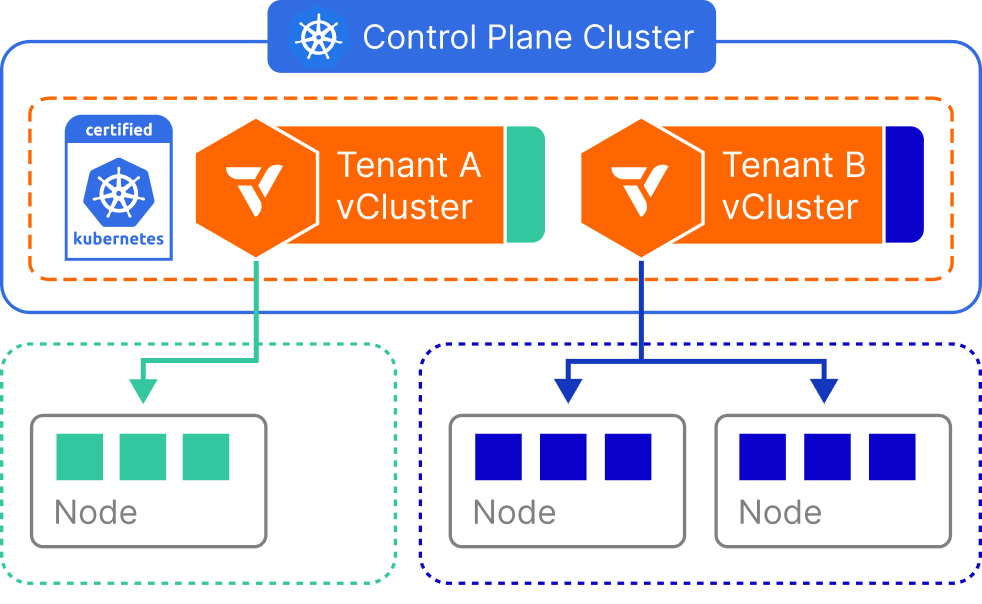
Give each customer a dedicated Kubernetes environment. vMetal provisions infrastructure, and vCluster separates tenant control planes while workloads run on dedicated Private Nodes.
Customer-facing Kubernetes needs both an independent control-plane boundary and dedicated production worker capacity.
Namespace-only designs share control-plane and node-level components between customers.
A separate physical management stack for every customer increases infrastructure and operational work.
When customers share worker nodes, their workloads compete for compute, network and storage resources.
vCluster gives each customer an independent Kubernetes control plane and cluster-admin access within that environment. vMetal manages machines, and Private Nodes dedicate the customer's worker capacity. vCluster Labs software powers 100K+ GPUs.
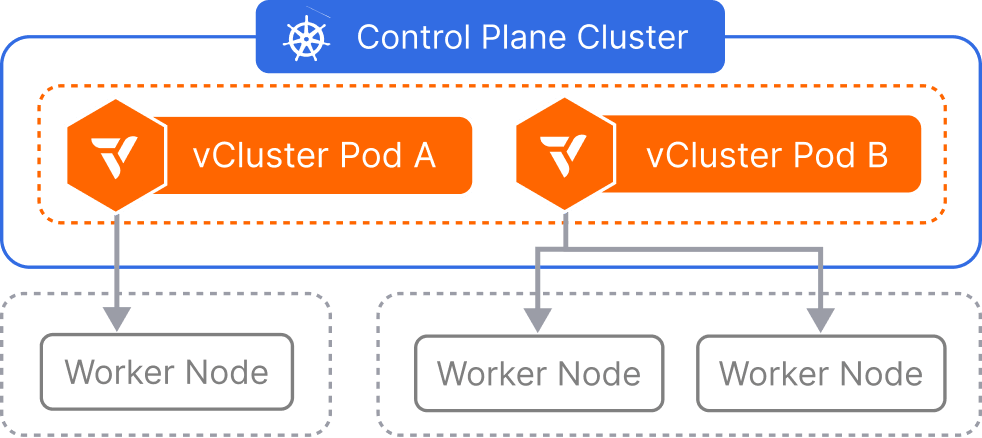
Each customer gets an independent Kubernetes API, dedicated worker capacity and tenant-scoped administration, managed through a central platform.
Private Nodes dedicate worker capacity to one tenant cluster, with its own CNI and storage configuration. For customer-owned Kubernetes environments, select physical servers or VMs according to the required infrastructure boundary.

Every customer receives a separate virtualized API server and RBAC boundary on the control plane cluster.

Tenant clusters use a certified Kubernetes distribution and standard APIs for existing tools, CRDs, and operators.
Customers receive cluster-admin inside their own environment while the provider retains platform-level control.
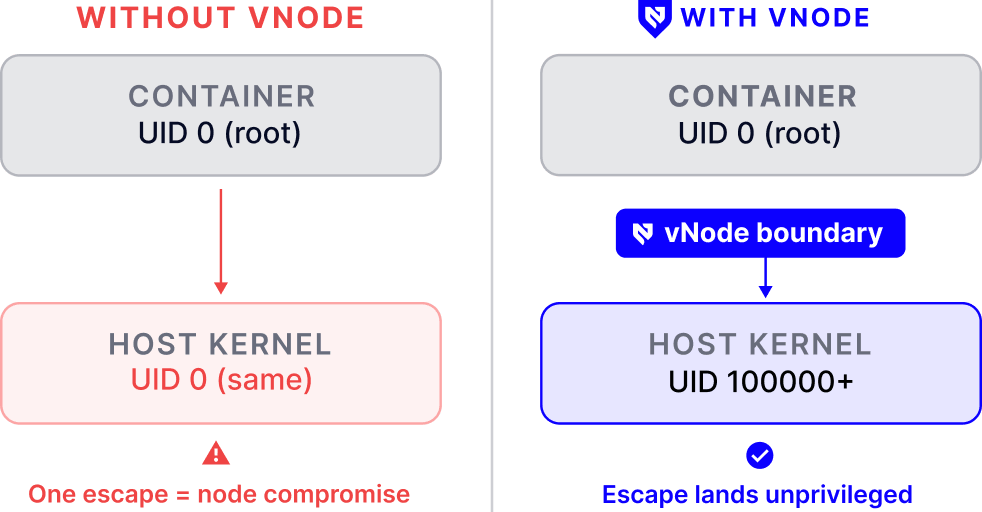
vNode uses Linux user namespaces and seccomp to restrict workload privileges and system calls. It adds runtime hardening for customer-owned Kubernetes environments without a guest kernel or hypervisor, complementing dedicated workers rather than allocating GPUs.

This isn’t a side project. Behind every vCluster deployment is 5+ years of deep K8s engineering, security hardening, and battle-tested infrastructure work at massive scale.
Talk to our team about your stack
Deploy vCluster on your infra in minutes
Go live with a hyperscaler-grade tenant experience in days
vCluster gives each tenant an independent Kubernetes API, data store and RBAC scope. Private Nodes dedicate worker capacity to that tenant, including its own CNI and storage configuration. vMetal orchestrates the machines underneath. This separates tenant administration and worker placement; shared infrastructure, application permissions and network policies still require an explicit security design.
Private Nodes are worker nodes joined to one tenant cluster, with that tenant's own CNI and storage configuration. They can be physical machines or supported VMs. Use dedicated bare metal when the service requires exclusive physical servers. vMetal can provision the underlying machines, while platform policies define which capacity a tenant may request and how it is released.
Namespaces divide resources within a Kubernetes cluster, but share its API and cluster-wide administrative scope. RBAC, quotas and network policies remain useful controls. vCluster adds a separate tenant API and data store, with Private Nodes dedicating production workers. This reduces dependencies between tenant environments while platform administrators still manage the underlying infrastructure and its failure domains.
A tenant control plane and its worker capacity have different readiness requirements. Existing provisioned workers can shorten onboarding, while new machines require the selected infrastructure driver's provisioning workflow. Templates, networking, storage and GPU drivers must also be ready before workloads can run. Configure Private Nodes when creating the tenant cluster, and validate application readiness separately from Kubernetes API availability.
Tenants can receive cluster-admin within their own Kubernetes environment, including permission to install CRDs and supported operators. With Private Nodes, worker-level GPU tooling belongs to that tenant's dedicated nodes. Platform administrators retain infrastructure controls and define supported configurations. Private Node clusters do not sync workload resources to the control plane cluster, so integrations must support direct tenant worker operation.
vCluster Platform coordinates tenant environments through a central UI, CLI and API. Operators use templates, access policies and quotas while each Kubernetes tenant retains its own API and dedicated production workers. vMetal manages supported machine provisioning below the fleet. Operational consistency still depends on template configuration, version management and the monitoring and recovery workflows you connect to the platform.
See how vCluster delivers a dedicated Kubernetes cluster for each customer with Private Nodes as the recommended production model.