platform-eng
Dedicated Kubernetes Environments for AI Clouds
Give customers Kubernetes environments they control. vMetal supplies machines, and vCluster separates tenant control planes while Private Nodes dedicate each customer's worker capacity.
Give customers Kubernetes environments they control. vMetal supplies machines, and vCluster separates tenant control planes while Private Nodes dedicate each customer's worker capacity.
Standard Kubernetes forces a tradeoff between tenant isolation and operational efficiency.
Tenants can see platform internals they should not: cluster-wide agents, other tenants' nodes and running pods.
Provisioning physical clusters per tenant multiplies hardware cost and adds hours of spin-up time per environment.
Building dedicated Kubernetes environments in-house requires significant engineering investment, slowing time-to-market and diverting resources from core product development.
vCluster runs independent tenant control planes without dedicated control-plane servers per customer. vMetal supplies infrastructure, and Private Nodes dedicate worker capacity with each tenant's own networking and storage configuration. vCluster Labs software powers 100K+ GPUs.
Combine separate tenant APIs with dedicated workers, tenant-owned networking and storage configuration, and central fleet operations.
Each tenant has an independent Kubernetes API, data store and RBAC boundary. Lightweight control-plane hosting reduces dedicated server requirements for dedicated Kubernetes environments; Private Nodes keep production workers tenant-specific.
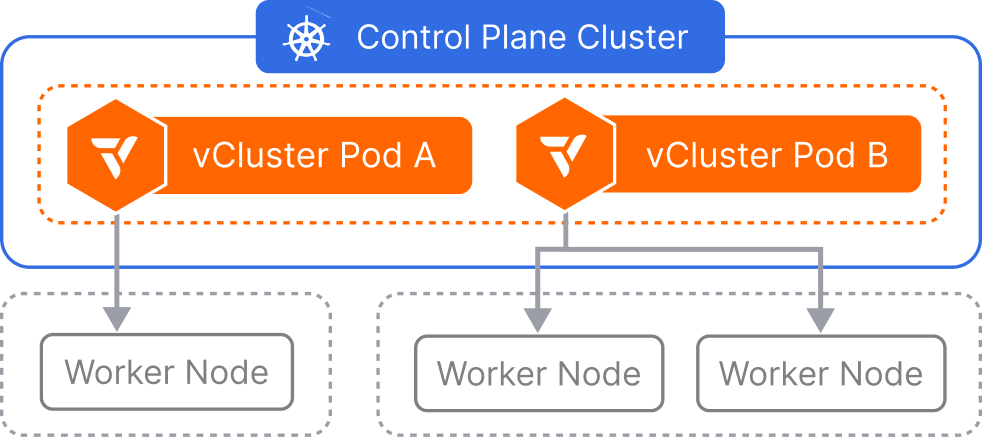
Private Nodes dedicate worker capacity to one tenant cluster, with its own CNI and storage configuration. For dedicated Kubernetes environments, select physical servers or VMs according to the required infrastructure boundary.
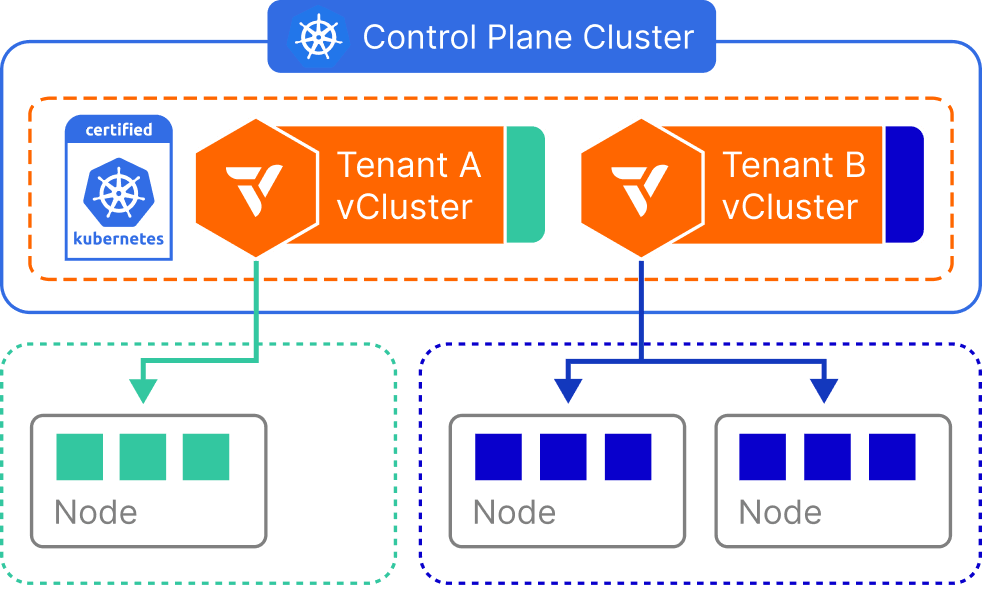
Every dedicated Kubernetes environment is a CNCF-certified cluster serving standard Kubernetes APIs. Tenants get a real Kubernetes cluster, not a proprietary or partial implementation.
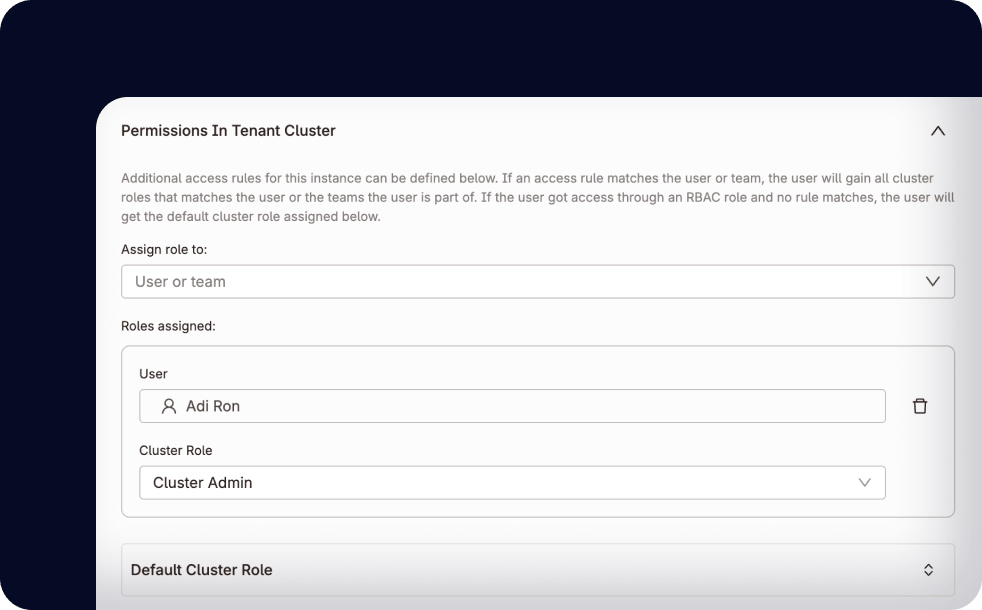
Give tenants cluster-admin within their own Kubernetes environment for dedicated Kubernetes environments. They manage CRDs, operators and RBAC there, while platform administrators retain control of tenant provisioning, infrastructure access and fleet policies.
Coordinate tenant environments for dedicated Kubernetes environments through one UI, CLI and API. Templates, access policies and quotas provide central operator controls while tenant Kubernetes APIs and dedicated production workers remain separate.
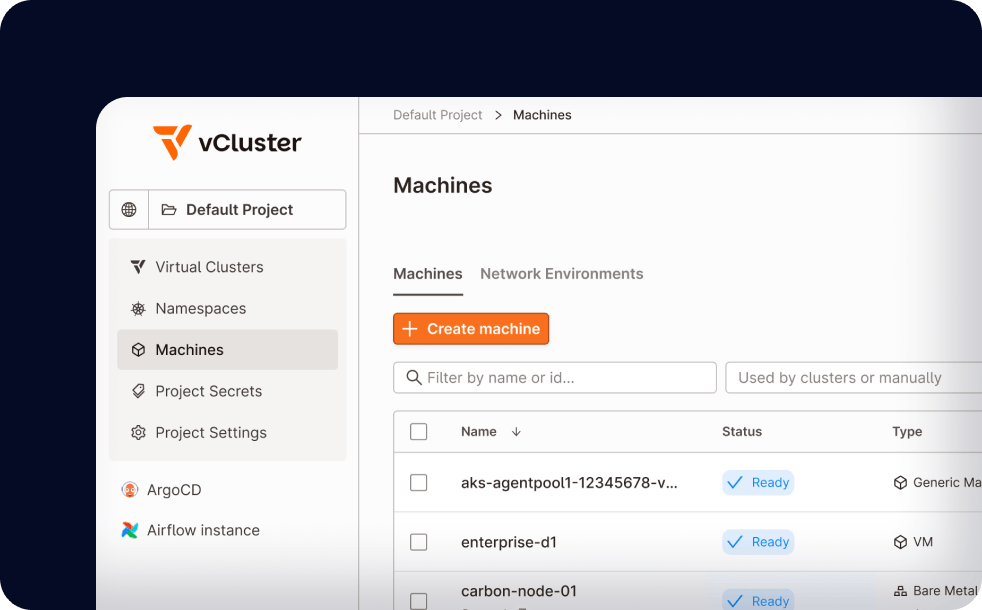
This isn’t a side project. Behind every vCluster deployment is 5+ years of deep K8s engineering, security hardening, and battle-tested infrastructure work at massive scale.
Talk to our team about your stack
Deploy vCluster on your infra in minutes
Go live with a hyperscaler-grade tenant experience in days
vCluster virtualizes the Kubernetes control plane, so each tenant gets its own API server, data store, scheduler and RBAC running as isolated processes on the control plane cluster. At the node level, Private Nodes give tenants dedicated worker nodes with their own CNI and CSI, so no other tenant's workloads run on the same machines. The environment is dedicated where it matters (control plane and data plane) without a separate physical cluster per tenant.
Yes. Every tenant environment is a CNCF-certified Kubernetes cluster serving standard Kubernetes APIs. Tenants can use standard Kubernetes tooling, install custom CRDs, configure RBAC, run Helm charts and connect CI/CD pipelines exactly as they would with a standalone cluster. There is no proprietary API layer or partial Kubernetes implementation.
Tenant control planes come up once its control plane and workers are ready, because they run as lightweight pods on the control plane cluster rather than on new machines. QumulusAI, for example, spins up isolated Kubernetes environments in about 1 minute. That speed makes self-service workable: tenants provision their own dedicated environments on demand.
vCluster offers an isolation spectrum. Private Nodes are the recommended production model, giving tenants dedicated worker nodes with their own networking stack. Shared Nodes provide namespace-level boundaries for internal dev, test and CI/CD by trusted teams. Dedicated VMs add OS-level isolation for the control plane, and vNode adds workload isolation using Linux user namespaces and seccomp with no hypervisor tax. Teams match isolation depth to their compliance and performance requirements.
vCluster Platform coordinates tenant environments through a central UI, CLI and API. Operators use templates, access policies and quotas while each Kubernetes tenant retains its own API and dedicated production workers. vMetal manages supported machine provisioning below the fleet. Operational consistency still depends on template configuration, version management and the monitoring and recovery workflows you connect to the platform.
Supported plans include air-gapped deployment and FIPS features. Private Nodes, tenant-scoped access and optional network segmentation provide controls you can include in a regulated deployment. Select supported images and configurations, and validate the full environment against your requirements. These capabilities do not establish certification of the customer's service, application, hardware or operational procedures.
See how vCluster delivers dedicated tenant clusters on GPU hardware in a live demo.
