platform-eng

Beyond Kubernetes Namespace Isolation for Real Tenants

Kubernetes namespace isolation leaves tenants sharing the same control plane, blast radius, and kernel. vCluster gives every tenant a dedicated API server and true isolated Kubernetes without provisioning separate physical clusters.

Trusted by the fastest-growing AI cloud providers
Problem

Namespace Isolation Is Not Enough

Shared namespaces create real risks that compound as workload density grows.

Shared Blast Radius

A misbehaving tenant can destabilize other workloads. Namespace boundaries do not prevent cluster-wide failures from spreading.

Tenants See Too Much

Tenants can observe platform internals, cluster-wide agents, and other tenants' nodes — namespace isolation was never designed for this.

CRD and RBAC Conflicts

Tenants need cluster-admin to install operators and CRDs. In shared namespaces, that access breaks everyone else.

Solution

True Tenant Isolation Without Separate Physical Clusters

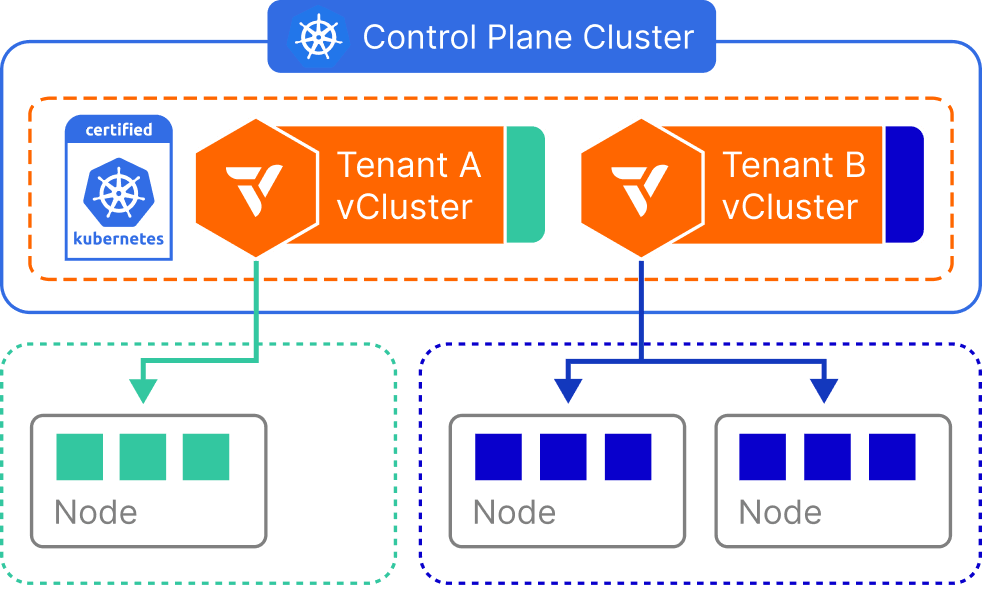
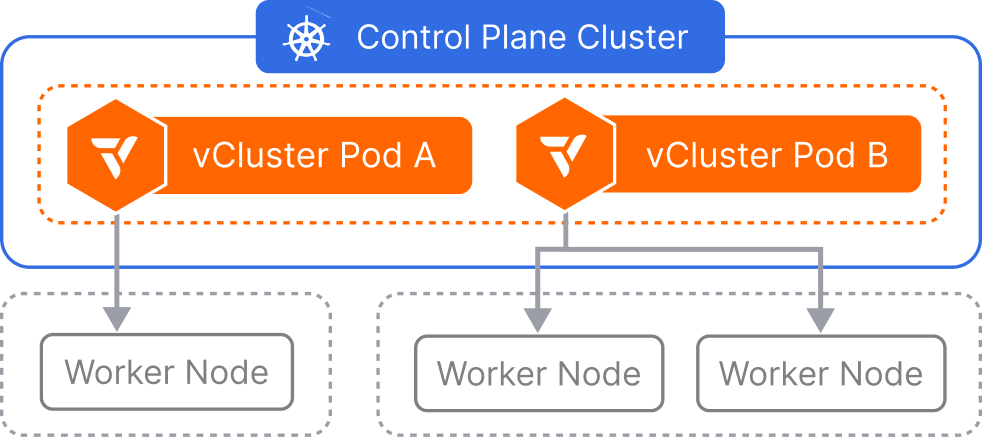
vCluster virtualizes the Kubernetes control plane itself. Each tenant gets a dedicated API server, etcd, scheduler, and RBAC as a lightweight pod inside your existing infrastructure — eliminating shared blast radius without the cost or delay of provisioning separate physical clusters.

Isolation That Goes Beyond Namespaces

Give every tenant a real Kubernetes cluster with full isolation across the control plane, network, and workload runtime — without the overhead of separate physical machines.

Control Plane Isolation

Dedicated K8s API Per Tenant

Each tenant runs their own API server, etcd, and scheduler as lightweight pods. No shared control plane, no shared blast radius — real Kubernetes namespace isolation replaced by real cluster isolation.

  • Own API server per tenant
  • Spins up in seconds
  • Zero shared control plane risk
Tenant Autonomy

Full Cluster Admin Per Tenant

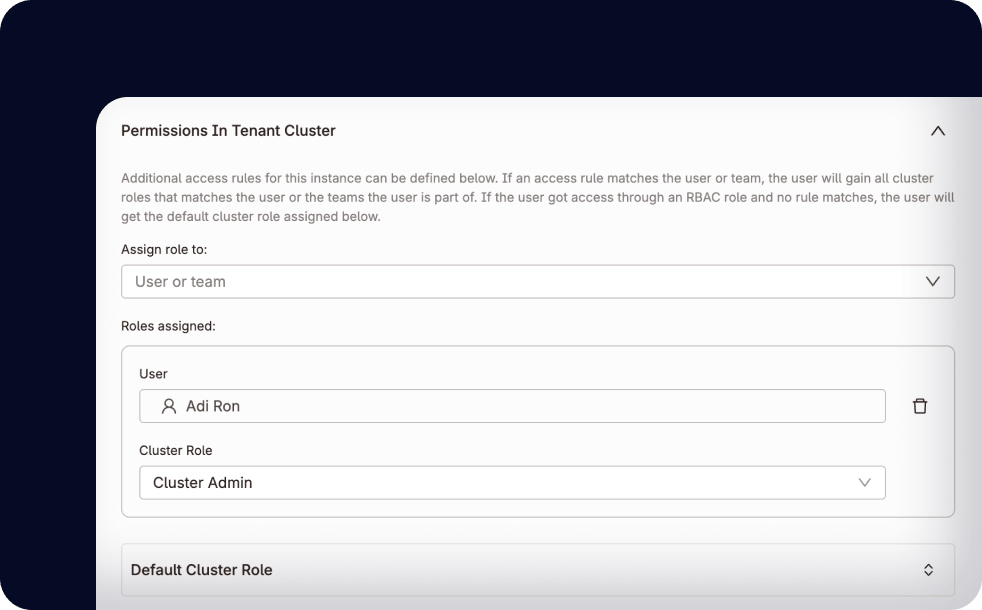
Every tenant gets cluster-admin rights within their own environment. Install CRDs, configure RBAC, run operators — without any risk of interfering with neighboring tenants or platform internals.

  • CRDs without host cluster impact
  • Full RBAC control per tenant
  • Operators run safely in isolation
Workload Security

Kernel-Native Workload Isolation

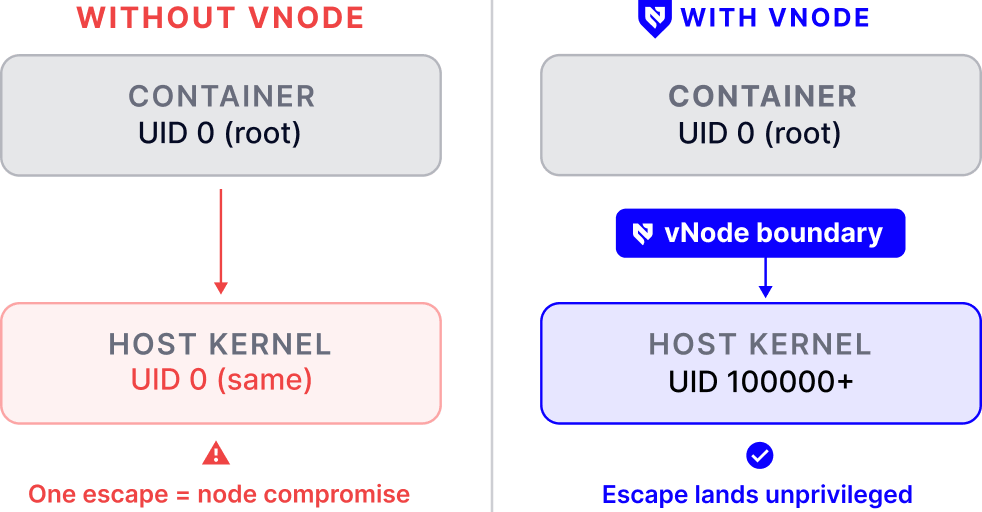
vNode (currently in private beta) wraps each workload in its own secure runtime using seccomp, cgroups, namespaces, and AppArmor. Container breakout protection with no hypervisor tax — GPU performance is well-preserved.

  • Container breakout prevention
  • No hypervisor overhead
  • Bare metal GPU performance preserved
Node Isolation

Fully Private Nodes Per Tenant

For tenants requiring hardware-level separation, assign dedicated physical nodes with their own CNI and CSI. No workloads from other tenants on the same machine — eliminating noisy-neighbor risk entirely.

  • Dedicated physical nodes per tenant
  • Own CNI and CSI per tenant
  • Zero cross-tenant workload sharing
Standards Compliance

CNCF-Certified K8s Per Tenant

Every tenant cluster is a fully conformant, CNCF-certified Kubernetes distribution — 100% API compatible. Not a namespace partition or a proprietary abstraction. Real Kubernetes for every tenant.
  • 100% Kubernetes API compatibility
  • CNCF-certified per tenant cluster
  • No proprietary API lock-in

Why vCluster

This isn’t a side project. Behind every vCluster deployment is 5+ years of deep K8s engineering, security hardening, and battle-tested infrastructure work at massive scale.

100K+
GPU Nodes Powered
50+
GPU Clouds & F500s
<45
Days to Launch
30K
GitHub Stars

Get Started in 3 Steps

1
Schedule a Demo

Talk to our team about your stack

2
Deploy vCluster

Deploy vCluster on your infra in minutes

3
Onboard Your Tenants

Go live with a hyperscaler-grade tenant experience in days

FAQs

Why is Kubernetes namespace isolation not sufficient for tenant separation?

Kubernetes namespaces share a single control plane, meaning all tenants share the same API server, etcd, and cluster-wide resources. A misconfigured or malicious tenant can affect others through RBAC escalation, CRD conflicts, or resource exhaustion. There is no kernel boundary between namespaces — only logical partitioning. For workloads requiring genuine isolation, especially GPU or compliance-sensitive environments, a shared control plane is a structural risk that namespace-level policies cannot fully address.

How does vCluster provide stronger isolation than namespaces?

vCluster gives each tenant a fully dedicated Kubernetes control plane running as a lightweight pod inside your host cluster. Every tenant has their own API server, etcd, scheduler, and RBAC. This means a tenant-side failure, misconfiguration, or security event is contained entirely within their environment. The host cluster remains unaffected, and other tenants are significantly less exposed — delivering strong cluster-level isolation without the cost of separate physical infrastructure.

Can tenants install custom CRDs and operators with vCluster?

Yes. Because each tenant has their own dedicated control plane, they receive full cluster-admin rights within their environment. They can install CRDs, deploy operators, and configure RBAC freely — without any risk of conflicting with other tenants or exposing platform internals. This is one of the most common failure points with namespace isolation, where CRD conflicts across tenants are a routine operational problem.

Does stronger isolation come at the cost of GPU performance?

No. vCluster's tenant clusters run as lightweight pods — not as virtual machines with hypervisor overhead. Worker nodes are the same physical machines, so GPU access is direct and unaffected. When paired with vNode (currently in private beta) for workload-level isolation, security controls are applied at the kernel layer using seccomp, cgroups, and AppArmor — preserving bare metal GPU performance while adding a meaningful security boundary around each workload.

Is vCluster's Kubernetes distribution certified and API compatible?

Yes. Every tenant cluster created by vCluster is a CNCF-certified Kubernetes distribution with 100% API compatibility. Tenants interact with a real Kubernetes cluster — not a namespace partition or proprietary abstraction. This means existing tooling, Helm charts, operators, and CI/CD pipelines work without modification. vCluster is also named in the NVIDIA DGX SuperPOD reference architecture.

What isolation options are available beyond the default configuration?

vCluster supports a flexible isolation spectrum. Tenants can run on shared nodes for maximum density, private nodes for dedicated hardware with their own CNI and CSI, or dedicated nodes to eliminate noisy-neighbor GPU contention. Control plane isolation can be extended to VM-level separation for OS-level boundaries. vNode adds kernel-native workload isolation. Network isolation is available via hardware-enforced VLANs, VXLANs, and VRFs through Netris integration.

See Real Tenant Isolation in Action

Go beyond namespace isolation with dedicated control planes for every tenant.