platform-eng
OpenShift Alternative for GPU Clouds
Evaluate an OpenShift alternative for your GPU service. vMetal manages machines, while vCluster provides separate tenant control planes and dedicated production workers through Private Nodes.
Evaluate an OpenShift alternative for your GPU service. vMetal manages machines, while vCluster provides separate tenant control planes and dedicated production workers through Private Nodes.
GPU services need repeatable machine provisioning, independent tenant administration and dedicated customer worker capacity.
GPU customers need control of their own Kubernetes APIs, CRDs and policies without administering the provider’s infrastructure.
Dedicated customer workers require capacity planning, supported device access and explicit service boundaries across the infrastructure.
Choose infrastructure and application capabilities around the service you intend to sell, then validate the full customer workflow.
vCluster provides CNCF-certified Kubernetes tenant environments for GPU services. vMetal orchestrates machine provisioning, and Private Nodes dedicate production workers with tenant-owned networking and storage configuration. Lintasarta runs 170+ tenant clusters in production.
What a GPU cloud needs from the layer underneath it, without the application delivery surface on top.
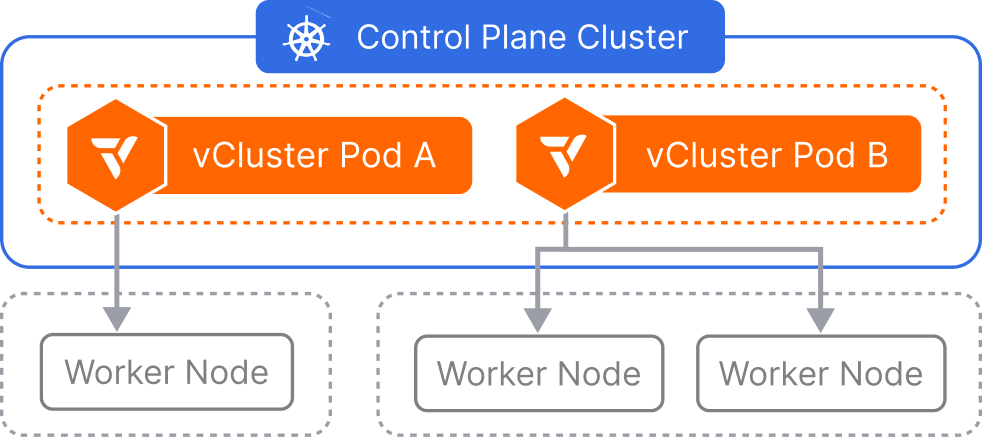
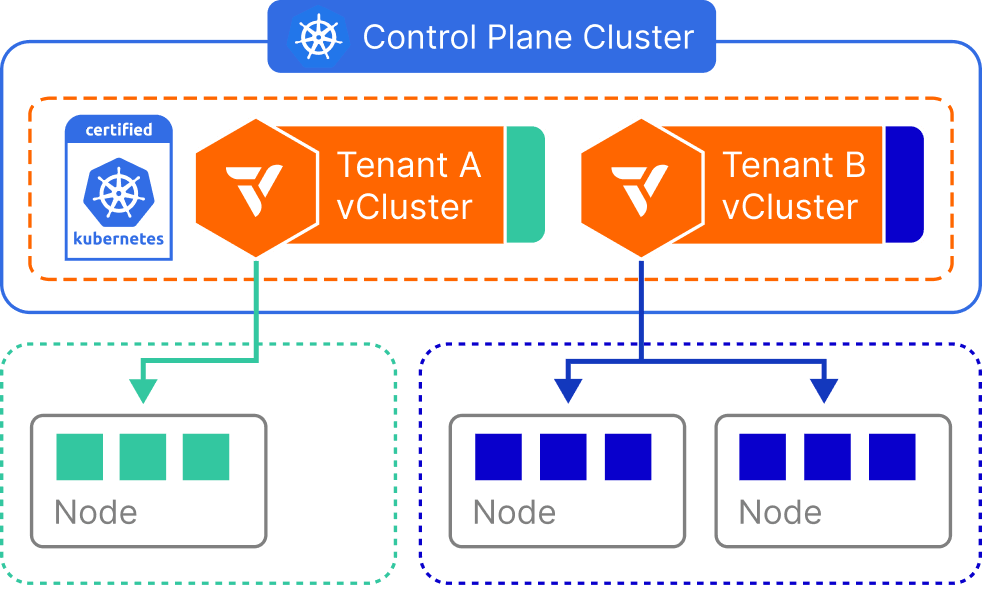
Each tenant has an independent Kubernetes API, data store and RBAC boundary. Lightweight control-plane hosting reduces dedicated server requirements for GPU service delivery; Private Nodes keep production workers tenant-specific.
CNCF-certified Kubernetes provides standard APIs for GPU service delivery. Tenants can use familiar tooling and cluster-scoped resources; validate GPU drivers, storage, networking and runtime requirements for the selected infrastructure.
Private Nodes dedicate worker capacity to one tenant cluster, with its own CNI and storage configuration. For GPU service delivery, select physical servers or VMs according to the required infrastructure boundary.
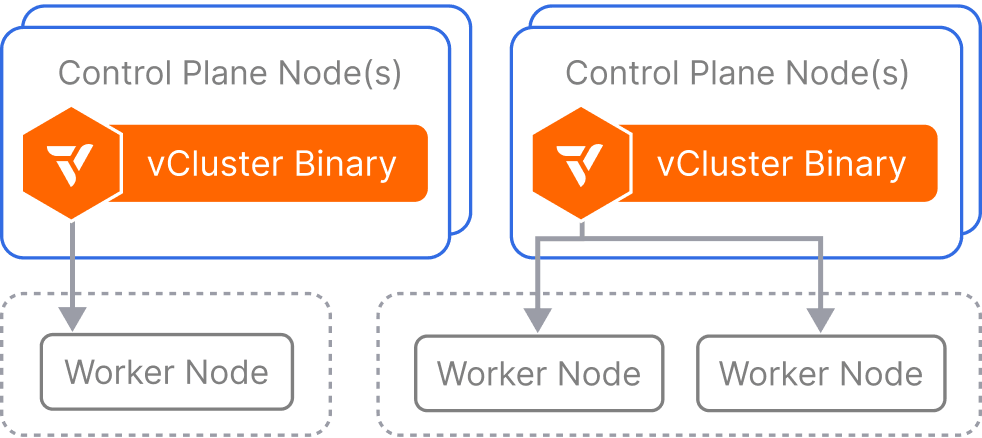
vCluster Standalone runs Kubernetes as a CNCF-certified binary on Linux, without an existing Kubernetes cluster. It supplies a Kubernetes foundation for GPU service delivery; vMetal separately orchestrates machine and OS provisioning.
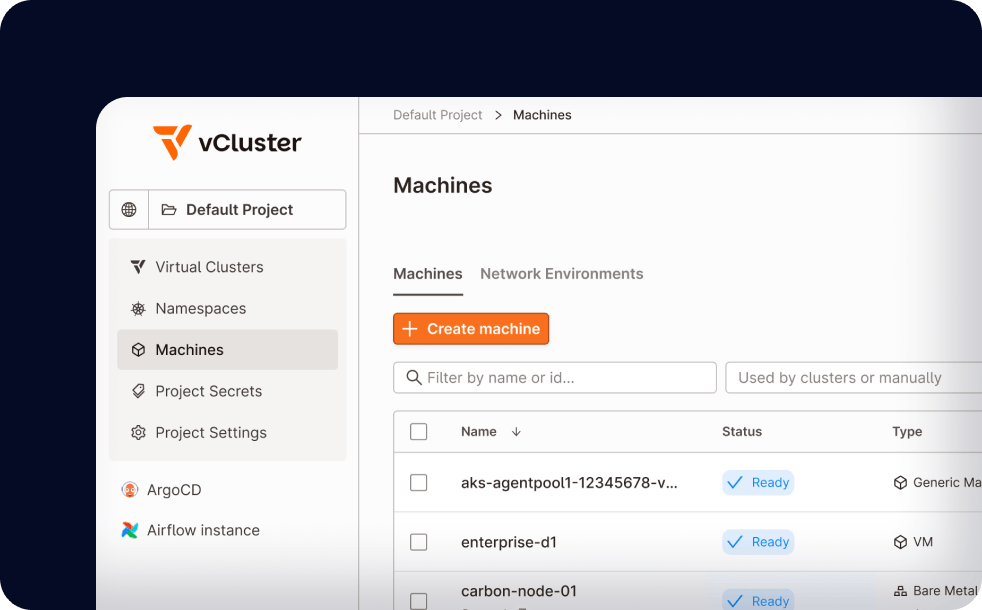
Coordinate tenant environments for GPU service delivery through one UI, CLI and API. Templates, access policies and quotas provide central operator controls while tenant Kubernetes APIs and dedicated production workers remain separate.
This isn’t a side project. Behind every vCluster deployment is 5+ years of deep K8s engineering, security hardening, and battle-tested infrastructure work at massive scale.
Talk to our team about your stack
Deploy vCluster on your infra in minutes
Go live with a hyperscaler-grade tenant experience in days
Evaluate vCluster against the service you need to deliver: separate tenant Kubernetes APIs, dedicated production workers and infrastructure lifecycle operations. Private Nodes provide the recommended customer worker model, while vMetal orchestrates machines and Platform coordinates templates and access. Compare documented versions and configurations directly; an embedded runtime alone does not describe every capability of another vendor's platform.
Operators expose approved Kubernetes templates through vCluster Platform interfaces or an integrated customer portal. Templates define supported configurations, while access and capacity policies govern requests. vMetal can provision machines and Private Nodes dedicate production workers. Customers receive their own Kubernetes environment once its control plane, networking, storage and worker capacity are ready; application stacks have additional prerequisites.
vCluster gives each tenant an independent Kubernetes API, data store and RBAC scope. Private Nodes dedicate worker capacity to that tenant, including its own CNI and storage configuration. vMetal orchestrates the machines underneath. This separates tenant administration and worker placement; shared infrastructure, application permissions and network policies still require an explicit security design.
Private Nodes are worker nodes joined to one tenant cluster, with that tenant's own CNI and storage configuration. They can be physical machines or supported VMs. Use dedicated bare metal when the service requires exclusive physical servers. vMetal can provision the underlying machines, while platform policies define which capacity a tenant may request and how it is released.
vCluster is a CNCF-certified Kubernetes distribution and exposes standard Kubernetes APIs in tenant environments. This supports familiar clients, Helm charts and cluster-scoped resources such as CRDs. Certification covers Kubernetes conformance rather than an entire AI platform or customer deployment. Validate the selected version, networking, storage, GPU drivers and runtime integrations for the workloads you plan to support.
Boost Run went from decision to production launch in under 45 days for its managed Kubernetes service. That is a customer example rather than a promised implementation time. Your launch depends on machine inventory, driver configuration, networking, storage, templates and service integrations. vMetal and vCluster connect machine orchestration with tenant cluster delivery, reducing the infrastructure workflows you need to build yourself.
See how GPU clouds sell vanilla Kubernetes on their own hardware.
