inference

Single Tenant AI Inference for Dedicated Customer Environments

Serve customer models in dedicated inference environments. vMetal provisions infrastructure, and vCluster assigns Private Nodes with separate tenant control planes and optional runtime hardening.

Trusted by the fastest-growing AI cloud providers
Problem

Where Shared Inference Infrastructure Falls Short

Shared inference infrastructure needs clear tenant boundaries across the control plane, worker capacity, runtime, and network.

Shared Components Complicate Compliance

Namespace-only designs share control-plane and node-level components between customers.

Cross-Tenant Resource Contention

Shared worker nodes can expose inference workloads to cross-tenant resource contention.

Data Residency Requires Full-Stack Planning

Data residency depends on the placement and configuration of compute, storage, networking, and inference services, not on a single product setting.

Solution

Tenant Isolation for Single-Tenant AI Inference

vMetal supplies machines for inference workloads, and vCluster provides independent Kubernetes tenant environments with dedicated Private Nodes. Runtime and network controls complement application authentication, model access policies and workload readiness checks. vCluster Labs serves 50+ GPU clouds & Fortune 500s.
Built for Single-Tenant AI Inference

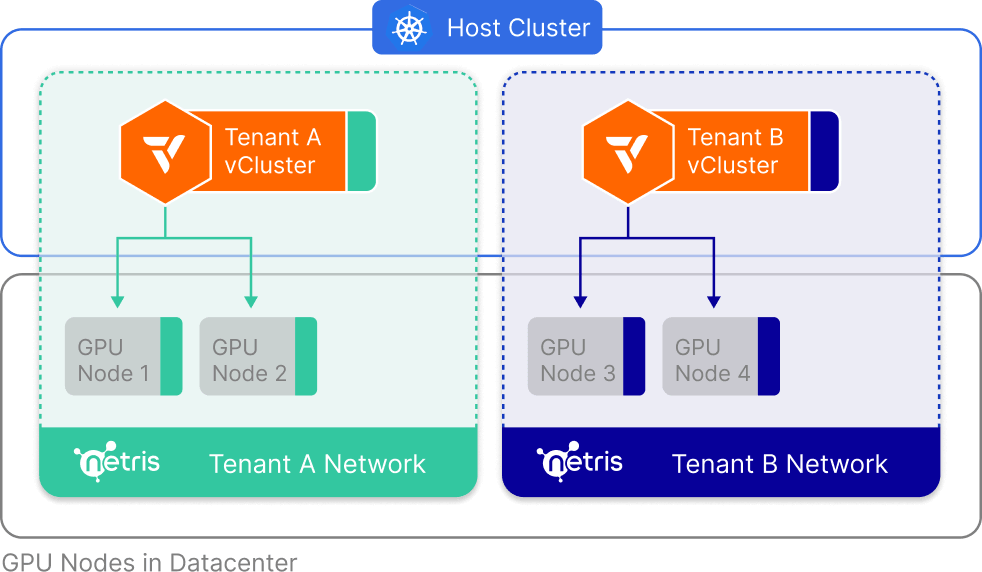
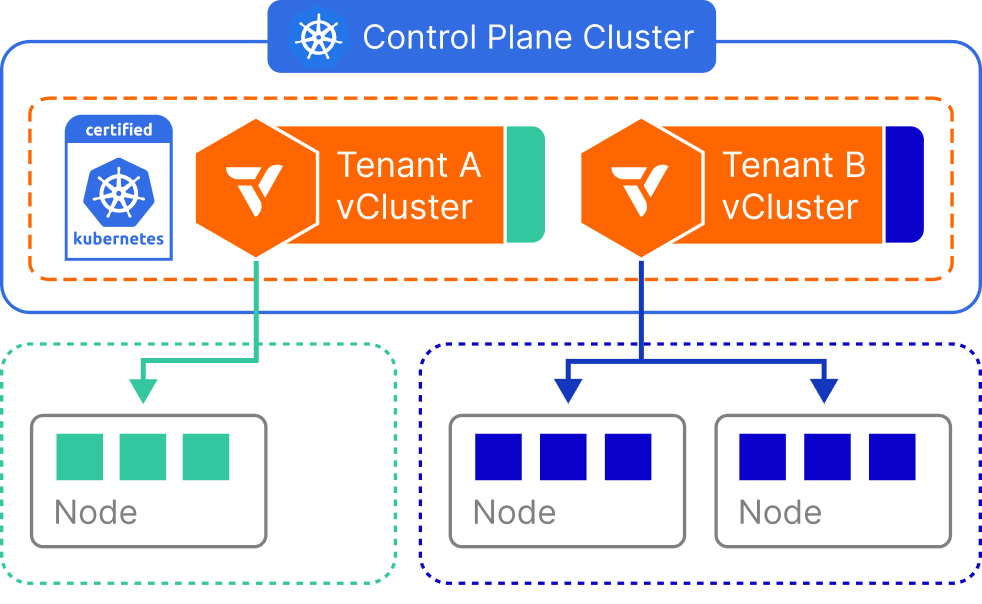
Single-tenant AI inference combines a separate tenant control plane, Private Nodes, and optional runtime and physical network isolation.

Compute Isolation

Private Nodes for Inference Tenants

Private Nodes dedicate worker capacity to one tenant cluster, with its own CNI and storage configuration. For dedicated inference workloads, select physical servers or VMs according to the required infrastructure boundary.

  • Dedicated worker nodes per tenant
  • Tenant-owned CNI and storage configuration
  • Physical servers or supported VMs
Workload Security

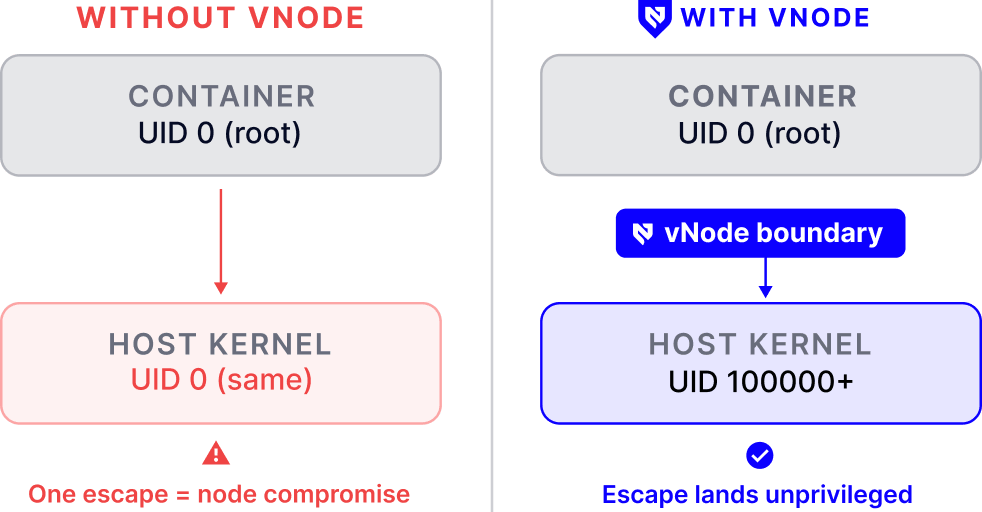
Runtime Isolation With vNode

vNode uses Linux user namespaces and seccomp to restrict workload privileges and system calls. It adds runtime hardening for dedicated inference workloads without a guest kernel or hypervisor, complementing dedicated workers rather than allocating GPUs.

  • Linux user namespaces and seccomp
  • No guest kernel or hypervisor
  • Helps limit workload breakout
Network Isolation

Optional Hardware Network Isolation

Tenant-owned CNI configuration and supported Netris integrations provide separate network controls for dedicated inference workloads. Ethernet segmentation can use VLANs, VRFs and ACLs; InfiniBand isolation uses fabric partitions rather than Ethernet constructs.

  • Tenant-owned worker network configuration
  • Netris integration for supported fabrics
  • Explicit segmentation and access policies
Sovereign Compliance

Air-Gapped Platform Deployment

vCluster Platform supports air-gapped deployments and FIPS features on supported plans for infrastructure operated in controlled environments.

  • Air-gapped deployment supported
  • FIPS features on supported plans
  • Controlled deployment locations
Tenant Clusters

Separate Control Plane Per Tenant

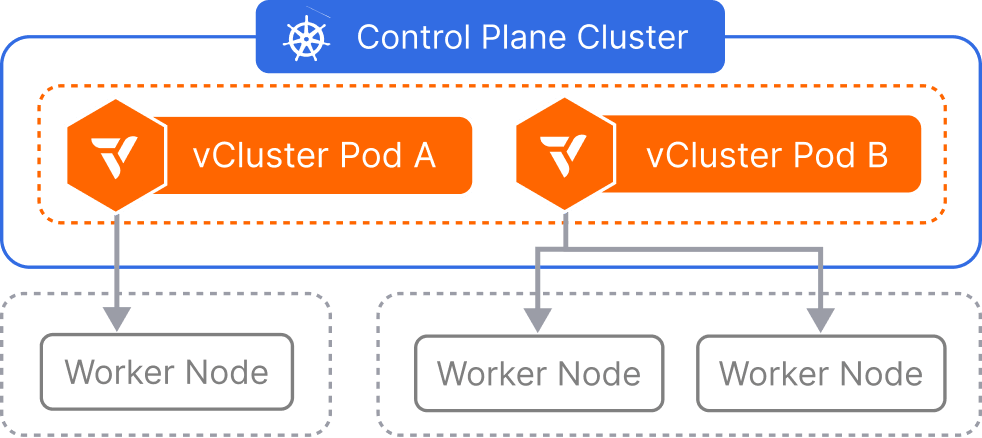
Each inference tenant gets its own virtualized Kubernetes control plane, API server, and RBAC boundary.

  • Independent tenant API and data store
  • Tenant-scoped scheduling on Private Nodes
  • No dedicated control-plane servers per tenant

Why vCluster

This isn’t a side project. Behind every vCluster deployment is 5+ years of deep K8s engineering, security hardening, and battle-tested infrastructure work at massive scale.

100K+
GPUs Powered
50+
GPU Clouds & F500s
<45
Days to Launch
30K
GitHub Stars

Get Started in 3 Steps

1
Schedule a Demo

Talk to our team about your stack

2
Deploy vCluster

Deploy vCluster on your infra in minutes

3
Onboard Your Tenants

Go live with a hyperscaler-grade tenant experience in days

FAQs

What makes vCluster single-tenant AI inference different from namespace isolation?

Namespaces divide resources within a Kubernetes cluster, but share its API and cluster-wide administrative scope. RBAC, quotas and network policies remain useful controls. vCluster adds a separate tenant API and data store, with Private Nodes dedicating production workers. This reduces dependencies between tenant environments while platform administrators still manage the underlying infrastructure and its failure domains.

How does vCluster support data residency for sovereign AI inference?

Residency depends on where you place the platform, tenant clusters, storage, networking and inference services, so the architecture must be set up for the required jurisdiction. vCluster Platform supports air-gapped deployments and FIPS features on supported plans, and Polarise uses it to enforce 100% data residency at the infrastructure layer.

Does single-tenant inference require a separate physical cluster per tenant?

vCluster gives each tenant an independent Kubernetes API, data store and RBAC scope. Private Nodes dedicate worker capacity to that tenant, including its own CNI and storage configuration. vMetal orchestrates the machines underneath. This separates tenant administration and worker placement; shared infrastructure, application permissions and network policies still require an explicit security design.

How does vNode strengthen inference workload isolation?

vNode uses Linux user namespaces and seccomp to restrict workload privileges and system calls, helping prevent container breakout. It uses the underlying Linux kernel rather than a separate guest kernel. Add it as runtime hardening alongside dedicated Private Nodes, patching and least-privilege policies. Validate kernel, container runtime, GPU access and workload compatibility; it is not a replacement for GPU allocation or application authorization.

Can vCluster support inference tenants across regions or data centers?

vCluster Platform can coordinate tenant environments across supported clouds and data centers. Each Kubernetes tenant has its own control plane; a central fleet interface does not mean one tenant API or one failure domain. Plan worker placement, routing, storage and data residency for each location. An optional encrypted VPN can connect control planes and workers where appropriate for the deployment.

How quickly can providers create isolated inference environments?

Provisioning a tenant control plane is one step in creating an inference environment. Private Node capacity, GPU drivers, model downloads, storage and serving endpoints must also be ready. vMetal can automate supported machine provisioning, while your serving stack manages model loading and endpoint health. Test authenticated requests and model readiness before treating the environment as available to customers.

Launch Isolated Inference Environments on Your GPU Hardware

See how vCluster Platform delivers single-tenant AI inference environments with hard tenant isolation.