platform-eng

Tenant Isolation for AI Cloud Providers

AI clouds demand strong tenant isolation without VM overhead. vCluster combines virtualized control planes with vNode's kernel-native workload isolation to protect every tenant at bare metal speed.

Trusted by the fastest-growing AI cloud providers
Problem

Isolation Without Compromise Is Hard

Standard Kubernetes forces a painful tradeoff between security, performance, and cost.

Namespace Isolation Is Too Weak

Tenants can see platform internals they should not — cluster-wide agents, other tenants' nodes and pods.

Separate Clusters Are Too Expensive

Provisioning full physical clusters per tenant destroys density, slows onboarding, and kills margins.

Container Escapes Are a Real Risk

AI workloads running untrusted code on shared GPUs create real exposure to cross-tenant data leaks.

Solution

Full Stack Tenant Isolation at Bare Metal Speed

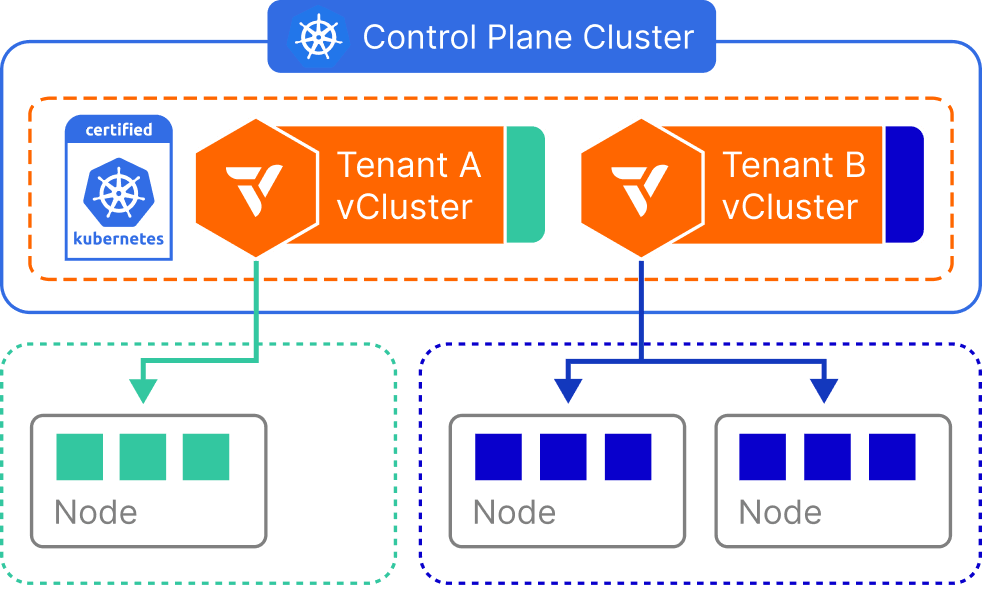
vCluster delivers a complete isolation spectrum — from virtualized control planes to kernel-native workload security via vNode. Every tenant gets a fully isolated, CNCF-certified Kubernetes cluster without hypervisor overhead, production-proven across 100K+ GPU nodes and 50+ GPU clouds.

Built for Strong Tenant Isolation at Scale

Every layer of the stack is designed to give tenants hard boundaries without sacrificing GPU performance or operational efficiency.

Workload Security

Kernel-Native Isolation for Every Tenant

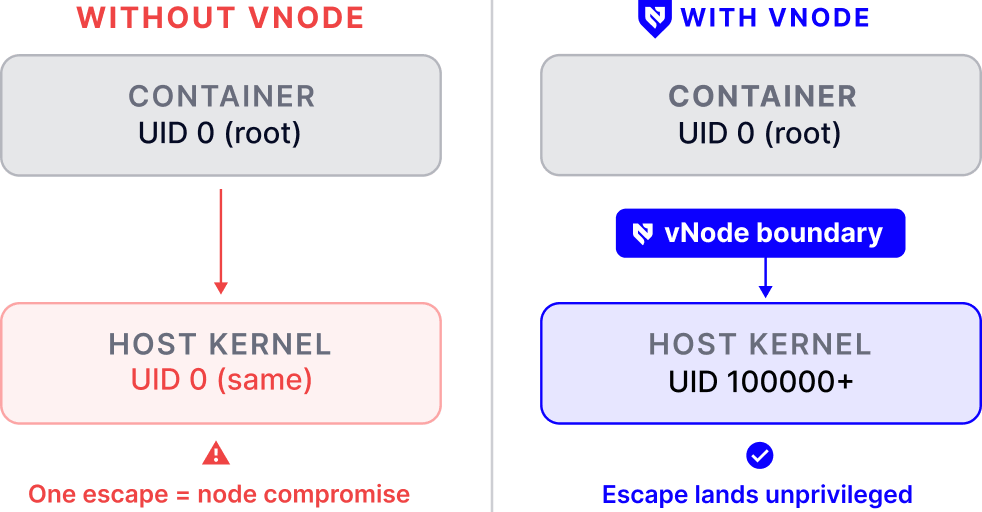
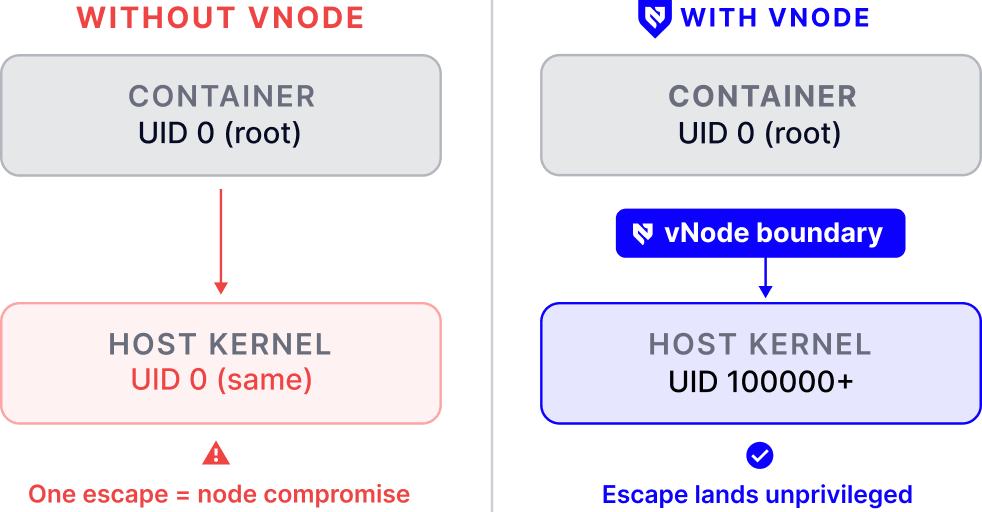
vNode (currently in private beta) gives each workload its own secure runtime using seccomp, cgroups, Linux namespaces, and AppArmor — preventing container breakouts without any hypervisor tax on GPU performance.

  • No VM overhead on GPU workloads
  • Prevents container breakout attempts
  • AppArmor and seccomp per workload
Control Plane

Isolated Tenant Clusters in Seconds

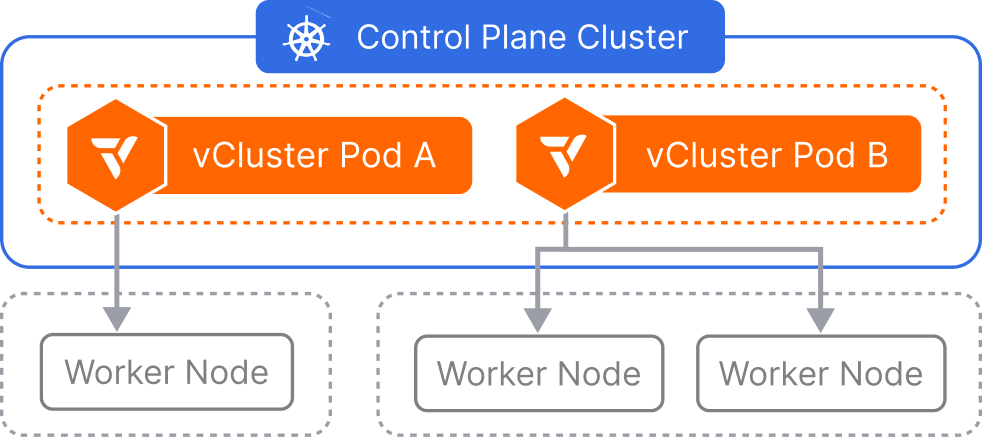
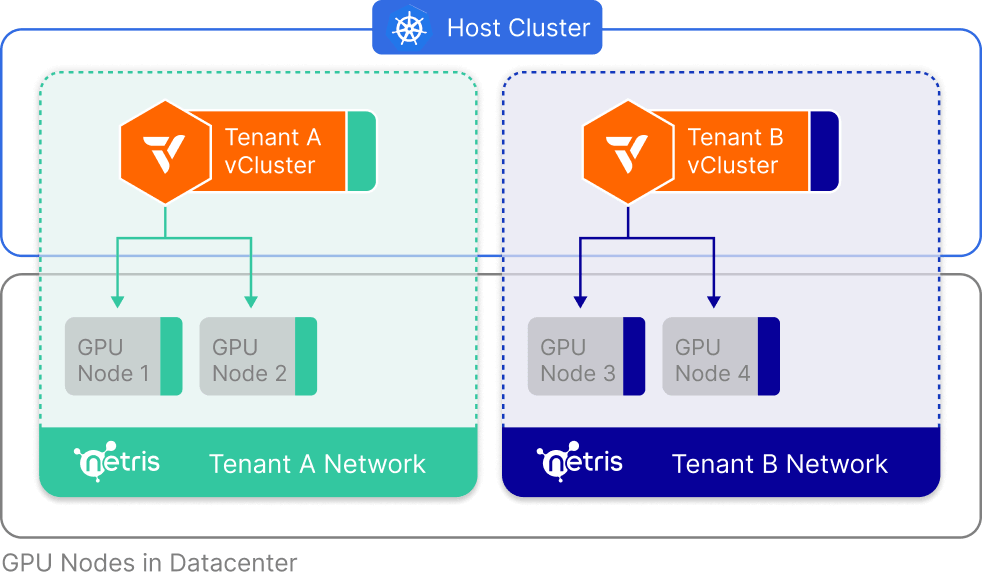
Each tenant gets their own API server, etcd, scheduler, and RBAC running as lightweight pods — providing real Kubernetes isolation without provisioning separate physical clusters.

  • Own API server and etcd per tenant
  • Spins up in seconds not hours
  • Strongly contained blast radius per tenant
Node Isolation

Dedicated Physical Nodes Per Tenant

Assign tenants their own physical nodes with dedicated CNI and CSI. No workloads from other tenants share the hardware, delivering complete node-level tenant isolation.

  • No cross-tenant workload sharing
  • Dedicated CNI and CSI per tenant
  • Full hardware-level boundaries
Defense in Depth

Container Breakout Protection Built In

vNode's (currently in private beta) defense-in-depth architecture strongly limits workload escape from container boundaries. Compatible with gVisor and Kata Containers for additional layered security where requirements demand it.

  • Prevents workload escape attempts
  • Compatible with gVisor and Kata
  • Defense-in-depth isolation stack
Network Security

Hardware-Enforced Network Isolation

Per-tenant network boundaries enforced via VLANs, VXLANs, VRFs, ACLs, and DPU policies through Netris integration — ensuring tenant traffic never crosses boundaries at the network layer.

  • VLANs and VRFs per tenant
  • ACL and DPU policy enforcement
  • Netris-powered network segmentation

Why vCluster

This isn’t a side project. Behind every vCluster deployment is 5+ years of deep K8s engineering, security hardening, and battle-tested infrastructure work at massive scale.

100K+
GPU Nodes Powered
50+
GPU Clouds & F500s
<45
Days to Launch
30K
GitHub Stars

Get Started in 3 Steps

1
Schedule a Demo

Talk to our team about your stack

2
Deploy vCluster

Deploy vCluster on your infra in minutes

3
Onboard Your Tenants

Go live with a hyperscaler-grade tenant experience in days

FAQs

What is tenant isolation in Kubernetes and why does it matter for AI clouds?

Tenant isolation in Kubernetes means ensuring that each customer's workloads, data, and control plane resources are fully separated from other tenants on shared infrastructure. For AI clouds running GPU workloads, weak isolation creates real risks — container escapes, data leaks, and noisy-neighbor GPU contention. Strong tenant isolation requires separation at the control plane, workload runtime, and network layers simultaneously, which namespace-level partitioning alone cannot provide.

How is vCluster's tenant isolation different from Kubernetes namespaces?

Kubernetes namespaces share a single API server, etcd, and control plane across all tenants — so a misconfiguration or privilege escalation in one namespace can affect others. vCluster gives every tenant a fully isolated API server, etcd, scheduler, and RBAC as a lightweight pod inside the host cluster. This means each tenant has a real Kubernetes cluster boundary, not just a logical partition, eliminating the shared blast radius that namespace isolation creates.

Does strong tenant isolation require sacrificing GPU performance?

Not with vCluster. Traditional VM-based isolation imposes hypervisor overhead that degrades GPU performance — a critical problem for AI workloads. vNode (currently in private beta) uses kernel-native isolation (seccomp, cgroups, Linux namespaces, AppArmor) to deliver strong workload-level tenant isolation without any VM tax. Tenants get protected runtimes running at bare metal GPU speeds, making it possible to enforce security without compromising the performance your customers are paying for.

What isolation options does vCluster provide for different security requirements?

vCluster offers a flexible isolation spectrum. Shared Nodes provide namespace and resource quota boundaries for cost-sensitive workloads. Private Nodes give tenants fully dedicated physical hardware with their own CNI and CSI. Dedicated VMs add OS-level kernel separation for regulated environments. vNode (private beta) layers kernel-native workload isolation on top of any configuration. This spectrum means you can match isolation strength to each tenant's security requirements without changing your platform architecture.

Can vCluster prevent container breakout attacks in multi-tenant GPU environments?

Yes. vCluster's vNode component is specifically designed to prevent workload escape from container boundaries. Using seccomp profiles, AppArmor policies, Linux cgroups, and kernel namespace isolation per workload, vNode prevents the syscall-level attacks that enable container breakouts. It is also compatible with gVisor (user-space kernel) and Kata Containers (lightweight VMs) for environments that require additional defense-in-depth layers beyond kernel-native isolation.

Is vCluster's tenant isolation proven at GPU cloud scale?

Yes. vCluster powers 100K+ GPU nodes in production across 50+ GPU clouds and Fortune 500 customers including CoreWeave and Nscale. It is named in the NVIDIA DGX SuperPOD reference architecture and referenced in the SemiAnalysis ClusterMax evaluation criteria for GPU cloud providers. Lintasarta launched Indonesia's leading GPU cloud in 90 days using vCluster, and Boost Run launched managed Kubernetes in under 45 days with zero new platform engineering hires.

See Tenant Isolation in Action

Learn how AI cloud providers enforce strong tenant isolation at bare metal speed.