ai-cloud

Tenant Isolation GPU Cloud for AI Providers

Give every tenant its own Kubernetes control plane and RBAC boundary, backed by Private Nodes with dedicated compute, networking, and storage. vCluster Platform adds self-service tenant management, templates, capacity policy, and fleet operations.

Trusted by the fastest-growing AI cloud providers
Problem

The GPU Cloud Isolation Trap

GPU cloud providers need tenant boundaries that cover both the Kubernetes control plane and the worker infrastructure.

Namespace Isolation Is Too Weak

Namespace-only designs share control-plane and node-level components between tenants.

Physical Clusters Are Too Expensive

A separate management stack for every tenant increases infrastructure and operational work.

DIY Isolation Requires Significant Engineering Investment

Custom isolation layers take ongoing engineering effort to maintain across cluster, network, and machine lifecycles.

Solution

Tenant Isolation for GPU Clouds: Private Nodes as the Production Default

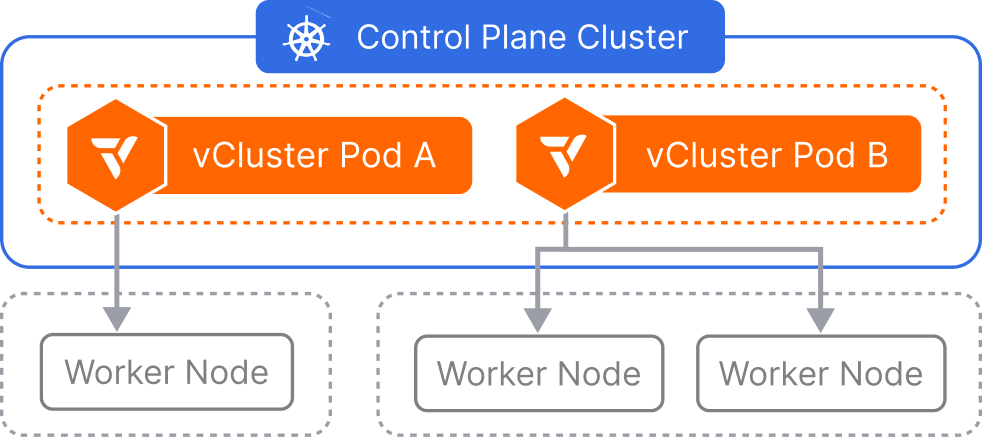
vCluster Platform combines a separate virtualized control plane for every tenant with Private Nodes as the production default. Operators manage tenants, access, templates, capacity, and observability from one platform.
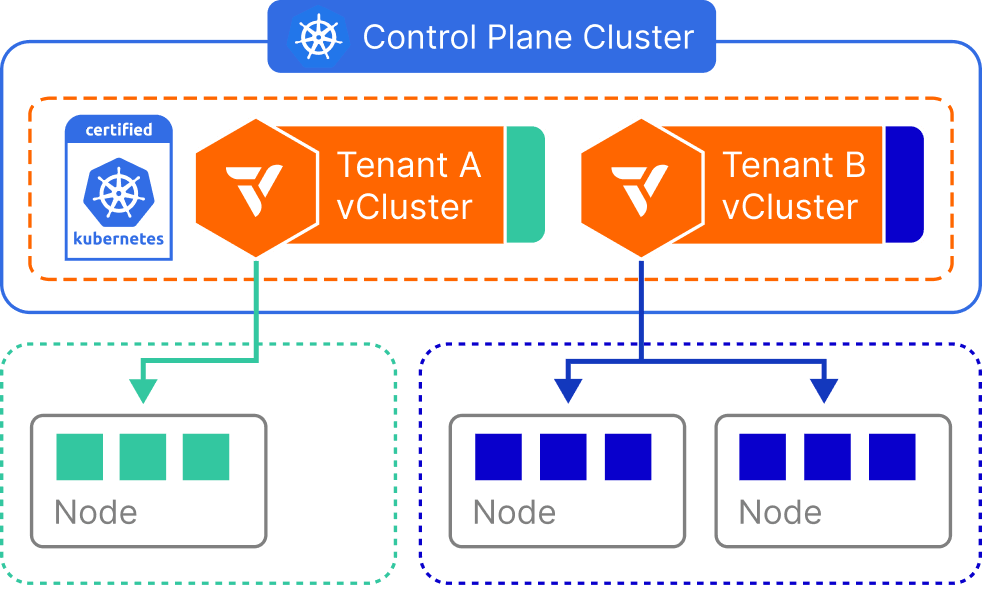
Full Stack Tenant Isolation for GPU Clouds

vCluster covers the tenant cluster, worker node, runtime, and optional physical network boundaries needed for GPU cloud tenant isolation.

Hardware Isolation

Private Nodes Per Tenant on GPU Hardware

Private Nodes dedicate worker capacity, networking, and storage to one production tenant cluster at a time.

  • Per-tenant CNI and storage
  • No cross-tenant workload overlap
  • Hardware-level isolation by default
Control Plane

Isolated Control Planes Per Tenant

Every tenant cluster gets its own virtualized control plane, API server, and RBAC boundary on the control plane cluster.

  • Own API server and etcd per tenant
  • Lightweight control plane
  • No dedicated control plane servers
Workload Security

Kernel-Native Isolation Without VM Overhead

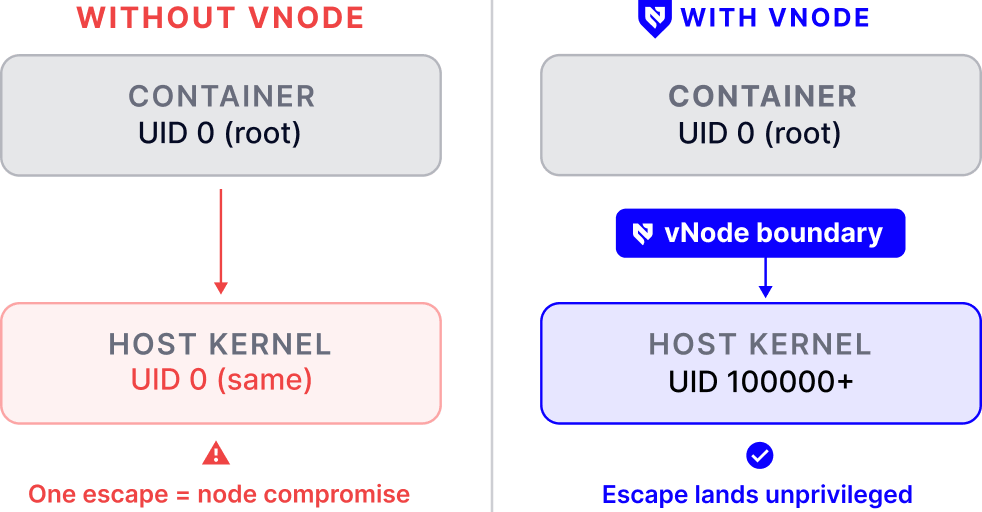
vNode adds a tenant isolation container runtime based on Linux user namespaces and seccomp filters for workloads that need a stronger runtime boundary.

  • Stronger runtime boundary
  • No VM layer
  • Seccomp, cgroups, namespaces per workload
Network Isolation

Hardware-Enforced Per-Tenant Network Boundaries

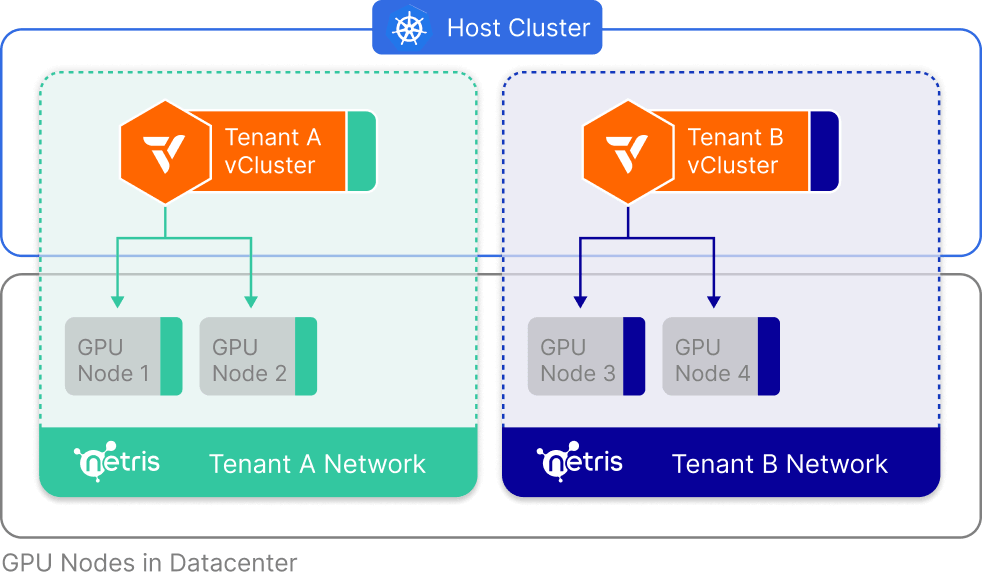
When Netris is configured, separate network environments provide hardware-backed L2 isolation for tenant traffic.

  • VLANs and VXLANs per tenant
  • Hardware-backed L2 isolation
  • Hard network isolation at the hardware layer
Tenant Experience

Self-Service Cloud Experience for Tenants

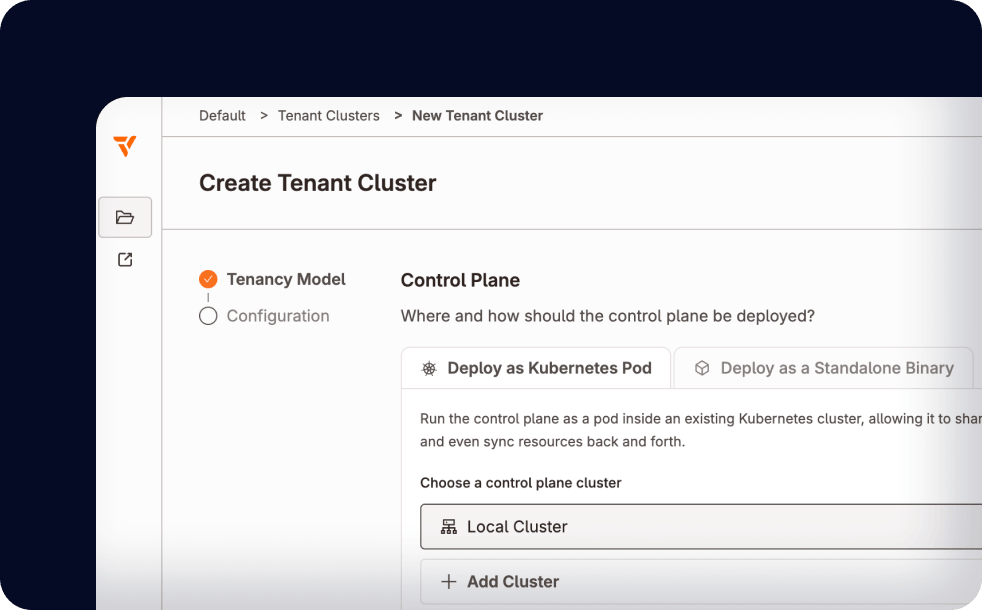
Tenants can create approved cluster products through the built-in UI and CLI or through a custom portal backed by vCluster APIs.

  • EKS-like tenant portal
  • Cluster provisioned in under a minute
  • Full cluster-admin per tenant

Why vCluster

This isn’t a side project. Behind every vCluster deployment is 5+ years of deep K8s engineering, security hardening, and battle-tested infrastructure work at massive scale.

100K+
GPUs Powered
50+
GPU Clouds & F500s
<45
Days to Launch
30K
GitHub Stars

Get Started in 3 Steps

1
Schedule a Demo

Talk to our team about your stack

2
Deploy vCluster

Deploy vCluster on your infra in minutes

3
Onboard Your Tenants

Go live with a hyperscaler-grade tenant experience in days

FAQs

What is tenant isolation in a GPU cloud context?

Tenant isolation separates each customer's control plane, permissions, workloads, and infrastructure boundary. vCluster provides a virtualized control plane for each tenant, while Private Nodes dedicate worker capacity, networking, and storage to that tenant cluster.

How is vCluster Platform different from namespace-level isolation?

Namespace-only designs share a Kubernetes API server and node-level components. vCluster gives each tenant its own API server and RBAC boundary, then uses Private Nodes as the production default for dedicated worker capacity.

Do tenants need to share physical GPU nodes with other tenants?

Production tenants do not need to share worker nodes. Private Nodes assign dedicated nodes to one tenant cluster at a time, whether those nodes come from bare metal, VMs, or other Linux machines.

How quickly can a new tenant cluster be provisioned?

Virtualized control planes are lightweight and can be created quickly. For bare metal capacity, vMetal provisions a Machine and joins it to the target tenant cluster automatically after the infrastructure driver completes provisioning.

What GPU cloud providers use vCluster for tenant isolation?

vCluster powers 100K GPUs across 50+ GPU Clouds & Fortune 500s and is validated in the NVIDIA DGX reference architecture.

Does vCluster Platform support compliance and air-gapped deployments?

vCluster Platform supports air-gapped deployments and FIPS features on supported plans. Private Nodes and optional Netris network integration provide deployment controls for regulated or data-residency-sensitive environments.

Launch Your Tenant Isolation GPU Cloud

See how GPU clouds deliver hardware-level tenant isolation with Private Nodes as the production default.