The AI Cloud Monetization Ladder: More Revenue From the GPUs You Already Own

Nov 12, 2026
|
10
min Read
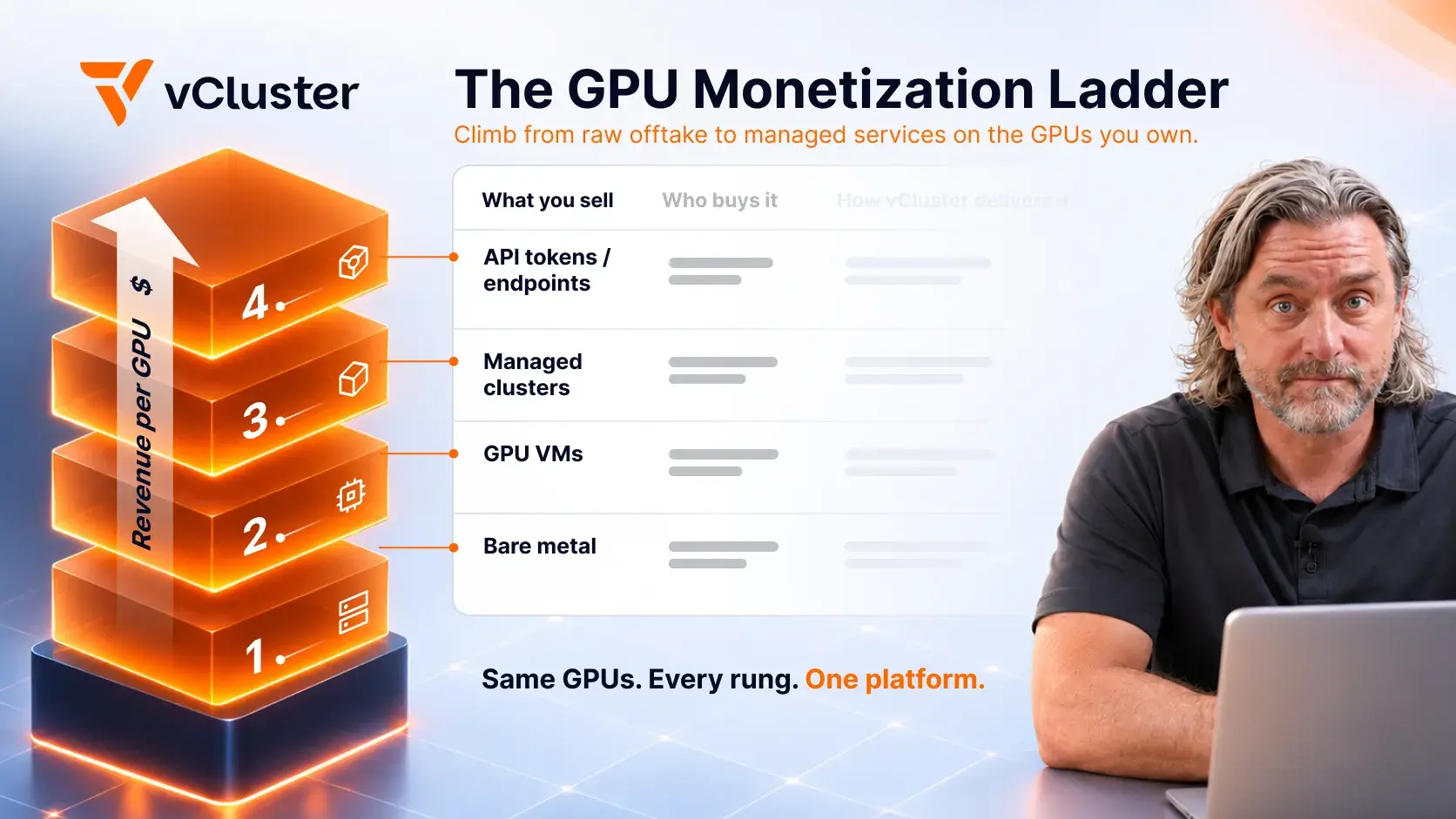
I spend most of my time with AI Cloud teams as they turn large GPU purchases into working businesses. The pattern is consistent. Many financed those GPUs with debt, and the loan payments start whether or not the hardware is earning, so every idle GPU is a cost that compounds.
Under that pressure, the fastest path to revenue is usually a long-term bare metal lease to one or two large buyers. It fills the data hall and covers the loan, but it locks in the lowest margin and leaves the business riding on a few renewals. The providers that pulled ahead made a different early call: they automated the machine layer and built tenant isolation in from day one, so every new service ran on the same foundation instead of a new stack.
Those lessons became the AI Cloud Monetization Ladder. The technical choices you make on the first rung decide how fast you can reach the highest-margin rungs above it. Get them right, and the same GPUs move from raw offtake to managed clusters and inference, at the best margins, without a rebuild.
Two AI Clouds can run the same H100s, in the same data hall, on the same power, and end up with completely different businesses. One leases racks to two customers on multi-year terms. The other sells managed Slurm, Kubernetes, and inference to hundreds of teams. The hardware is identical. The margin is not.
The difference is what you sell on top of the metal. This post walks through four rungs, from raw bare metal offtake up to inference, each earning more per GPU and spreading revenue across more customers. For each one, it covers what it takes to deliver, and why we built vCluster so an AI Cloud can climb without rebuilding its platform at every step.
Selling whole servers on long contracts is the fastest way to fill a new data hall. It is also the lowest-margin way to run one. McKinsey puts gross margin on raw bare metal at 14% after depreciation, and finds that most providers earn more than half their revenue from one or two customers.
That concentration cuts both ways. The buyer holds the leverage at renewal, and every renewal is a negotiation with a customer you cannot afford to lose. A business built on a few large leases has its pricing set by its biggest buyer.
The market already shows the alternative. Company filings and Bernstein put colocation at $3.5 to 4.5M of annual revenue per megawatt, while AI Clouds selling compute and managed clusters get close to $10M. That is roughly 2.5x the revenue on the same power. The gap comes from the software layer above the hardware, not from the hardware or the real estate.
Each rung up earns more revenue per GPU and sells to more customers on shorter terms. Bare metal offtake sits at the bottom: a handful of buyers on multi-year contracts. Inference sits at the top: thousands of developers paying as they go. In between are GPU virtual machines and managed clusters.
The key point is that every rung runs on the same GPUs. Moving up does not require new hardware. It requires a software layer that can carve that hardware into isolated products, provision them fast, and hand capacity back when a contract ends.
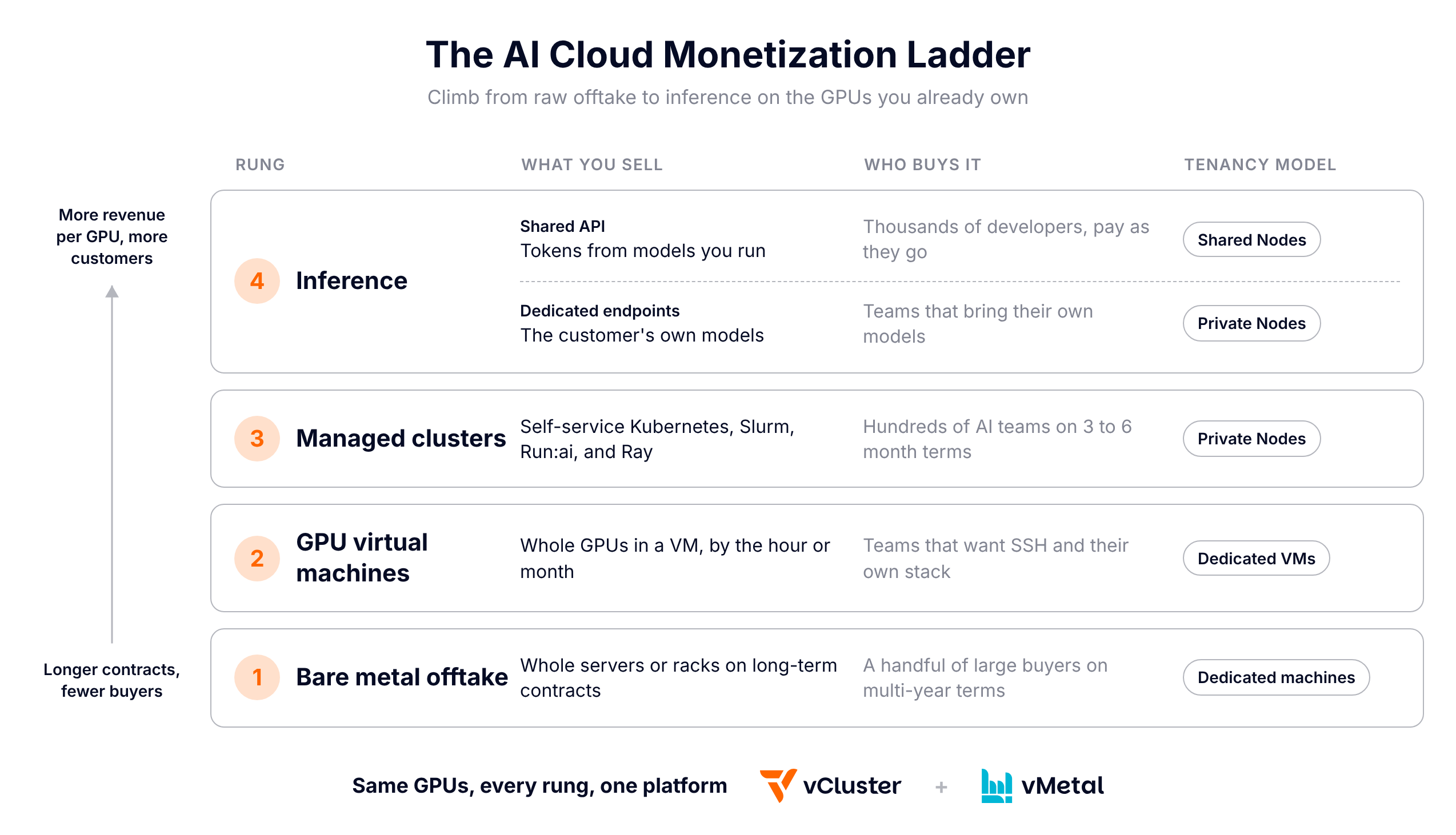
Bare metal is the foundation of every rung above it, so it has to be automated even when it is the only thing you sell. vMetal provisions and reprovisions the machines through one stable Machine API. Each tenant gets its own machines on its own isolated network, with network automation through Netris.
vMetal orchestrates the provisioning tools you already run, such as Metal3, KubeVirt, NVIDIA NICo, BCM, MAAS, OpenStack, or VMware. It does not replace them. New hardware that needs a different provisioning stack becomes a driver underneath, and the API above it stays the same.
That is what makes the first rung a launch point instead of a dead end. If a bare metal customer later wants a managed cluster, it runs on Private Nodes on the same machines, managed through the same API.
This is the first step from leasing hardware to selling a cloud product. Shorter terms and smaller buyers mean more customers per GPU, but only if a new VM is ready in minutes rather than after a ticket and a week of racking.
vMetal delivers this rung on the same machines as rung 1. It provisions virtual machines with whole GPUs passed through, so each tenant gets dedicated GPUs and its own operating system, through the same Machine API. When a VM customer leaves, the GPUs go back to the pool instead of sitting dark until the next long-term contract.
This is where the margin moves. Customers now expect the hyperscaler experience: a cluster on demand, managed upgrades, and no tickets. SemiAnalysis, an independent research firm, publishes ClusterMAX, a rating of AI Clouds that scores providers on criteria like security, reliability, and orchestration and ranks them in tiers from Platinum down. SemiAnalysis found that CoreWeave charges roughly 10 to 15% more per GPU-hour for managed Slurm or Kubernetes than its direct competitors. In ClusterMAX terms, the tier is a price, not just a badge.
Building that platform yourself is the hard part. McKinsey estimates 12+ months to build a managed-service platform, and the providers who did it, like CoreWeave and AWS, staffed it with 200+ engineers.
vCluster delivers this rung as tenant clusters on Private Nodes: one isolated cluster per customer, with its control plane up in minutes. Each tenant gets a virtualized control plane and dedicated nodes, with network, storage, and compute isolated per tenant. The customer sees its own nodes and workloads, and nothing else: no control plane components, no other tenant. That is the same experience EKS gives its users, and kubectl, Helm, Argo CD, and Crossplane work unmodified.
Kubernetes is only one cluster type here. The same tenant cluster model delivers Slurm for training teams, Run:ai for scheduling, and Ray for distributed workloads, on the same estate. AI Clouds running this rung today report concrete results:
The top rung sells outcomes instead of infrastructure, and it comes in two shapes.
A shared API reaches the widest market. You run the models, and customers only call the endpoint, so they never run code on your infrastructure. That is why Shared Nodes fit here.
Dedicated endpoints serve customers whose model is the product. They bring their own weights, adapters, or fine-tunes, which means they load code and data onto your GPUs. Each endpoint gets its own tenant cluster on Private Nodes, so one customer's model never shares a node with another's.
Both run on the same GPUs as the rungs below. Inference demand is spiky and grows fast, so the ability to shift capacity from managed clusters to inference, and back, matters as much as the inference stack itself.
Shared Nodes only where customers never run their own code. Anything they run or load gets Private Nodes.
That rule is what lets an AI Cloud sell to external customers with confidence at every rung. Shared Nodes give each tenant its own virtualized control plane, but tenants share the kernel and worker nodes. That suits trusted tenants: internal teams, dev, test, and CI/CD. It also suits a shared inference API, where customers only send requests. It never backs an offering where a customer gets cluster, scheduler, or workload access.
Private Nodes give each tenant dedicated nodes, with network, storage, and compute isolated per tenant and no cross-tenant visibility at the infrastructure level. That is the model for managed clusters, dedicated endpoints, regulated workloads, and sovereign deployments.
The ladder is not only about where a customer starts. It also changes what happens between contracts. Sell idle GPUs at whichever rung has demand right now: VMs this week, a managed Slurm cluster next month, inference capacity during a launch spike.
That only works if moving capacity between rungs is fast and automatic. vMetal and Auto Nodes hand capacity back to the pool when a tenant is done, and the next tenant is up in hours on the same hardware. A GPU that sat dark for weeks between leases now earns at the rung with the best price.
Most AI Clouds do not fail to climb because they lack demand. They stall because each rung was built on a different stack: a provisioning tool for bare metal, a separate VM platform, a homegrown Kubernetes service, and then a fourth system for inference. Every new rung becomes a re-platform.
We built vCluster and vMetal so the stack stays the same from the first rung to the last:
Adding a rung means adding a cluster type, not a platform. Adding a chip generation means adding a driver under vMetal, not re-architecting. You can start turnkey, with tenants self-serving through the vCluster UI and CLI, and later put your own branded portal in front of the same APIs. It is a two-way door.
The platform work also counts toward how buyers rate you. vCluster covers 87 of the 142 criteria in SemiAnalysis's ClusterMAX scorecard out of the box, strongest in lifecycle, orchestration, and reliability. Those are the criteria that separate the tiers, and the tiers set the price. Today vCluster runs across 100K+ GPUs at 50+ GPU clouds and Fortune 500 companies.
The margin in AI infrastructure lives in the services, not the servers. Raw offtake will always have a place, but an AI Cloud that only sells bare metal is betting its business on a few renewals.
The ladder offers a better bet: more revenue per GPU, more customers per rack, and idle capacity that earns at whichever rung has demand. The hardware you already own can support every rung. The question is whether your platform can.
If you are planning your next rung, talk to our team about launching managed clusters fast.
Kurt Madel is a Senior Solutions Architect at vCluster, the platform operators use to build and run their own AI cloud like a hyperscaler. vCluster turns raw GPUs into cluster products they can sell, from bare metal provisioning up through managed Kubernetes, Slurm, and inference clusters, with tenant isolation at the infrastructure layer. The result is more margin per GPU, less dependence on a few big customers, and new managed services live in days instead of months. Trusted by fast-growing AI cloud providers including Nebius, Groq, Firmus, and Corvex to run them across 100K+ GPUs.
Deploy your first tenant cluster today.
