GitOps + Kubernetes: Adopting GitOps in Enterprises

Apr 9, 2023
|
min Read

Enterprises dealing with cloud-native infrastructure and applications often quickly realize that managing large-scale environments can be a real challenge. Deployments in modern cloud-native environments using traditional DevOps practices can be tough and error-prone, leading to an increased risk of downtime, errors, and security vulnerabilities. This is where GitOps comes in.
GitOps is an operational model for managing infrastructure and application deployments using Git as the single source of truth. With GitOps, any changes to the infrastructure or application code are automatically tracked and versioned in Git, enabling greater visibility, control, and auditability. By treating everything as code, GitOps enables teams to manage their deployments in a more agile and efficient way, with greater reliability and security. This approach is particularly useful in managing the complexity of cloud-native environments, where microservices, containers, and Kubernetes clusters can be difficult to manage using traditional methods.
This article explores the benefits of GitOps for enterprises, the affinity between GitOps and Kubernetes, and the components involved in a GitOps and Kubernetes architecture. It will then provide an overview of the typical GitOps deployment workflow for Kubernetes as well as considerations for GitOps in an enterprise environment.
GitOps is becoming more popular in enterprise environments as a way to streamline infrastructure and application management. Many organizations are investing in the development of GitOps capabilities, including building internal GitOps teams, creating GitOps centers of excellence, and implementing GitOps best practices across their organizations. GitOps has also been found to improve collaboration between development and operations teams, increase the speed of deployments, and reduce the risk of errors and downtime. As a result, more and more large organizations are adopting GitOps as part of their greater digital transformation efforts.
There are still challenges to be addressed in the adoption of GitOps in the enterprise space. These challenges include resistance to change, the need for specialized skills and expertise, and the difficulty of integrating GitOps with existing processes and tools. Nevertheless, GitOps is expected to continue to grow in popularity in the enterprise space and is poised to become an increasingly important part of the enterprise DevOps landscape in the years to come.
Enterprises can benefit from GitOps in a variety of use cases, including:
GitOps and Kubernetes share a natural affinity due to their shared principles of declarative infrastructure and version control. Kubernetes manages containerized applications and their infrastructure through declarative YAML files, while GitOps applies the same declarative approach to managing infrastructure and application deployments. You can use GitOps to manage Kubernetes environments by keeping the desired state of the deployments in a Git repository, making it the single source of truth for the entire infrastructure, including application code, configuration files, and deployment manifests. When you make changes to the infrastructure or application through GitOps, they are automatically tracked and versioned in Git. This provides a complete audit trail of all changes, making it easy for you to track and revert to previous versions if necessary.
Using GitOps to manage Kubernetes environments has several advantages, including declarative configuration management, automated deployments and rollbacks, version control and audit trails, consistency and reproducibility, and an additional layer of security by enforcing a separation of duties between developers and approvers/operators.
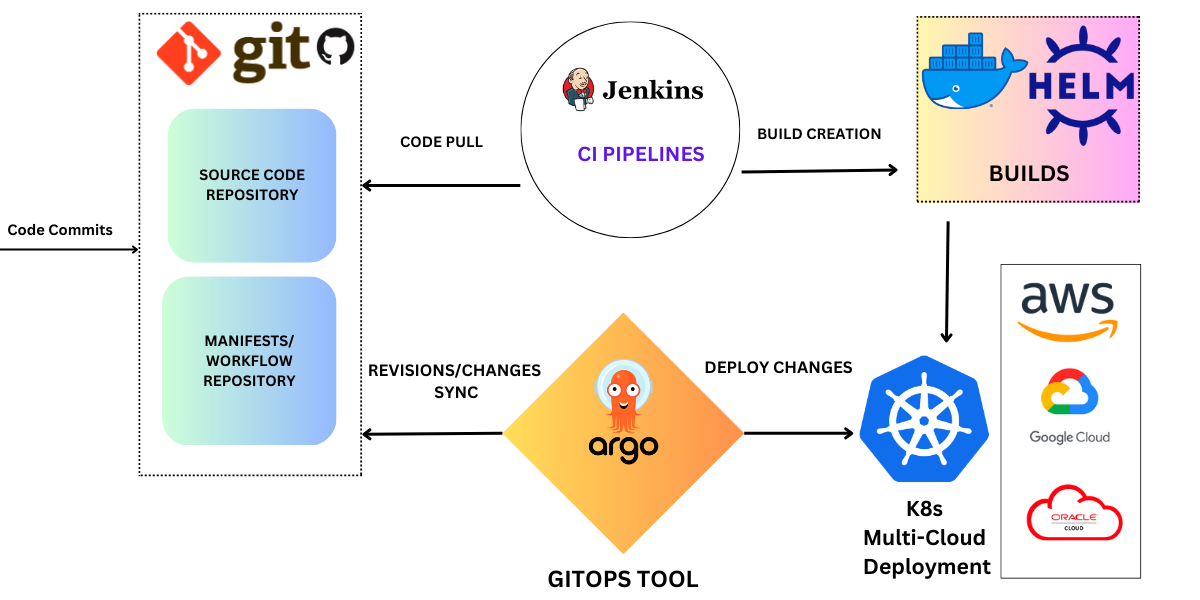
The typical GitOps Kubernetes architecture includes four key components:
Adopting GitOps to manage infrastructure and applications on Kubernetes lets you benefit from a declarative approach where the desired state of the system is defined in code and stored in a Git repository. This allows you to make changes to code or configuration files, such as Kubernetes YAML files, Helm charts, or Terraform files, and commit them to the Git repository. GitOps tools, such as Flux or Argo CD, continuously monitor the Git repository for changes and automatically synchronize the desired state of the infrastructure with the actual state without requiring any manual intervention. The GitOps deployment workflow supports different deployment strategies, such as rolling update, blue-green, and canary, to ensure zero-downtime deployments.
By following the GitOps deployment workflow, you can simplify the management of large-scale Kubernetes environments, ensuring that the infrastructure is always in the desired state and any drift is automatically corrected.
The GitOps workflow consists of several stages that ensure the desired state of the infrastructure and applications is automatically deployed in a consistent manner across environments:
The synchronization process involves updating the Kubernetes manifests, Helm charts, or other infrastructure configuration files with the changes defined in the Git repository. Once the configuration files have been updated, the GitOps tool deploys the changes to the target environment using the Kubernetes API or other infrastructure management tools. The GitOps tool ensures that the deployment is consistent and reliable, using strategies like rolling updates or blue-green deployments to minimize downtime and ensure that the changes are applied in a controlled manner.
Before adopting GitOps for managing your infrastructure and applications, there are several factors you should consider.
Large enterprises often have a large number of deployments that are complex and interdependent, which can add to the standard cost of migration to GitOps. You should evaluate the costs associated with implementing and managing the necessary infrastructure and tooling for GitOps, including the cost of personnel training, as well as any ongoing costs associated with maintaining and updating the GitOps implementation.
Depending on the complexity of the infrastructure and applications being managed, you may need to adopt additional tools for testing, monitoring, and managing secrets and configurations. For example, you may need tools such as Prometheus or Grafana for monitoring, HashiCorp Vault for managing secrets, and Ansible or Puppet for configuration management.
Keep in mind that larger enterprises have a complex process for the onboarding, auditing, and adoption of new tools, which may require the approval of finance, compliance, management, and legal teams. This can significantly slow down the implementation and adoption of new tools.
Establishing clear policies and procedures for managing access to the Git repository and deploying changes to the infrastructure and applications is crucial for ensuring compliance with relevant regulatory requirements and security standards. Failing to take the right steps to ensure compliance could lead to severe legal and financial penalties, as well as harm the organization's reputation.
Implementing GitOps in a large enterprise with diverse teams can also present governance challenges. Effective strategies need to be set up to ensure that teams follow established policies and procedures, including establishing clear lines of communication, training employees on the GitOps process, and regularly auditing and updating the GitOps implementation.
Adopting GitOps can introduce new security risks, such as potential vulnerabilities in the Git repository or the use of secrets in GitOps pipelines. To mitigate these risks, it's important to ensure that appropriate security measures are in place. Some key points to consider include:
GitOps offers significant benefits for enterprises looking to improve their infrastructure and application management. By leveraging GitOps and Kubernetes together, organizations can achieve greater automation, reliability, and scalability, which is especially important for large enterprises with complex and interdependent deployments. The increased visibility and control provided by GitOps can help enterprises meet governance and compliance requirements while reducing the risk of errors and downtime. Overall, GitOps can help you streamline operations, improve your security posture, and stay competitive in a rapidly evolving market.
If you're considering adopting GitOps to manage your Kubernetes environment, it's worth exploring how a tool like Loft can help with the process. Loft is a platform that provides a powerful combination of GitOps and Kubernetes management capabilities. Its features include multi-tenancy, resource sharing, and self-service namespaces. With Loft, organizations can streamline their Kubernetes workflows and simplify the adoption of GitOps best practices.
Deploy your first virtual cluster today.
