Introducing Private Customer Clouds: A Cloud for Every Customer, on the Metal You Already Sell

Nov 19, 2026
|
6
min Read

Most AI Clouds already run a real business on bare metal. A customer signs a contract for a block of GPUs, the provider racks and provisions the machines, and the customer takes it from there. It works, and it pays.
What it doesn't do is scale gracefully. Behind most offtake deals sits a pile of scripts, SSH keys, switch tickets and spreadsheets. Onboarding a new customer is a project. Moving machines between customers when a contract ends is a teardown and rebuild. Every new site or GPU generation means more people doing the same work by hand. And customers who signed for bare metal increasingly expect it to behave like a cloud: self-service, their own images, their own clusters, no ticket queue.
Today we're introducing private customer clouds in vCluster Platform, now in limited availability. It's a new abstraction that lets a provider carve out a private cloud for each of its customers, on the hardware it already owns and already sells. Same metal, same control plane, one step up. Read the full announcement.
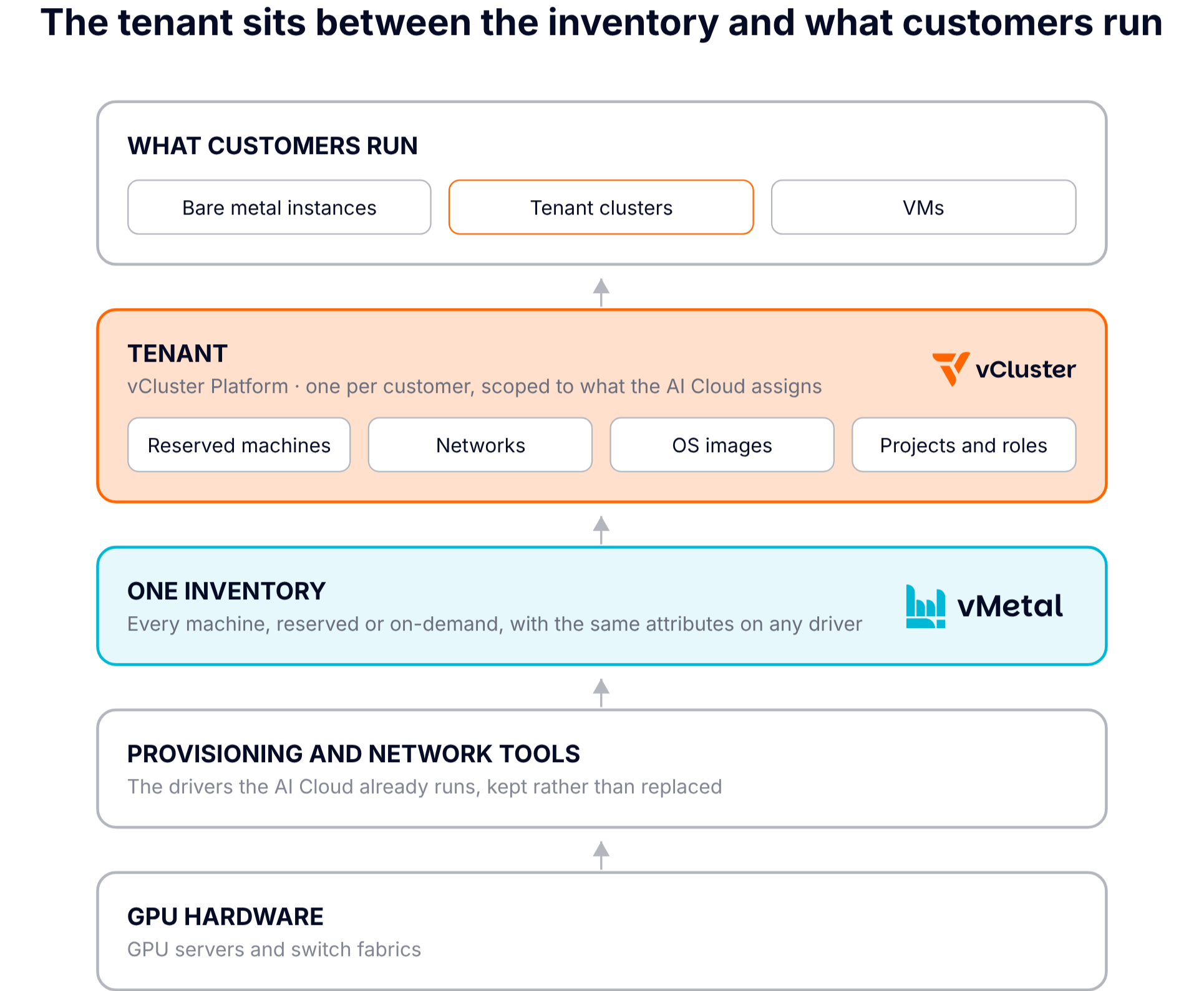
The release introduces the tenant as a first-class object in vCluster Platform. A tenant is one of the provider's customers, and it owns the resources the provider assigns to it: machines, network environments and OS images.
That one change reshapes how the platform works for both sides:
The provider defines the managed services each customer can use, and the customer chooses which of its own machines power them. Everything beneath a tenant inherits its boundary: every machine, network, image and cluster the customer uses stays inside it.
Offtake is how most of this market buys, so private customer clouds start there.
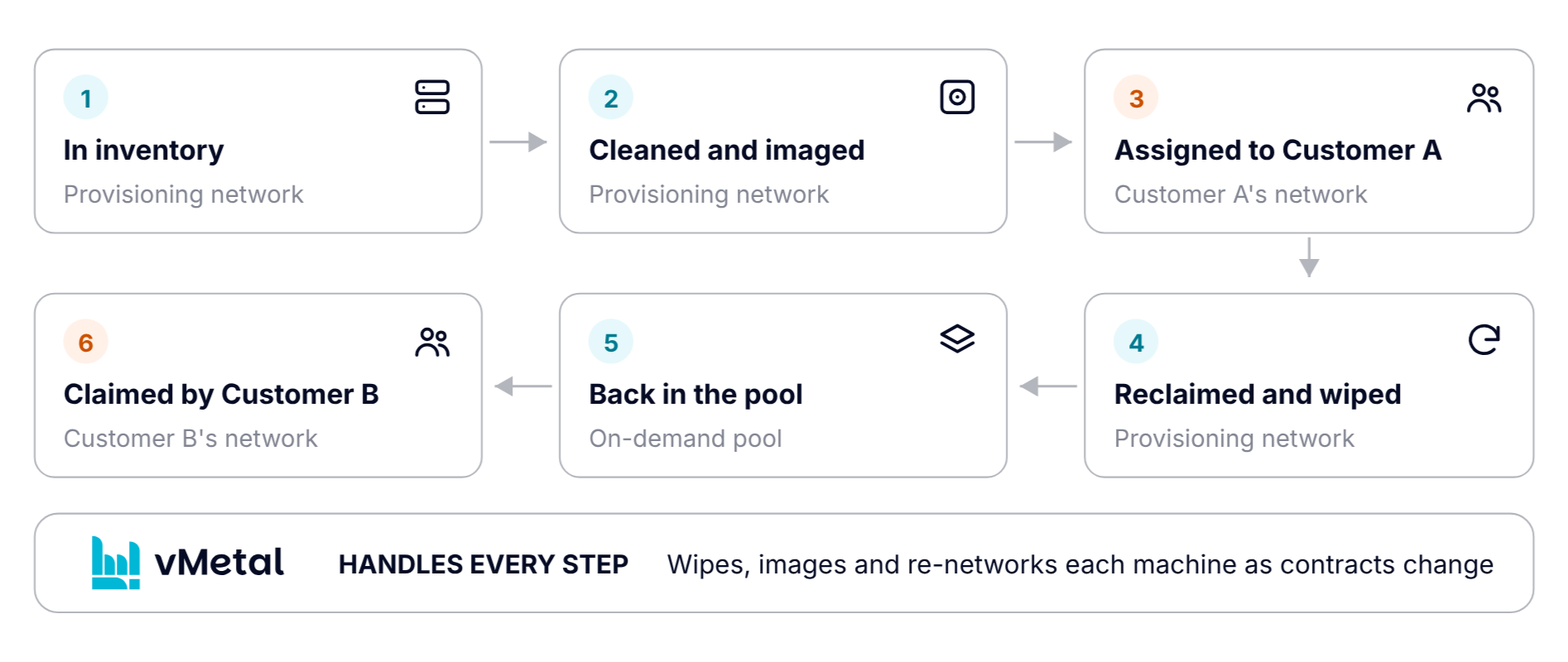
Every machine in the inventory is either reserved to one customer for the length of its contract or left on-demand for customers to claim from a shared pool. Reserved capacity lets a provider sell the long-term contract on day one. On-demand capacity puts machines to work between contracts instead of sitting idle.
When a contract starts or ends, moving a machine to another customer is a reassignment, not a teardown and rebuild. The machine is cleaned, moved onto the right network and handed over in hours rather than days or weeks. That changes the math on shorter terms and smaller customers, which are now more economical to serve.
The same reserved and on-demand model applies to VMs, so a provider can offer them on shared capacity or on a customer's own reserved machines, from the same inventory.
Inside its tenant, a customer runs its own cloud, behind its own branding and UI settings, without a separate install. It can:
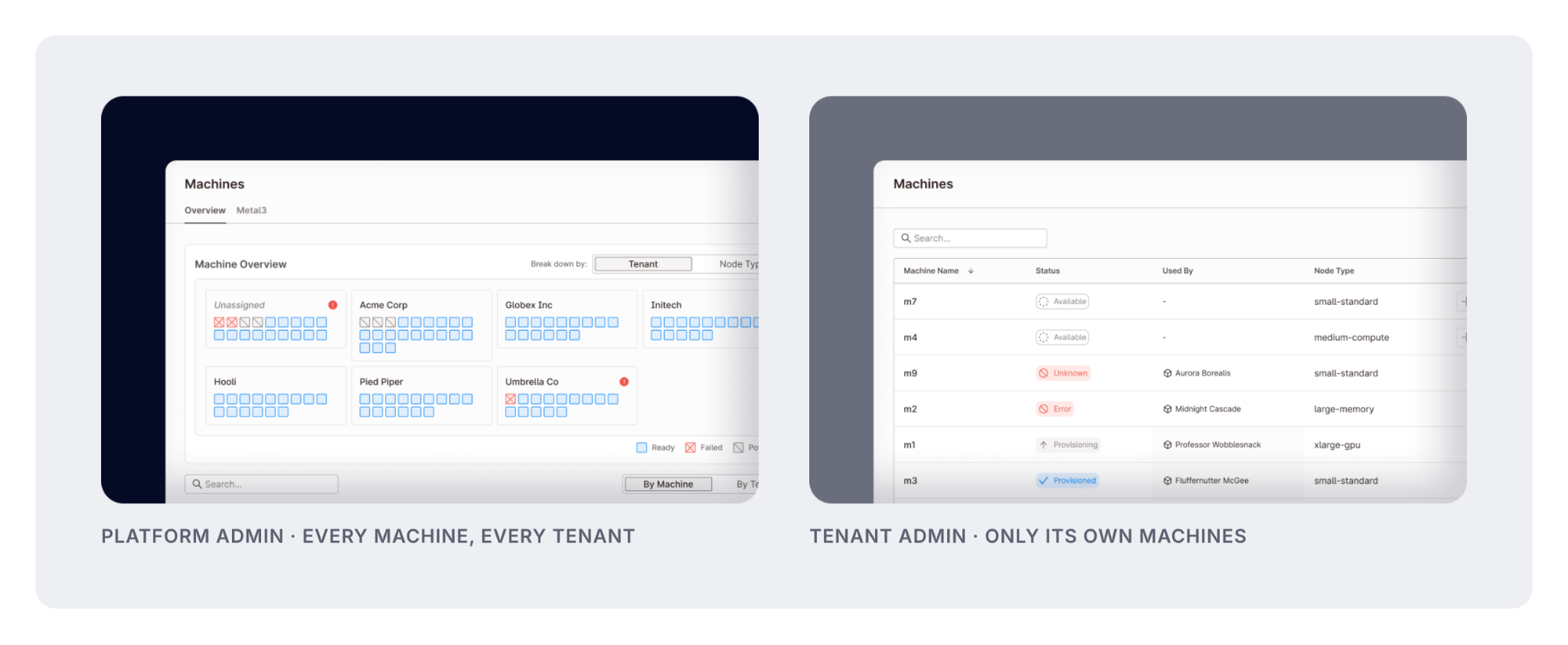
The provider stays in control of what each customer is entitled to, and the customer gets the speed of doing everything else itself. That’s the demand AI Clouds like Corvex are seeing. “Customers who commit to dedicated capacity want to run it themselves. Their platform teams want to divide capacity among internal groups and give developers a fast path to compute. vCluster Platform v5.0 gives our customers a self-service environment of their own on dedicated hardware,” said Seth Demsey, CEO of Corvex.
Giving customers self-service only works if the boundaries between them hold. Private customer clouds draw those boundaries at the infrastructure layer:
A customer provisioning its own machines can only reach what it was assigned.
No provider runs a single, uniform fleet for long. New GPU generations arrive with new provisioning tools, new sites come online, and what's already delivered keeps running. Every new GPU order is a chance to standardize what comes next, without ripping out what's in place.
vMetal, the infrastructure orchestrator beneath vCluster Platform, presents every machine in one inventory, whichever driver provisions it. Providers keep the provisioning tools they already run, whether Metal3 or NVIDIA Infra Controller (NICo), and each machine carries the same set of attributes to the provider and to its customers either way.
On top of that inventory, providers choose how their customers experience it:
vCluster started by giving every tenant its own control plane, so teams could share infrastructure without sharing a cluster. Private customer clouds take that same tenant boundary down the stack, from the control plane to the machine, the network and the image.
That makes Kubernetes one of the things a provider can sell on the platform, not the only one. A customer can rent bare metal and never ask for a cluster. Another can start with machines and add clusters when it needs them. Both sit on the same platform, inside the same tenant, so moving up from raw capacity to managed services is a configuration change, not a re-platforming project. Services like NVIDIA Run:ai, Dynamo and Saturn Cloud deploy into a customer's tenant clusters as Stacks, so a provider can offer more than raw capacity without building each service by hand, including custom inference solutions.
For existing vCluster users, tenant mode can stay off until you're ready.
This release puts the core objects in place: tenants, machines, network environments and images, under one inventory and one API.
As private customer clouds move toward general availability, every machine will be validated before it reaches a customer, through burn-in testing and hardware profiling that checks its BIOS settings against a golden template. Providers will be able to give each customer its own storage, choosing a tier and size. Early versions are already in testing with customers.
From there, the platform can start fixing problems itself, like swapping a failed machine out of a customer’s pool. The longer arc is a platform that sees compute, network and storage together, so an AI Cloud can manage its whole fleet the way a hyperscaler does. Private customer clouds are the first step.
Deploy your first tenant cluster today.
