NIS2 Compliance for Sovereign AI Clouds: How vCluster Accelerates Readiness

May 21, 2026
|
8
min Read
You are building an AI Cloud, and your customers include essential and important entities in energy, healthcare, transport, finance, and public administration. The moment that happens, the NIS2 Directive becomes part of your world. Under Implementing Regulation (EU) 2024/2690, AI Clouds are themselves directly in scope as cloud computing and data centre service providers, not just suppliers to regulated customers.
NIS2 is less about qualifying a static architecture and more about proving ongoing cyber resilience. The question is not only whether workloads are isolated. It is whether risk-management measures can be evidenced, incidents reported inside a 24-hour and 72-hour window, recovery exercised credibly, and supply chain boundaries defended under audit. vCluster helps with the technical patterns underneath that, especially Tenant Isolation, scoped incident evidence, backup and recovery, and access control. Broader NIS2 obligations still sit with the entity and its governance, legal, and reporting processes.
Shared AI infrastructure is designed for density, speed, and GPU utilization. NIS2 pushes those same platforms to layer strong governance, tight incident reporting timelines, repeatable recovery, and disciplined supply chain controls on top.
In practice, teams struggle with:
Traditional approaches force a painful tradeoff: spin up a separate physical cluster for every regulated tenant, environment, or workload class (expensive, slow to provision, operationally heavy), or rely on namespace separation (insufficient for the Tenant Isolation, audit, and recovery boundaries NIS2 implies). vCluster helps operators avoid that tradeoff by providing scoped, recoverable, auditable Tenant Clusters on shared infrastructure.
Instead of treating NIS2 as a long list of controls, it is more useful to map it to platform-level challenges for AI Clouds. Several of those challenges align with capabilities vCluster helps operators implement.
Article 21(2)(a), (e), (g), and (h) cover risk analysis, security in the acquisition and operation of network and information systems, basic cyber hygiene, and cryptography. Implementing Regulation (EU) 2024/2690 makes these expectations more concrete for cloud and data centre providers: hardened baselines, network segmentation, secure configuration management, and documented cryptographic controls. For an AI Cloud, this is the layer where supervisors and customers expect to see real engineering practice, not just policy.
vCluster supports this layer with:
The security policy framework itself, the risk assessment process, and the evidence that controls are reviewed for effectiveness under Article 21(2)(f) remain the entity's responsibility.
Article 21(2)(b) requires incident handling capabilities. Article 23 then turns that into a hard cadence: an early warning within 24 hours of becoming aware of a significant incident, a more detailed notification within 72 hours, and a final report within one month. The clock starts at awareness, not at investigation completion. The operational difficulty is rarely the existence of a process on paper. It is producing clean evidence fast enough to support classification, escalation, and reporting inside those windows.
vCluster does not classify or report incidents, but it can make the underlying evidence easier to produce by localizing it:
When each tenant or regulated workload has its own Virtual Control Plane boundary, incident analysis stops looking like forensics inside one giant shared cluster and starts looking like working inside a scoped system with clearer ownership. That clarity matters when an early warning is due in 24 hours.
Article 21(2)(c) makes business continuity, backup management, disaster recovery, and crisis management a first-class part of the risk-management framework. Implementing Regulation (EU) 2024/2690 expects backup policies, restoration procedures, and tested recovery for cloud and data centre service providers. Saying backups exist is not enough. Recovery has to be designed, exercised, and credible.
vCluster supports this pattern at the Tenant Cluster boundary:
Instead of treating backup and restore as a whole-cluster exercise, teams rehearse recovery at the Tenant Cluster boundary. Designing, testing, and evidencing recovery against NIS2 expectations remains the entity's responsibility.
Article 21(2)(d) is where AI Cloud operators feel NIS2 most acutely. Entities must manage supply chain security, take into account the vulnerabilities specific to each direct supplier, and weigh the overall quality of products and cybersecurity practices of those suppliers. Article 22 adds coordinated security risk assessments of critical supply chains on top. In practice, every NIS2-regulated customer running on your platform will treat your platform as a supply chain risk to be assessed, contracted, and audited.
vCluster does not remove those questions, but it gives operators multiple isolation models so technical answers can match workload sensitivity:
Supplier risk assessments, contractual provisions covering security obligations, exit plans, and concentration risk at the entity level still sit outside the architecture layer.
Article 21(2)(i) and (j) cover human resources security, access control policies, asset management, multi-factor authentication, and secure communication. Implementing Regulation (EU) 2024/2690 reinforces this for cloud and data centre providers with explicit expectations on identity lifecycle management, privileged access, and authentication strength. In an AI Cloud, this is also where platform-versus-tenant separation of duties shows up technically.
vCluster supports the technical side of this with:
Identity governance, privileged access reviews, joiner-mover-leaver processes, and personnel security at the entity level remain the customer's and operator's organizational responsibility.
Article 21(2)(h) and (j) call out cryptography and secure communication explicitly. For an AI Cloud, that translates into how secrets are stored, how TLS is managed inside tenant workloads, and how the control plane communicates with nodes and the Platform. These are exactly the touchpoints customers will examine during supplier security reviews.
vCluster supports this with:
Cryptographic key management policy, key rotation cadence, and assurance levels for cryptographic modules still need to be defined by the entity, with FIPS-validated images available where required.
Article 21(2)(f) requires policies and procedures to assess the effectiveness of cybersecurity risk-management measures. NIS2 also expects systematic documentation and the ability to produce consistent evidence during supervisory reviews. When environments drift, evidence quality drifts with them, and resilience tests stop predicting how production will behave under stress.
vCluster helps operators keep environments repeatable and evidence consistent:
Fast, isolated Tenant Clusters also make resilience tests and recovery drills less disruptive to the rest of the platform. Designing the testing program, scoping it to systems supporting essential or important services, and reviewing results against NIS2 obligations sit with the entity.
vCluster, or any other infrastructure solution, is not a NIS2 compliance product and does not by itself satisfy NIS2 obligations. Those obligations apply to essential and important entities and, where designated under Implementing Regulation (EU) 2024/2690, to cloud computing and data centre service providers.
vCluster operates at the technical architecture layer. The following items sit outside that scope and must be addressed through other means:
Where this article refers to NIS2 provisions, the intent is to describe technical patterns that support readiness, not to claim that any product, including vCluster, satisfies those provisions on its own. With that boundary established, the rest of the article looks at where the technical architecture layer can meaningfully accelerate the work.
vCluster does not replace NIS2 compliance processes. It helps accelerate how quickly teams can implement the technical architecture those processes depend on, which is often the biggest bottleneck on the path to readiness.
Key acceleration points:
The result is a faster, more predictable path to NIS2 readiness at the technical architecture layer.
A typical architecture that supports this alignment includes:
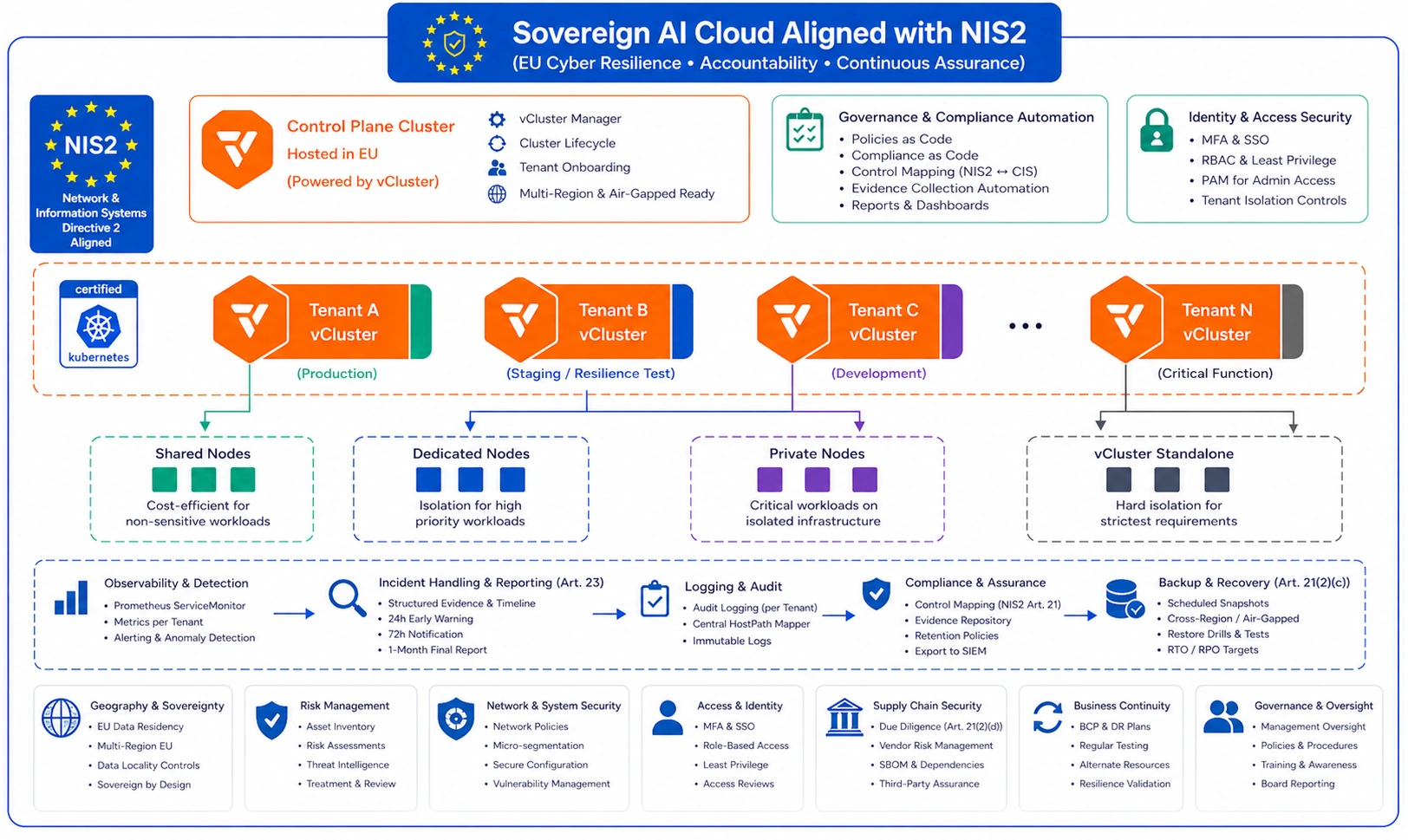
This approach balances cybersecurity, Tenant Isolation, scalability, and operational efficiency. vCluster provides the isolation, recovery, and environment management layer. The surrounding infrastructure, identity, monitoring, and organizational controls address governance, supply chain, reporting, and entity-level NIS2 obligations.
For sovereign AI Clouds working toward NIS2, the main bottleneck is rarely understanding the directive. It is operationalizing cybersecurity and resilience without freezing platform delivery. Incident evidence has to be scoped and accessible inside 24 hours. Backups have to be real and restorable. Test environments have to match production closely enough to matter. Supply chain boundaries have to be clear enough to survive customer due diligence and supervisory review.
vCluster helps by:
With the technical architecture handled, NIS2 readiness becomes less of a paperwork exercise and more of an ongoing operational discipline, shaped by governance, legal, and reporting processes that continue to sit with the entity.
Want to see how this fits your AI Cloud architecture? Speak with the vCluster team to accelerate your NIS2 readiness timeline.
NIS2 is only one part of the compliance picture for sovereign AI Clouds. If your platform also needs to support public-sector, financial-services, or regulated EU workloads, these related guides may help:
Deploy your first virtual cluster today.
